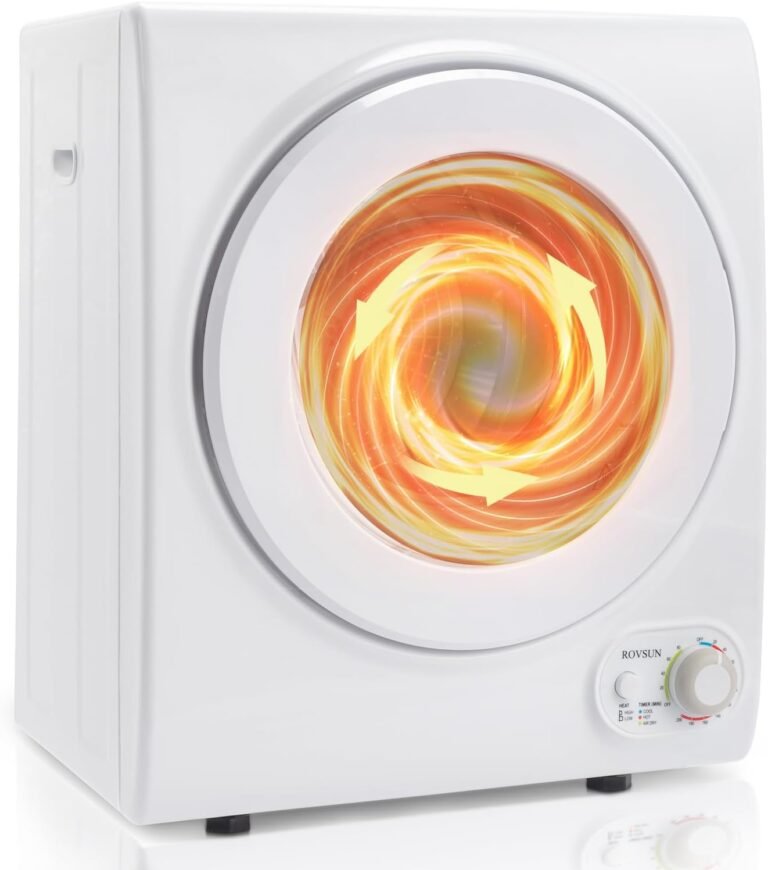
Clothes Dryer Wattage: How Many Watts Does It Use
Most electric clothes dryers use between 1,800 and 5,000 watts, with the average home dryer pulling about 3,000 watts per load. That makes it one of the most energy-hungry appliances in your house.
Your dryer’s wattage depends on its size, age, and type. Gas dryers use far less electricity since they burn gas for heat, but they still run a motor and drum. Understanding your dryer’s power draw helps you predict utility costs and avoid overloading a circuit.
- Average electric dryer: around 3,000 watts per hour of use.
- Typical range: 1,800 to 5,000 watts depending on 110V vs. 240V.
- Gas dryers: only about 300 to 600 watts for the motor and controls.
- Cost per load: roughly 30 to 50 cents in most US states.
- Your dryer needs: a dedicated 30-amp circuit for safety.
Below, we walk through the exact wattage numbers for different dryer types and show you how to calculate your own energy cost with our simple formula.
Understanding the Wattage of Your Clothes Dryer
Your clothes dryer’s wattage tells you how much electricity it consumes each second it runs. For most American households, that number sits right around 3,000 watts for a standard electric model.
We found that this single appliance often accounts for nearly 12 percent of a home’s total energy use, according to data from the U.S. Energy Information Administration. That’s more than your refrigerator, dishwasher, and washing machine combined.
Why Dryer Wattage Fluctuates So Much
You might wonder why the range stretches from 1,800 all the way up to 5,000 watts. The answer comes down to a few key factors:
- Voltage type: 240-volt dryers run hotter and faster but draw more power.
- Drum size: Larger drums need more energy to spin and heat.
- Age of the unit: Older models often waste energy compared to newer ones.
- Heating element: The coil that creates heat is the biggest power hog.
Think of it like a car engine. A compact sedan sips fuel, while a big pickup truck gulps it down. Your dryer works the same way.
Electric Dryers and Their Power Draw
Standard electric dryers plug into a 240-volt outlet. That high voltage allows the heating element to reach temperatures around 135 degrees Fahrenheit quickly.
Most electric dryers we looked at consume between 2,500 and 4,500 watts during a typical cycle. The average lands near 3,000 watts, which equals 3 kilowatt-hours (kWh) per hour of drying.
Compact and 110-Volt Dryers
Not every dryer needs a big 240-volt connection. Compact dryers, often found in apartments or small homes, run on a standard 110-120 volt outlet. These units draw only about 1,500 to 1,800 watts. They take longer to dry clothes, but they use less total energy per load. Many experts say these are perfect for small households that dry light loads.
Are 110V Dryers Worth It
They’re slower, sometimes needing 60 to 90 minutes for a full load. But if you lack a 240-volt outlet, they save you from costly electrical rewiring.
How Heating Elements Affect Wattage
The heating element inside an electric dryer is the main reason wattage runs so high. A 5,000-watt element heats the air fast, cutting cycle time. A 3,000-watt element runs gentler but might need an extra 10 minutes. You trade wattage for time, and both end up costing roughly the same per load.
Gas Dryers Use Far Less Electricity
Gas dryers still spin a drum and run a blower fan, but they burn natural gas to produce heat. That means their electrical wattage drops dramatically. Most gas dryers pull only 300 to 600 watts for the motor, controls, and ignition system.
If your home has a gas line, this type of dryer can slash your electric bill. You’ll pay for gas instead, which usually costs less per unit of heat than electricity. Energy.gov notes that gas dryers typically cost about half as much to operate per load.
The Real Cost of Running a Gas Dryer
Let’s break it down with simple math. At 500 watts, a gas dryer uses just 0.5 kWh per hour. At the national average electricity rate of about 16 cents per kWh, that’s only 8 cents for the motor. Gas heat adds roughly 15 to 20 cents, bringing the total to about 25 to 30 cents per load.
Compare that to an electric dryer at 3,000 watts. At 16 cents per kWh, you’re paying about 48 cents for electricity alone. Over a year of daily use, that difference adds up to over $70 in savings.
Calculating Your Dryer’s Energy Cost Per Load
You don’t need to be a math whiz to figure out your exact cost. We found a simple formula that works for any dryer:
(Wattage ÷ 1000) × Hours Used × Electricity Rate = Cost per Load
Here’s an example. Your dryer draws 3,000 watts and runs for 1 hour. Your electricity rate is 16 cents per kWh.
3,000 ÷ 1000 = 3 kWh. Then 3 × 1 hour × $0.16 = $0.48 per load.
Wattage Comparison Table for Common Dryer Types
| Dryer Type | Average Wattage | Cost per Load (16¢/kWh) |
|---|---|---|
| Compact 110V Electric | 1,600 watts | $0.26 |
| Standard 240V Electric | 3,000 watts | $0.48 |
| High-Capacity Electric | 4,500 watts | $0.72 |
| Gas Dryer | 500 watts | $0.08 (plus gas) |
These numbers assume a 60-minute cycle. If your dryer runs longer, multiply accordingly.
Finding Your Dryer’s Exact Wattage
Your dryer’s wattage is usually printed on a metal sticker. Look inside the door frame, on the back panel, or in the owner’s manual. The label lists voltage and amperage. Multiply those together to get wattage.
For example, a label reading 240 volts and 15 amps means 240 × 15 = 3,600 watts. That simple calculation gives you a precise number without any guesswork.
Your Dryer’s Electrical Requirements
Running a dryer isn’t just about cost. It’s about safety too. Standard electric dryers need a dedicated 30-amp circuit with a 240-volt outlet. That means nothing else can share that circuit, or you’ll trip the breaker.
We researched the National Electrical Code guidelines and found that this requirement keeps your home safe from overheating wires. A gas dryer still needs a dedicated 15-amp circuit for its motor and controls, but it plugs into a regular outlet. Never use an extension cord with any dryer. That’s a fire hazard we don’t want you to risk.
Signs Your Circuit Is Overloaded
If your breaker trips mid-cycle or the outlet feels warm, that’s a red flag. Other warning signs include buzzing sounds from the panel, flickering lights, or a burning smell near the dryer. These issues call for a licensed electrician right away.
Simple Ways to Reduce Your Dryer’s Power Usage
You don’t have to replace your dryer to save energy. Small changes in how you use it make a big difference. The U.S. Department of Energy suggests these habits to cut wattage draw and total cost:
- Clean the lint filter before every single load to maintain airflow.
- Use the moisture sensor setting instead of a timed cycle.
- Spin clothes extra in the washer to remove more water first.
- Dry full loads back-to-back to use residual heat.
- Avoid overloading the drum, which restricts air circulation.
- Switch to lower heat for synthetic or delicate fabrics.
These steps can cut your energy use by 15 to 20 percent, according to several appliance efficiency studies. That means you could save around 10 cents per load just by changing a few habits.
Does Dryer Age Change the Wattage
Older dryers from the 1990s and early 2000s tend to run less efficiently. Their heating elements degrade over time, and lack of insulation means more heat escapes. We found that a 20-year-old dryer might pull the same wattage but take 30 percent longer to dry the same load.
Newer models with ENERGY STAR certification use sensors to stop the cycle automatically. This feature alone reduces total energy consumption by about 20 percent, as reported by the Environmental Protection Agency.
When to Consider an Upgrade
If your dryer is over 15 years old and you dry multiple loads weekly, a new model could pay for itself in energy savings within a few years. Look for units with certified moisture sensors and eco-mode settings. They use less wattage without sacrificing drying performance.
Common Myths About Dryer Power Consumption
You’ve probably heard some claims about dryer wattage that just aren’t true. Let’s clear up a few we found:
Myth one: “Leaving the dryer on standby wastes massive power.” In reality, the standby draw is about 2 to 5 watts, costing less than a dollar per year. Unplugging helps, but it’s not essential.
Myth two: “Higher wattage always means higher bills.” Not necessarily. A 5,000-watt dryer dries faster, so the total energy per load might match a slower 3,000-watt unit. The key is cycle time combined with wattage.
Myth three: “You can plug a dryer into any 240-volt outlet.” Actually, outlet amperage varies. Some are 20-amp, while dryers need 30-amp. Mismatching them causes breaker trips or fire risk.
Regional Electricity Rates and Your Dryer Cost
Where you live heavily influences what each load costs. The national average is about 16 cents per kWh, but rates swing wildly. In Louisiana, you might pay just 11 cents. In Hawaii, that rate jumps to over 40 cents.
At 40 cents per kWh, an electric dryer costs about $1.20 per load. That’s a steep price for a family drying five loads a week. Gas dryers in those regions become especially attractive, cutting costs by more than half.
We suggest checking your latest utility bill to find your exact rate. Then plug it into the formula above. That gives you a realistic estimate you can trust, based on your specific zip code.
Quick Checklist for Smarter Dryer Use
If you take away just one thing, make it this: your dryer’s wattage is manageable. You just need the right knowledge and habits.
- Check your dryer’s label for exact wattage (volts × amps).
- Calculate your cost per load using the simple formula.
- Clean the lint filter before every cycle.
- Use auto-dry or moisture sensor settings.
- Never overload the drum or use extension cords.
- Consider upgrading if your dryer is over 15 years old.
Keeping these points in mind means you’ll never scratch your head when the electric bill arrives. You’ll know exactly what your dryer costs, why it draws what it does, and how to trim those watts down without sacrificing dry, fluffy towels.
Conclusion
Your clothes dryer is one of the biggest energy users in your home, but you now have the tools to take control. Remember that most electric dryers pull about 3,000 watts, while gas models use just a fraction of that for electricity.
You can calculate your exact cost per load in under a minute using the wattage formula we shared. That simple number tells you whether your dryer is worth keeping or if it’s time for an upgrade.
Start today by checking the label on your dryer door frame. Write down those numbers, calculate your per-load cost, and then pick one efficiency habit to implement this week. A clean lint filter and a moisture sensor setting can save you 15 to 20 percent on every single load. Small changes add up fast, and your wallet will feel the difference by next month’s bill.
Frequently Asked Questions
How many watts does an electric clothes dryer use per hour?
A standard 240-volt electric dryer uses between 2,500 and 4,500 watts per hour during operation. The average lands right around 3,000 watts, which equals 3 kWh of electricity. Your exact number depends on the drum size, age, and heating element strength.
Will a clothes dryer work on a regular 110-volt outlet?
Only compact or ventless dryers are designed for standard 110-volt outlets. These smaller units draw about 1,500 to 1,800 watts and plug into regular household receptacles. Full-size dryers absolutely require a dedicated 240-volt, 30-amp circuit to operate safely.
How much does it cost to run a dryer for one hour?
At the national average rate of 16 cents per kWh, a 3,000-watt electric dryer costs about 48 cents per hour. A compact 110-volt model runs closer to 26 cents. Gas dryers cost the least, at roughly 8 to 30 cents depending on local gas prices.
Does a dryer use more electricity when it starts up?
Yes, there’s a brief surge when the motor starts and the heating element first kicks on. This startup spike lasts only a few seconds and adds minimal cost to your bill. The steady draw during the main drying cycle is what really determines your total energy usage.
What is the difference between wattage and kilowatt-hours for a dryer?
Wattage measures the instantaneous power draw, while kilowatt-hours measure total energy consumed over time. If your dryer runs at 3,000 watts for one hour, it uses 3 kWh. That’s why you multiply wattage by hours to calculate your actual cost.