How to Carry a Mattress Without Handles: A Complete Guide to Moving Your Mattress Safely
Moving a mattress can feel like wrestling with a giant marshmallow that refuses to cooperate. If you’ve ever tried to transport a mattress without built-in handles, you know exactly what I mean. Your mattress is bulky, awkward, and seemingly determined to slip from your grasp at the worst possible moment. But here’s the good news: carrying a mattress without handles is absolutely doable once you know the right techniques and tricks.
Whether you’re relocating to a new home, rearranging your bedroom, or helping a friend move, this comprehensive guide will walk you through everything you need to know about transporting a handleless mattress safely and efficiently. Let’s dive in and make this process far less stressful than you might be imagining.
Understanding the Challenge: Why Mattresses Are So Difficult to Move
Before we jump into solutions, let’s acknowledge why mattresses without handles present such a unique challenge. A typical mattress weighs between 50 and 100 pounds, depending on whether it’s a twin, queen, king, or California king. That weight is distributed across a large, floppy surface that doesn’t give you obvious places to grip.
The foam or spring interior shifts slightly as you move, which can throw off your balance. The fabric covering is smooth and slippery, making it hard to maintain a secure hold. When you combine these factors, you’re essentially trying to carry something that’s heavy, awkward, and actively working against you. Understanding this challenge is the first step toward mastering it.
Essential Preparation Before You Start Moving
Assess Your Space and Plan Your Route
Before you even touch your mattress, take a moment to plan your journey. Walk the route you’ll be taking from your bedroom to the moving truck or new location. Look for potential obstacles like tight corners, narrow hallways, low doorways, and stairs. Measure doorways and stairwells if you’re concerned about clearance. A mattress that fits through one doorway might need to be angled differently to fit through another.
This planning phase might seem tedious, but it’s incredibly valuable. There’s nothing worse than getting halfway through your move and realizing your queen mattress won’t fit around that corner in the stairwell. Give yourself the advantage of knowing exactly what you’re dealing with before you lift a single ounce.
Gather Your Materials and Tools
You don’t need fancy equipment to move a mattress without handles, but having the right materials makes a tremendous difference. Here’s what I recommend gathering:
- A mattress bag or plastic sheeting to protect the mattress from dirt and damage
- Moving straps or furniture sliders
- Grip-enhancing gloves with rubber soles
- A dolly or hand truck if available
- Helper friends or family members
- Clear tape for securing your protective covering
Having these items ready means you won’t waste energy searching for supplies midway through your move. Organization is your secret weapon here.
Prepare Your Mattress
Start by making sure your mattress is clean and dry. Strip off all bedding and pillows. If your mattress has been in storage or hasn’t been used recently, give it a quick vacuum to remove dust and debris. This might seem like an extra step, but it helps protect your belongings and your health during the move.
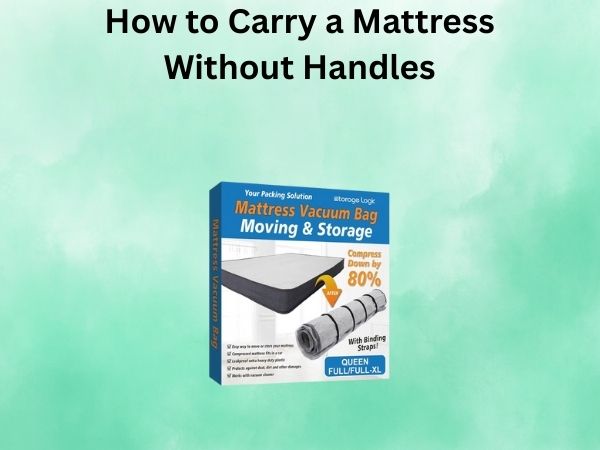
Next, wrap your mattress in a protective covering. A plastic mattress bag works wonderfully, but you can also use heavy-duty plastic sheeting. Wrap it snugly around all sides and secure it with tape. This protects your mattress from dirt, moisture, and damage during transport. Plus, the plastic layer actually provides slightly better grip than the bare fabric.
The Two-Person Carry Technique: The Most Practical Method
Positioning Yourselves Correctly
The two-person carry is the gold standard for moving mattresses without handles, and once you understand the proper positioning, you’ll see why. Stand on opposite long sides of the mattress, with one person at the head and one at the foot. This positioning distributes the weight more evenly than standing at the corners.
Face the same direction so you can move in sync. If you’re moving through a hallway, both of you should face forward to navigate turns smoothly. Your feet should be shoulder-width apart, giving you a stable, balanced stance. Never cross your feet or stand with your legs too close together, as this compromises your stability.
The Lifting Process: Doing It Right
Here’s where technique really matters. Instead of bending at the waist and using your back muscles, bend at the knees. Keep your back straight and let your legs do the heavy lifting. This is the cardinal rule of moving anything heavy, and it applies perfectly to mattresses.
Grip the mattress at the bottom edge, near the floor level. This might seem counterintuitive, but gripping near the edge rather than the middle gives you better control. Your hands should be roughly 12 to 18 inches from the corner, distributed along the length of the mattress side.
On the count of three, both of you lift simultaneously. Synchronized lifting is crucial because uneven lifting causes the mattress to tilt, which makes it infinitely harder to hold. Once the mattress is lifted to waist height, keep your core engaged and maintain steady pressure with your grip.
Movement and Navigation
Move slowly and deliberately. There’s absolutely no prize for speed when you’re carrying something this unwieldy. Small, controlled steps are far better than long strides. Communicate with your partner constantly. Call out warnings about obstacles, doorways, and corners.
When approaching a doorway, angle the mattress slightly on its edge. Most doorways can accommodate a mattress standing partially upright, and this angle actually makes navigation easier. For stairs, take them one at a time, with the person at the higher level doing more of the lifting. Never try to rush stairs with a mattress.
The Solo Carry Method: When You’re Moving Alone
Using Furniture Sliders for Success
If you’re tackling this solo, furniture sliders become your best friend. These small plastic or felt discs go under the mattress and allow it to glide across floors with minimal effort. Position four sliders under the mattress corners, and you can practically push it across your entire house without lifting.
The advantage of sliders is that they require minimal strength. Your job becomes guiding the mattress rather than carrying it. Just push steadily and steer around obstacles. For stairs, however, sliders won’t help, so you might need assistance for that portion.
The Lean and Drag Method
For moving a mattress short distances on flat surfaces, you can use the lean and drag method. Tilt the mattress onto one edge, creating a lean angle of about 45 degrees. This position reduces the effective weight you’re dealing with and gives you leverage. Grip the top edge firmly and drag the mattress along the floor.
This method works best on hardwood or tile floors where dragging won’t cause damage. It’s slower than the two-person carry, but it doesn’t require assistance. The key is maintaining your grip and keeping the mattress at a consistent angle throughout the movement.
The Dolly or Hand Truck Approach
If you have access to a dolly or hand truck, this becomes the easiest solo method by far. Tip the mattress onto its edge first, then carefully slide the dolly underneath. Strap the mattress securely to the dolly using moving straps or rope. Once secured, you can wheel the entire thing wherever you need to go.
The dolly method takes the physical strain out of the equation almost entirely. Your job becomes steering and navigating rather than supporting weight. If you’re moving to a new home anyway, renting a dolly is an investment that pays for itself in reduced physical strain and time saved.
Advanced Techniques for Tricky Situations
Navigating Narrow Hallways and Tight Corners
Narrow hallways are where most mattress-moving mishaps occur. The solution is to stand the mattress on edge and maneuver it lengthwise through the space. Instead of carrying it flat, rotate it to a vertical position where one edge is on the floor and the opposite edge is at ceiling height. This dramatically reduces the width you need to navigate.
For tight corners, take your time and communicate. One person should guide the corner while the other maintains lift. Pivot slowly and adjust your grip as needed. Never force a mattress around a corner. If it’s not sliding smoothly, stop, reassess, and try a different angle.
Moving Mattresses Up and Down Stairs
Stairs present their own special challenge. The two-person team should have one person on the lower step and one on the higher step, with the mattress tilted at about 45 degrees. The person on the higher step does most of the lifting while the lower person guides and supports.
When moving down stairs, reverse the process. The lower person now does more of the supporting to prevent the mattress from sliding too quickly. Take one step at a time, never try to skip steps, and always maintain solid footing before moving to the next step. Rushing stairs with a mattress is a recipe for injury.
Moving Through Second-Story Windows
In some older homes or apartment buildings, moving a mattress through a window is actually easier than navigating stairs. This method requires removing the window and being extremely careful, but it can save tremendous time and effort. You’ll need someone outside with a rope or pulley system to safely lower the mattress.
This is definitely an advanced technique that requires planning and safety equipment, but it’s worth considering if you’re facing particularly difficult stairwell configurations. Make sure whoever is outside is prepared and that you have proper safety measures in place.
Protective Gear and Safety Considerations
What You Should Wear
Your clothing choices matter more than you might think. Wear comfortable, fitted clothing that doesn’t restrict movement. Avoid loose shirts that could get caught on corners or edges. Closed-toe shoes with good grip are essential. Avoid flip-flops, sandals, or smooth-soled shoes that could slip.
Consider wearing work gloves with enhanced grip. These protect your hands from splinters and rough fabric edges while providing better purchase on the mattress surface. Some people also wear a supportive back brace, especially if they have any history of back problems.
Preventing Injury
Back injuries are the primary risk when moving heavy objects like mattresses. To minimize this risk, always lift with your legs, not your back. Keep the mattress close to your body rather than at arm’s length. Maintain proper posture throughout the entire move.
Don’t be too proud to ask for help. If you feel like the mattress is too heavy or the situation is too awkward, stop and find a helper. Your health is far more important than completing a move solo. Taking breaks is also fine. There’s no rule saying you have to move the mattress in one uninterrupted stretch.
Choosing the Right Time and Conditions
Weather Considerations
If you’re moving your mattress outside as part of a longer journey, weather matters. Avoid moving in rain or high humidity, as moisture can damage the mattress interior and make the fabric slippery. Cold temperatures don’t pose a problem, but extreme heat can soften foam layers, making them more prone to damage.
Dry, mild weather is ideal for mattress moving. If you’re stuck moving in less-than-perfect conditions, the plastic wrapping becomes even more important for protecting your mattress from moisture and debris.
Timing and Preparation
Choose a time when you’re well-rested and energized. Moving a mattress when you’re tired or stressed increases the likelihood of mistakes and injuries. Morning moves are often better than evening moves for this reason.
Give yourself plenty of time. Rushing through the process is when accidents happen. If you think you need two hours, budget three. The extra time allows for breaks, problem-solving, and careful navigation of tricky areas.
Common Mistakes to Avoid
Learning from others’ mistakes can save you from making your own. One of the biggest errors people make is trying to grip the mattress in the middle rather than at the edges. The middle has less structural support, which makes it harder to hold and more likely to slip.
Another common mistake is lifting too quickly. A slow, controlled lift is far safer and easier than a fast jerk. Similarly, many people underestimate the importance of planning their route. Discovering halfway through your move that the mattress won’t fit through the doorway is incredibly frustrating.
Don’t skip the protective covering, thinking it’s an unnecessary extra step. That plastic layer protects your mattress from damage and actually improves your grip. Finally, avoid moving a mattress solo when you realistically could find a helper. The time saved and the reduced physical strain make having assistance worthwhile.
Conclusion
Carrying a mattress without handles might seem like an impossible task before you get started, but it’s entirely manageable with the right techniques, preparation, and mindset. The two-person carry method using proper lifting technique remains the gold standard, but solo alternatives like furniture sliders and dollies offer viable options when you’re moving alone.
Remember that preparation is half the battle. Planning your route, gathering materials, wrapping your mattress, and briefing your helpers all contribute to a smooth, injury-free move. Pay attention to your body mechanics, take your time navigating tricky areas, and don’t hesitate to ask for help when you need it.
Whether you’re moving across the room or across the city, these techniques will help you transport your mattress safely and efficiently. The next time you face the challenge of moving a handleless mattress, you’ll approach it with confidence rather than dread.
Frequently Asked Questions
Can I move a mattress alone without any equipment?
While it’s challenging, you can move a mattress alone using the lean and drag method on flat surfaces. However, this method is slow and can strain your back. For longer distances, moving stairs, or any upward movement, having a helper or using equipment like a dolly or furniture sliders is strongly recommended. Your safety is worth the extra effort to find assistance.
Should I deflate an air mattress before moving it?
Yes, deflating an air mattress before moving makes the process significantly easier. A deflated air mattress is much more compact and flexible, making it easier to navigate tight spaces and corners. Just make sure you have an air pump available when you reach your destination so you can re-inflate it properly.
What’s the best way to protect a mattress during a move?
The best protection is a combination of methods. Start with a plastic mattress bag or heavy-duty plastic sheeting wrapped tightly around the entire mattress and secured with clear tape. Additionally, avoid placing heavy items on top of your mattress during transport, and never fold or bend it in ways that could damage the interior structure. Proper wrapping prevents dirt, moisture, and damage to the fabric.
Is it better to move a mattress vertically or horizontally?
The answer depends on your situation. Horizontally is more stable and easier for level surfaces and shorter distances. Vertically is better for navigating stairs, tight hallways, and narrow corners. For most moves, you’ll use both orientations depending on the specific challenges you encounter. Vertical positioning reduces the footprint width, making it easier to navigate tight spaces.
How do moving straps actually help with mattress moving?
Moving straps, also called furniture sliders or moving harnesses, wrap around the mattress and allow you to distribute the weight across your back and shoulders rather than just your arms and hands. This reduces strain on your upper body and provides better control.
![What Is The Best Mattress For Herniated Disc In Lower Back [In 2026]](https://homeunderstandable.com/wp-content/uploads/2025/12/Best-Mattress-For-Herniated-Disc-In-Lower-Back.jpg)
![What Is The best king size mattress for stomach sleepers [In 2026]](https://homeunderstandable.com/wp-content/uploads/2025/12/Best-king-size-mattress-for-stomach-sleepers.jpg)
![What Is The Best Mattress for Back and Neck Pain Side Sleepers [In 2026]](https://homeunderstandable.com/wp-content/uploads/2025/11/Best-Mattress-for-Back-and-Neck-Pain-Side-Sleepers.jpg)
![What Is The Best Mattress for Arthritic Joints [In 2026]](https://homeunderstandable.com/wp-content/uploads/2025/11/Best-Mattress-for-Arthritic-Joints.jpg)