
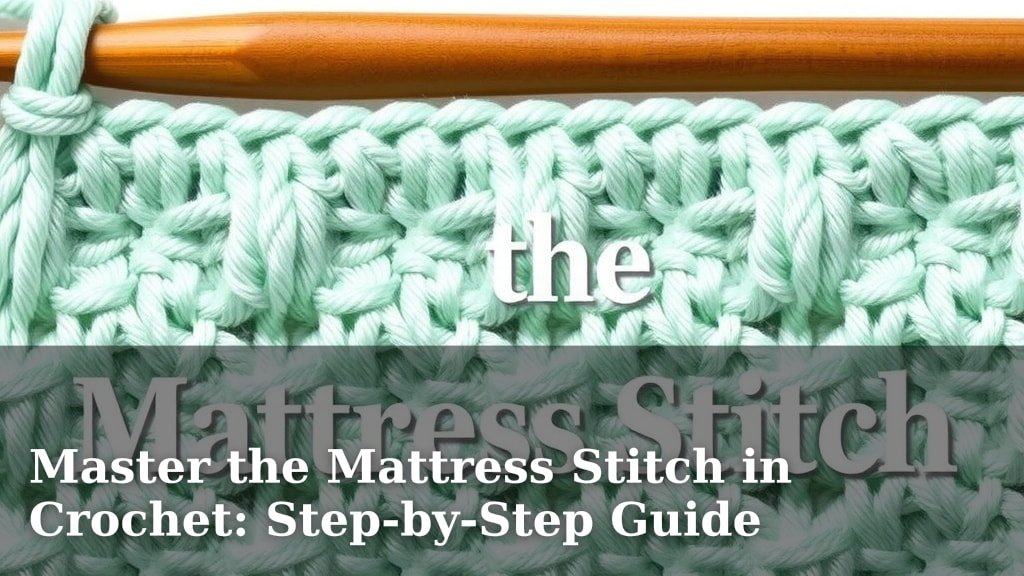
Master the Mattress Stitch in Crochet: Step-by-Step Guide
The mattress stitch is your go-to method for creating a nearly invisible seam when joining two pieces of crochet or knitting, like when making blankets or garments. This stitch works by mimicking the look of a mattress seam. You’ll find it gives your projects a clean, professional finish without any raised lines.
Many crafters love the mattress stitch because it’s incredibly versatile. It works well for joining pieces either vertically or horizontally. You can use it to join motifs, assemble amigurumi parts, or even close up sweater seams. Mastering the mattress stitch will transform your finished objects.
- Mattress stitch makes seams disappear.
- It looks like a real mattress seam.
- Great for blankets, garments, and toys.
- Works for vertical and horizontal joins.
- Gives a professional, clean finish.
Let’s walk through exactly how to create this magic stitch step by step.
Here is the main body content for your blog post about the mattress stitch:Joining Your Crochet Pieces with the Mattress Stitch
You’re ready to join your crocheted or knitted pieces together. The mattress stitch is a fantastic technique for this. It creates a nearly invisible seam. You’ll find it works up smoothly. Let’s learn how to master this stitch.
Understanding How the Mattress Stitch Works
This stitch mimics the natural seams you see on mattresses. That’s where it gets its name. It involves weaving your yarn through the edges of your fabric. You’re essentially creating a ladder-like effect. This pulls the edges together tightly. The result is a flat and seamless join. It looks much cleaner than other methods.
Why Choose the Mattress Stitch?
Many crafters prefer the mattress stitch for good reason. It’s incredibly versatile. You can use it for both horizontal and vertical seams. This makes it perfect for blankets, sweaters, and even amigurumi. It’s also quite strong. You won’t have to worry about your seams coming undone. Plus, it lays perfectly flat. This means no bulky bumps to interrupt your design.
When to Use It
Think of the mattress stitch whenever you need a clean finish. It’s ideal for joining squares for a blanket. It’s also great for sewing up the sides of a sweater. Even assembling stuffed toys becomes easier. If you’re working with two pieces of fabric that have a similar edge stitch, it’s a perfect match. It works best when the edges you are joining have a consistent structure.
Preparing for the Mattress Stitch
Gathering Your Supplies
You’ll need a few basic items. Your crocheted or knitted pieces are the main things, of course. You’ll also need a yarn needle. A blunt-tipped needle is usually best for yarn. Make sure it has a large enough eye to thread your yarn. Lastly, you’ll need yarn that matches the color of your project. This helps the seam blend in. If you want a contrasting seam for decoration, you can use a different color. But for an invisible seam, match your yarn.
Blocking Your Pieces (Optional but Recommended)
Before you join, consider blocking your pieces. Blocking shapes your fabric. It can help make your edges even. This makes the mattress stitch much easier to work. It also ensures your final piece is the correct size and shape. Many sources suggest blocking as a key step for professional-looking results (Craft Yarn Council).
Step-by-Step Mattress Stitch Guide
Starting Your Seam
Lay your two pieces flat, right sides facing each other. Pin them together if needed. You want the edges you’re joining to be perfectly aligned. Decide which edge you’ll be working along. This is usually the edge with a clear row of stitches. You’ll be working into the edge stitches or the spaces between them.
Threading Your Needle
Cut a length of yarn. It should be about three times the length of the seam you need to sew. Thread this yarn onto your yarn needle. Don’t make it too long, or it can tangle. A good rule of thumb is to aim for manageable lengths.
Making Your First Stitch
Insert your needle into the edge of one of your pieces. Come up through the first “bar” or loop right next to your starting edge. Pull the yarn through, leaving a tail of about 6 inches. This tail will be used to secure the start of your seam later. Now, go to the other piece of fabric. Insert your needle into the corresponding spot. Come up through the first bar right next to the edge. You’ve now made your first connecting stitch.
Continuing the Stitch
Working Back and Forth
Now, you’ll alternate between your two pieces. Go back to the first piece. Insert your needle into the next available bar. Come up right next to where your yarn just exited. Pull the yarn through gently. Then, go to the second piece. Insert your needle into the next corresponding bar. Come up right next to where your yarn exited. Keep pulling your yarn through as you go. You want to create a snug fit, but don’t pull so tight that your fabric puckers.
Identifying the “Bars”
The key to the mattress stitch is knowing where to insert your needle. Look at the edge of your fabric. You’ll see horizontal bars of yarn. These bars are created by the yarn that makes up your stitches. For stockinette stitch fabric (like in knitting or some crochet patterns), you’ll be working under the “V” of the stitch on the edge. For crochet edges, you might be working into the last loop of the edge stitch. We found that consistently picking up the same part of the edge stitch is crucial for a clean look (The Spruce Crafts).
Weaving Through the Fabric
As you continue, you’ll see your yarn creating a line between the two pieces. Keep your stitches even. Aim for the same number of bars to be visible between each stitch. This visual consistency is what makes the seam disappear. It helps the edges blend together. You are essentially weaving a new thread between your two pieces of fabric.
Finishing Your Seam
Tying Off the Beginning
Once you’ve completed your seam, you’ll have two yarn tails: one at the beginning and one at the end. Take the tail from the start of your seam. Use your yarn needle to weave it back through the seam you just made. Do this a few times. Then, take the tail from the end of your seam. Weave it back through the seam in the opposite direction. This secures both ends nicely.
Weaving in the Ends
Trim any excess yarn. Your seam should now be secure and nearly invisible. You can tug gently on the fabric to help the seam settle. For an extra secure finish, some crafters suggest weaving the tail back through the seam one more time before trimming.
Common Mattress Stitch Pitfalls and Solutions
Uneven Tension
Are your seams looking a little wobbly? This is often due to uneven tension. Try to pull your yarn with consistent pressure. Don’t yank too hard, but don’t leave it too loose either. Practicing on scrap pieces can help you find that sweet spot. We found that relaxing and taking your time made a big difference in tension control.
Visible Seam Lines
If your seam is still noticeable, check where you’re inserting your needle. Are you consistently picking up the same part of the edge stitch on both sides? Inconsistent stitch placement is a common reason for a visible line. Ensure you’re working into the corresponding “bar” or loop on each piece of fabric.
Fabric Puckering
Is your fabric bunching up? You’re likely pulling your yarn too tight. Ease up on the tension. Let the fabric lay flat as you work. The goal is to bring the edges together snugly, not to cinch them closed.
Mattress Stitch vs. Other Seaming Methods
You might be wondering how the mattress stitch stacks up against other ways to join fabric. Here’s a quick comparison:
| Method | Pros | Cons |
|---|---|---|
| Mattress Stitch | Invisible seam, lays flat, works vertically and horizontally. | Can be slow to learn, requires careful attention to stitch placement. |
| Whip Stitch | Simple and fast, good for edges that aren’t perfectly neat. | Can create a visible raised line, may not lay as flat. |
| Single Crochet Seam | Creates a strong, sturdy seam, relatively quick. | Noticeable ridge, can be bulky on finer projects. |
Your Mattress Stitch Checklist
- Choose matching yarn for an invisible seam.
- Thread your yarn needle with yarn 3x the seam length.
- Lay pieces right sides together, aligning edges.
- Insert needle into the first corresponding bar on piece A.
- Insert needle into the first corresponding bar on piece B.
- Alternate between pieces, picking up the next bar each time.
- Maintain consistent tension throughout the seam.
- Weave in ends securely at the beginning and end.
Conclusion
You’ve now learned how to master the mattress stitch, a truly transformative technique for your crochet and knitting projects. Remember, this stitch is your secret weapon for creating those beautifully flat and nearly invisible seams that give your finished items that professional polish. Consistent practice is key, especially when it comes to tension and stitch placement. Don’t be discouraged if your first few attempts aren’t perfect; keep weaving, and you’ll soon find your rhythm. Now, go forth and join your pieces with confidence!
Frequently Asked Questions
What kind of yarn should I use for the mattress stitch?
For an invisible seam, you’ll want to use yarn that matches the color of your project pieces. If you’re aiming for a decorative or contrasting seam, you can choose a different color. The weight of the yarn should ideally match the yarn used for your project.
How do I know which “bar” to pick up on my crochet fabric?
When working with crochet edges, you’ll often be picking up the bar of yarn that forms the outermost edge of your stitch or the space directly before it. For stockinette-like crochet edges, look for the horizontal strand of yarn that runs along the edge, similar to knitting.
My mattress stitch seam looks tight and puckered. What did I do wrong?
This usually means you’re pulling your yarn too tightly. The mattress stitch should bring the edges together snugly, but not cinch them. Try to relax your tension and let the fabric lay flat as you work. Practicing on scrap pieces can help you find the right balance.
Can I use the mattress stitch for joining different types of crochet stitches?
The mattress stitch works best when the edges you’re joining have a similar structure, like the same stitch pattern or gauge. If your crochet edges are very different, you might find the seam becomes more visible. However, with careful attention to picking up corresponding loops, you can still achieve a good result.
How long should the yarn tail be when I start sewing?
A good rule of thumb is to cut a length of yarn that is about three times the length of the seam you need to sew. This ensures you have enough yarn to complete the seam without running out, and it leaves enough tail for securely weaving in your ends afterward.

![What Is The best lucid mattress for side sleepers [In 2026]](https://homeunderstandable.com/wp-content/uploads/2025/12/Best-lucid-mattress-for-side-sleepers-.jpg)
![What Is The Best Mattress for Good Price [In 2026]](https://homeunderstandable.com/wp-content/uploads/2025/06/best-mattress-for-good-price.jpg)