6 Gallon Air Compressor Wattage Explained
So, you’re wondering about the power needs for your 6-gallon air compressor? You’ve come to the right place! Generally, a 6-gallon air compressor uses about 1500-2000 watts when it’s running to fill its tank. This means you’ll need a power source that can handle that wattage. It’s important to check your compressor’s label for the exact figures.
The exact power draw can depend on a few things. Things like the motor’s horsepower and whether it’s currently filling the tank or just maintaining pressure play a role. We found that most 6-gallon models are designed for standard home outlets, but ensuring your circuit can handle the load is key. Think of it like giving your compressor enough juice to do its job efficiently.
- 6-gallon compressors typically need 1500-2000 watts.
- Check the compressor’s label for specific power requirements.
- Horsepower and operational status affect wattage.
- Most are designed for standard home outlets.
- Ensure your circuit can handle the power draw.
Let’s break down how to figure out the power needs for your 6-gallon air compressor and what that means for your home’s electrical setup.
Alright, let’s get down to the nitty-gritty of powering your 6-gallon air compressor. Understanding its wattage needs is key to making sure it runs smoothly and safely, without tripping breakers or causing electrical headaches. You’re not alone in wondering about this; it’s a common question for anyone setting up a new compressor or troubleshooting an existing one.
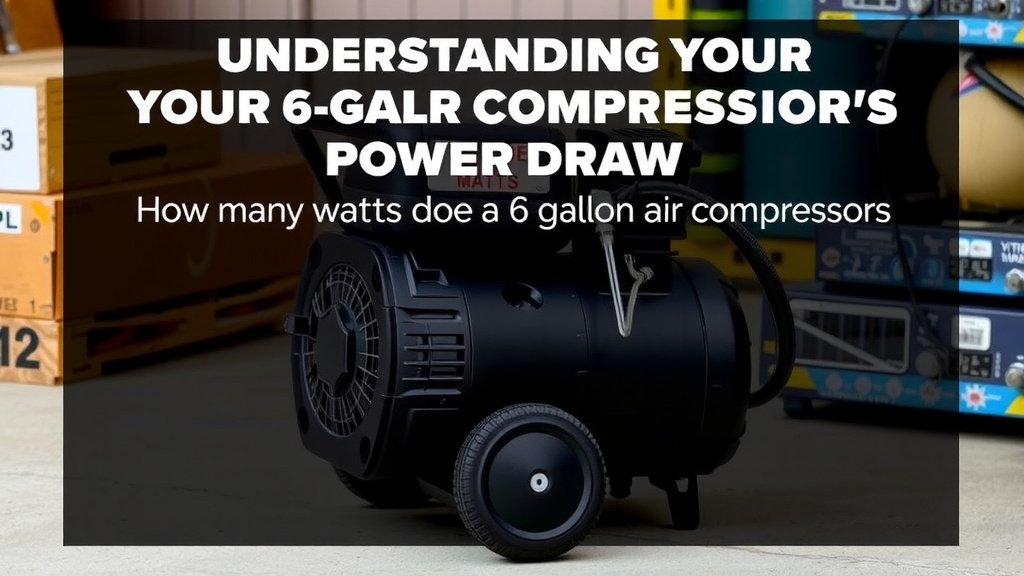
Understanding Your 6-Gallon Air Compressor’s Power Draw
So, what’s the scoop on how many watts a 6-gallon air compressor actually uses? Generally speaking, you can expect a 6-gallon air compressor to pull between 1500 and 2000 watts while it’s actively working to fill its tank. Think of this as its peak performance moment, when it’s working the hardest.
This wattage figure is super important because it tells you what kind of electrical supply your compressor needs to function properly. It’s not quite the same as the horsepower rating, which is more about the motor’s strength. Wattage is the direct measure of how much electrical power it consumes.
Wattage vs. Horsepower: What’s the Difference?
It’s easy to get wattage and horsepower confused, but they measure different things. Horsepower (HP) is a measure of the motor’s output power. It tells you how much work the motor can do. A higher HP generally means a more powerful compressor that can deliver more air (measured in Cubic Feet per Minute or CFM).
Wattage, on the other hand, is the electrical power consumption. It tells you how much electricity the motor draws from the wall outlet. While a higher HP motor might *suggest* a higher wattage draw, it’s not a direct 1:1 relationship. Different motor designs and efficiencies can affect how many watts are needed for a given HP.
Finding Your Compressor’s Specific Wattage
The most accurate way to know the exact wattage your 6-gallon air compressor needs is to check the manufacturer’s label. This is usually found on the compressor itself, often near the power cord or on the motor housing. It will list the voltage (V), amperage (A), and sometimes directly state the wattage (W) or(/^power (W)/). If it only lists voltage and amperage, you can easily calculate the wattage yourself using a simple formula: Watts = Volts x Amps.
For example, if your compressor is rated at 120 volts and draws 15 amps, it would use about 1800 watts (120V x 15A = 1800W). This is a common rating for many home-use compressors, and it’s helpful to know this so you can ensure your home’s electrical circuit is up to the task.
How the Compressor’s Task Affects Wattage
The power draw isn’t constant. It changes depending on what the compressor is doing. When the compressor tank is empty or low, the motor has to work harder to pump air. This is when you’ll see the highest wattage draw, typically in that 1500-2000 watt range we discussed.
Once the tank reaches its set pressure, the motor will likely shut off, or at least switch to a lower power mode to maintain pressure. This means the wattage consumption drops dramatically. When it cycles back on to top off the pressure, you’ll see that higher wattage draw again. This is a normal operational cycle.
Electrical Requirements for Your 6-Gallon Air Compressor
Now that you have a better idea of the wattage, let’s talk about your home’s electrical system. Most 6-gallon air compressors are designed to plug into a standard household outlet. In the US, this typically means a 120-volt outlet.
Standard Household Outlets and Circuits
Standard household circuits in the US are usually rated for 15 or 20 amps. A 15-amp circuit can safely handle up to 1800 watts (120V x 15A), and a 20-amp circuit can handle up to 2400 watts (120V x 20A). Since many 6-gallon compressors fall within the 1500-2000 watt range, they should work fine on a standard outlet.
However, there’s a crucial point: you need to consider what else is on that circuit. If your compressor is plugged into a circuit that also powers other appliances, like a refrigerator or a workbench lamp, you could overload the circuit. It’s always best to try and plug your air compressor into an outlet on its own circuit if possible, or at least one that doesn’t have many other high-draw devices connected.
Checking Your Circuit Breaker
To be absolutely sure, you can check your home’s electrical panel. Look for the circuit breaker that controls the outlet you plan to use. The breaker will be labeled with its amperage rating (15A or 20A). This confirms the maximum load that circuit can handle. You can then compare this to your compressor’s listed amperage draw on its label.
If your compressor’s amperage draw is close to or exceeds the circuit breaker’s rating, especially when other devices are running, you might need to consider a dedicated circuit. This is a job for a qualified electrician, of course.
Extension Cords: A Common Pitfall
Using an extension cord is often necessary, but it’s also a frequent source of problems for air compressors. Not all extension cords are created equal! If you need to use one, make sure it’s a heavy-duty cord with the appropriate gauge (thickness) for the amperage and distance. A cord that’s too thin can restrict power flow, causing the compressor motor to overheat and potentially fail.
Many experts recommend using the shortest possible extension cord, and one that is rated for outdoor use, even if you’re indoors. This generally means they are built to handle more power. Always check the extension cord’s rating to ensure it can safely handle the wattage your compressor requires.
Here’s a quick checklist to ensure you’re powering your compressor correctly:
- Verify the wattage and amperage on your compressor’s label.
- Locate the circuit breaker for the outlet and note its amperage.
- Ensure the outlet’s circuit can handle the compressor’s draw, plus any other devices.
- Use a heavy-duty extension cord if needed, checking its gauge and rating.
- Avoid running other high-power appliances on the same circuit.
- If in doubt, consult a qualified electrician.
Conclusion
You’ve learned that your 6-gallon air compressor likely needs 1500-2000 watts to run. Remember, the label on your compressor is your best guide for exact figures. Understanding this wattage helps you connect it to standard 120-volt household outlets safely. Just be mindful of what else shares that electrical circuit.
Double-checking your circuit breaker’s amperage is simple and smart. If you need an extension cord, always choose a heavy-duty one. Your next step is to check your compressor’s label and then the outlet you plan to use. This ensures you’re giving your compressor the power it needs without any electrical surprises.
Frequently Asked Questions
Can I plug my 6-gallon air compressor into any standard outlet?
Generally, yes, most 6-gallon air compressors are designed for standard 120-volt home outlets. However, you must ensure the specific circuit can handle the compressor’s wattage draw, especially if other appliances are running on it. Always check your compressor’s label and your circuit breaker rating.
How can I calculate the wattage if my compressor only lists volts and amps?
It’s simple math! You can find your compressor’s wattage by multiplying its voltage (V) by its amperage (A). For example, a compressor rated at 120 volts and 15 amps uses 1800 watts (120 x 15 = 1800). This calculation is key to understanding its power needs.
What happens if I overload the circuit with my air compressor?
If you overload the circuit, the circuit breaker will trip, shutting off power to prevent damage or fire. You might also notice the compressor motor struggling or overheating if the breaker doesn’t trip immediately. It’s best to avoid this by ensuring the circuit can handle the compressor’s load plus any other devices.
Is it okay to use a regular household extension cord with my air compressor?
It’s generally not recommended. Regular household extension cords are often too thin and can’t safely handle the high power draw of an air compressor. This can lead to overheating and damage to both the cord and the compressor. Always use a heavy-duty extension cord specifically rated for the amperage your compressor needs.
Does my 6-gallon air compressor use the same amount of watts all the time?
No, your compressor’s wattage use changes. It draws the most power, typically 1500-2000 watts, when its motor is running to fill the tank. Once the tank is pressurized, the motor may shut off or switch to a low-power mode to maintain pressure, drawing significantly fewer watts.