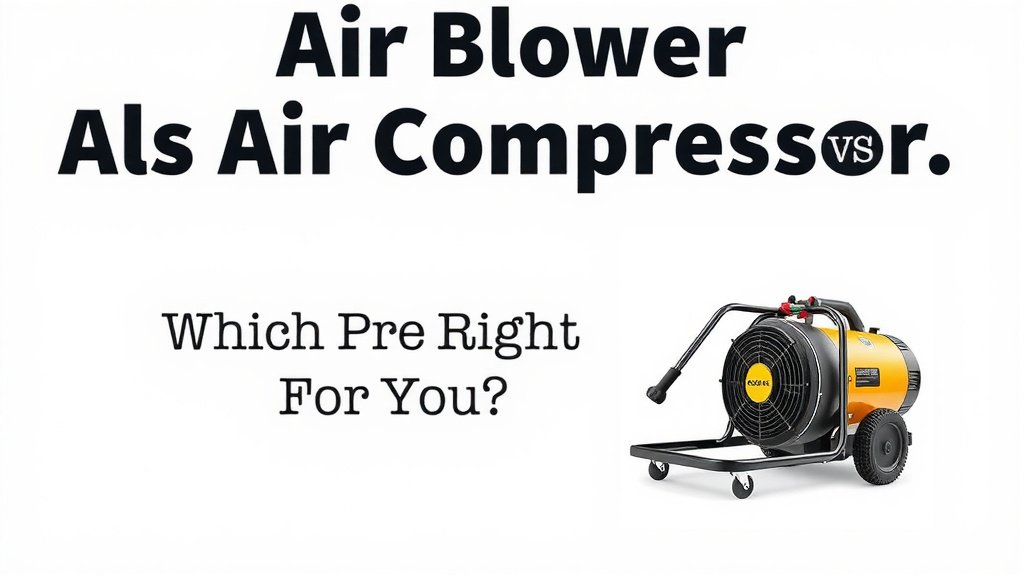
Air Blower vs Air Compressor: Which is Right for You
When you need to move air, you might wonder if you need an air blower or an air compressor. While both move air, they do it very differently. An air blower provides a large volume of air at low pressure, perfect for aeration or ventilation. An air compressor, on the other hand, creates a small volume of air at very high pressure, ideal for powering tools.
Understanding this key difference helps you choose the right equipment for your job. Many tasks that seem similar actually require distinct air-moving solutions. We found that picking the wrong device can lead to poor performance or even damage to your equipment. It’s all about matching the air’s volume and pressure to the need.
TL;DR:
- Air blowers move lots of air at low pressure.
- Air compressors create high-pressure air in smaller amounts.
- Choose based on whether you need volume or pressure.
- Using the wrong one can cause problems.
Let’s walk through exactly how air blowers and air compressors differ and when you should use each one.
“`htmlUnderstanding the Difference Between Air Blowers and Compressors
You need to move air, but which device is right for the job? It’s a common question that pops up for many DIYers and professionals alike. We’ve found that the core difference boils down to two things: how much air you need and how much force (pressure) that air needs to have.
Think of it like this: a blower is like a gentle, wide gust of wind, while a compressor is more like a powerful, focused jet stream. Both are air, but their delivery systems are worlds apart.
Air Blowers: The Masters of Volume
An air blower is designed to move a large volume of air. It’s all about quantity. These devices take in ambient air and expel it at a relatively low pressure. They’re built for continuous airflow.
How Blowers Work
Most blowers use rotating impellers or blades. These spin rapidly, pushing air outwards. Imagine a fan, but enclosed and designed to direct that airflow more effectively. This continuous push creates a steady stream of air. We found that this steady stream is perfect for applications where you need to circulate air or gently move materials.
Common Uses for Air Blowers
You’ll find air blowers in many places. For example, they are essential in wastewater treatment plants to supply oxygen to microorganisms. In HVAC systems, they circulate heated or cooled air throughout your home. Some pools use blowers for their features, like waterfalls or jets. Even vacuum cleaners often use a blower motor to create suction by pushing air away.
- Wastewater treatment aeration
- HVAC system air circulation
- Pool and spa features
- Creating suction for vacuum cleaners
- Drying surfaces
Air Compressors: The Champions of Pressure
An air compressor, on the other hand, is all about high pressure. It takes in air and compresses it into a smaller volume, significantly increasing its pressure. This stored, high-pressure air is then released on demand.
How Compressors Work
Compressors typically use pistons, screws, or vanes to squeeze air. A piston compressor works much like a car engine cylinder, compressing air with each stroke. Rotary screw compressors use interlocking screws to trap and compress air. The key is that they increase the air’s force. We found that this stored energy allows them to power tools that need a strong burst of air. For example, a 1-cylinder air compressor works much like a car engine cylinder, compressing air with each stroke.
Common Uses for Air Compressors
Air compressors are the workhorses behind many pneumatic tools. Think of nail guns, impact wrenches, and spray paint guns. They’re used in automotive repair shops to power lifts and tools. Dentists’ drills and even some medical equipment rely on compressed air. The high pressure is what gives these tools their power. Many manufacturing processes also use compressed air for automation and assembly. We found that without compressors, many modern industrial tasks wouldn’t be possible.
- Powering pneumatic tools (nail guns, drills)
- Automotive repair (lifts, tools)
- Industrial automation
- Painting and coating
- Inflating tires
Key Differences Summarized
To really nail down the distinction, let’s look at them side-by-side. It’s not just about volume versus pressure; it’s about the application each is best suited for. We’ve put together a quick comparison to help you see it clearly.
| Feature | Air Blower | Air Compressor |
|---|---|---|
| Primary Function | Move large volumes of air | Create high-pressure air |
| Airflow Rate | High volume, low pressure | Lower volume, high pressure |
| Mechanism | Impellers, fans | Pistons, screws, vanes |
| Energy Output | Continuous airflow | Stored, on-demand bursts |
| Typical Uses | Aeration, ventilation, circulation | Powering tools, inflation |
When to Choose a Blower Over a Compressor
So, when does a blower make more sense for your project? If your main goal is to move a lot of air gently and continuously, a blower is your best bet. Are you trying to aerate a pond? You need a blower. Do you need to circulate air in a large space? A blower is the answer. Trying to dry a wet surface quickly after a spill? A blower will move more air over the area.
We found that if the task involves simply pushing air around without needing significant force, a blower is generally more efficient and cost-effective. Think of providing oxygen to fish in a tank; they don’t need pressurized air, just a steady supply. That’s a blower’s job.
When to Reach for a Compressor Instead
Conversely, if you need to power a tool that requires a strong, sharp burst of air, you absolutely need a compressor. Trying to drive a nail with a nail gun? That requires the punch of compressed air. Inflating a car tire to the correct pressure needs that higher force. Even cleaning dust out of tight crevices with an air duster is a job for a compressor. We’ve seen many people try to use blowers for these tasks, and the results are usually disappointing or ineffective.
The stored energy in compressed air allows for powerful, short-duration tasks. Many experts agree that for any application demanding impact or force, a compressor is the only suitable option (National Institute for Occupational Safety and Health – NIOSH).
Potential Pitfalls of Misusing Them
Using the wrong device can lead to frustration and even damage. If you try to power a tool like a nail gun with an air blower, it simply won’t have the necessary pressure. The tool won’t fire, or it will perform very poorly. You’ll be wasting time and potentially stressing the blower’s motor by demanding more than it can deliver.
On the flip side, using a compressor when a blower would suffice might be overkill. For simple air circulation, a compressor might use more energy than needed. Imagine using a fire hose to water a small plant – it’s too much force. We found that understanding the specific air requirements of your task is key to choosing the right equipment and ensuring its longevity.
Quick Checklist for Your Decision
To help you decide, ask yourself these questions:
- Do I need to move a lot of air slowly, or a little air very fast?
- Is the main goal to fill a space with air, or to power a tool?
- Does the task require force or just airflow?
- Will the air be used continuously, or in short bursts?
- What kind of equipment am I trying to operate?
Conclusion
You now know the core difference between air blowers and air compressors: volume versus pressure. Blowers deliver large volumes of air at low pressure, ideal for circulation and aeration. Compressors provide smaller volumes of air at high pressure, perfect for powering tools and inflation. We found that understanding your project’s specific needs is key. Don’t let the similar names fool you; using the wrong device can lead to poor results or even equipment damage. Next time you need to move air, confidently choose the device that matches your task’s demand for volume or force. Your project will thank you for it!
Frequently Asked Questions
Can I use an air blower to inflate a tire?
No, you generally cannot use an air blower to inflate a tire. Air blowers produce low-pressure, high-volume air, which isn’t enough force to properly inflate a tire. You need the high pressure from an air compressor to get a tire to the correct PSI.
Are air compressors more energy-efficient than blowers?
It depends on the task. For simple air circulation or aeration, an air blower is usually more energy-efficient because it’s designed for continuous, low-pressure output. An air compressor uses more energy when it’s actively compressing air to build high pressure.
What happens if I try to power a nail gun with an air blower?
If you try to power a pneumatic nail gun with an air blower, it likely won’t work, or it will perform very poorly. Nail guns require the high-pressure “burst” of air that only an air compressor can provide. A blower simply doesn’t have the necessary force.
Can an air compressor be used for ventilation?
While technically possible, using an air compressor for general ventilation is usually inefficient and overkill. Air compressors are designed for high pressure, not high volume. For circulating air in a room or building, an air blower or a fan is a much more suitable and energy-conscious choice.
Which one is better for drying a wet surface quickly?
For drying a wet surface quickly, you’ll get better results with an air blower. You need to move a large volume of air across the surface to evaporate the moisture. While a compressor can blow air, its lower volume and higher pressure aren’t as effective for broad drying tasks.