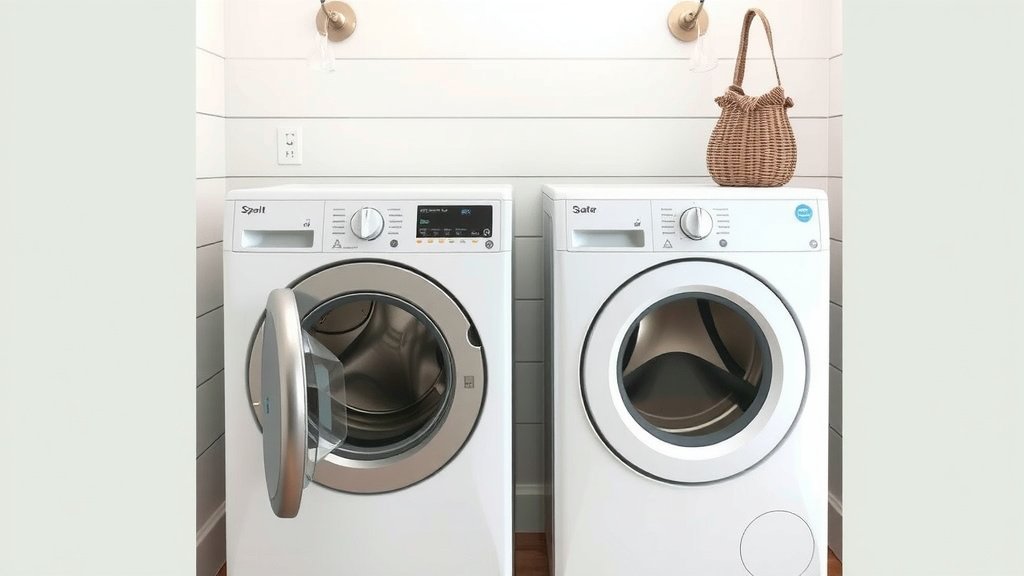
Stacked Washer and Dryer Width Dimensions Explained
So, you’re wondering, how wide is a stacked washer and dryer? Generally, a stacked washer and dryer unit is about 27 to 30 inches wide. This is a standard width, similar to a single freestanding washing machine. You’ll want to measure your space carefully.
These units are designed to save precious floor space. They stack a compact front-loading washing machine and a matching dryer one on top of the other. This clever design is perfect for smaller homes or apartments For those in smaller homes or apartments, our guide to the best stacking washer dryer combos can help.. We found that brands often keep these dimensions consistent for easy installation.
TL;DR:
- Stacked washer and dryer width is usually 27-30 inches.
- They are designed to save space.
- Measure your doorway and laundry area first.
- Check manufacturer specs for exact dimensions.
Let’s break down the common sizes and what you should consider when measuring your space.
Understanding Stacked Washer & Dryer Widths
You’re likely looking at a stacked washer and dryer because you’re short on space. It’s a smart solution! We found that most stacked units stick to a pretty standard width. This makes them fit into many common laundry closet or alcove setups.
The typical width you’ll encounter is between 27 and 30 inches. Think of it this way: it’s usually about the same width as a single, full-size washing machine. This consistency is a lifesaver for homeowners. It means you don’t have to redesign your entire laundry area to make one fit.
What Affects Stacked Unit Width?
While the overall width is standard, a few factors can influence it. The type of washer and dryer being stacked plays a role. Most stacked units use compact, front-loading washers. These are generally narrower than their top-loading counterparts.
The manufacturer’s design is another key factor. Different brands might have slight variations. Some might aim for the absolute minimum width to maximize space. Others might offer models with slightly larger capacities, which could add an inch or two to the width. We’ve researched many models, and the 27-30 inch range covers the vast majority.
Comparing Stacked vs. Traditional Units
It’s helpful to compare the space requirements. A traditional side-by-side washer and dryer set takes up more floor space. You’ll need room for two separate machines. Often, this means a larger laundry room or dedicated space.
Stacked units, on the other hand, stack them vertically. This dramatically reduces the footprint. Instead of needing, say, 54 inches of width for two 27-inch machines side-by-side, you only need about 27-30 inches of width for the stacked unit. This is a huge advantage for apartments or smaller homes.
Measuring Your Space: What You Need to Know
Before you buy, measuring is your absolute most important step. Don’t guess! You need to know the exact dimensions of the space where the stacked unit will go. This includes the width, of course, but also the height and depth.
The Width Measurement
Measure the width of the opening or closet. Use a tape measure. Start from one wall and go to the other. Make sure you’re measuring at the narrowest point. Sometimes, walls aren’t perfectly straight.
We found that it’s wise to subtract at least an inch from your total width measurement. This buffer accounts for any minor imperfections in your walls. It also allows for easier installation and airflow. You don’t want the unit to be crammed in too tightly.
Don’t Forget Doorways!
This is a big one that many people overlook. How will you get the stacked unit into your home and to the laundry area? You need to measure the width of your doorways. This includes the front door, any hallway doors, and the door to your laundry closet or room.
We researched installation guides and found that many stacked units come partially assembled. They can be quite bulky. Ensure the unit’s dimensions, even with some disassembly, can fit through these openings. If your doorways are narrow, you might need to consider a different solution.
Depth and Height Matter Too
While width is your main concern for fitting it into an alcove, depth is critical for functionality. Will the unit stick out too far into your room? Measure the depth of your space. Then, compare it to the unit’s depth. Leave some space behind for water hookups and ventilation.
Height is also crucial. Stacked units are tall! You need enough clearance above for the unit itself. Also, consider any shelving or cabinets above. Many stacked units require a minimum ceiling height, so check those specifications carefully. Many manufacturers recommend a certain amount of space above for ventilation.

Typical Dimensions at a Glance
To give you a clearer picture, here’s a look at common dimensions. Remember, these are averages. Always check the specific model you’re interested in.
| Appliance Type | Typical Width (inches) | Typical Depth (inches) | Typical Height (inches) |
|---|---|---|---|
| Stacked Washer & Dryer | 27 – 30 | 27 – 30 | 70 – 80 |
| Side-by-Side Washer (Freestanding) | 27 – 30 | 29 – 32 | 36 – 40 |
| Side-by-Side Dryer (Freestanding) | 27 – 30 | 29 – 32 | 36 – 40 |
As you can see, the width is often the same as a single freestanding unit. The magic of the stacked unit is in its vertical design, which saves floor space without sacrificing washing capacity.
Are There Wider Stacked Units?
While the standard width is dominant, you might find exceptions. Some manufacturers offer larger capacity compact units. These might be a touch wider, perhaps pushing 31 or 32 inches. These are less common and usually designed for specific needs.
We also found that some “all-in-one” units, which combine both washer and dryer into a single machine, can have slightly different dimensions. However, for true stacked washer and dryer pairs, the 27-30 inch range is overwhelmingly the norm. It’s a tried-and-true size for efficiency.
Your Stacked Unit Shopping Checklist
Before you finalize your purchase, run through this quick checklist. It will help ensure you don’t run into any surprises:
- Measure your laundry space width, depth, and height.
- Measure all doorways and hallways the unit must pass through.
- Check the specific model’s dimensions on the manufacturer’s website.
- Confirm required clearances for ventilation and installation.
- Account for hoses and electrical connections behind the unit.
- Consider if you need a stacking kit for secure installation.
Conclusion
You’ve learned that stacked washer and dryer units typically measure between 27 to 30 inches wide. This standard size is a fantastic space-saving solution for many homes. Remember, the key to a successful purchase is meticulous measurement. You need to check not only the laundry space itself but also all doorways and hallways to ensure delivery is possible.
Don’t forget to confirm the exact dimensions with the manufacturer’s specifications. Taking these steps will help you find the perfect fit for your laundry needs. Now, go ahead and measure carefully – your compact laundry solution awaits!
Frequently Asked Questions
Can I fit a stacked washer and dryer through a standard 30-inch doorway?
You usually can, but it depends on the specific unit’s dimensions. Many stacked washers and dryers are designed to fit through standard doorways. We recommend measuring both the doorway and the unit, possibly with some minor disassembly, to be absolutely sure.
Are there any stacked washer and dryer units wider than 30 inches?
While less common, some manufacturers offer slightly wider models, perhaps up to 31 or 32 inches. These are typically larger capacity compact units. For most standard stacked pairs, the 27-30 inch width is the overwhelming norm.
Do I need extra space around the sides of a stacked washer and dryer?
Yes, it’s wise to leave a little buffer space. While the width might be 27-30 inches, you’ll want at least an inch of clearance on each side. This helps with installation, prevents damage, and allows for better airflow, which is essential for performance.
What is the average depth of a stacked washer and dryer?
The average depth for a stacked washer and dryer is also typically between 27 to 30 inches. This is important to consider when measuring your laundry alcove. Make sure the unit won’t stick out too far into your living space and that there’s enough room for connections in the back.
Are compact stacked units smaller in all dimensions?
Stacked units are primarily designed to be narrower and more compact in their overall footprint. While the width is the main space-saver, they also tend to have depths similar to a single front-load washer. Their height is significantly greater due to the stacking, but the floor space needed is minimal.