
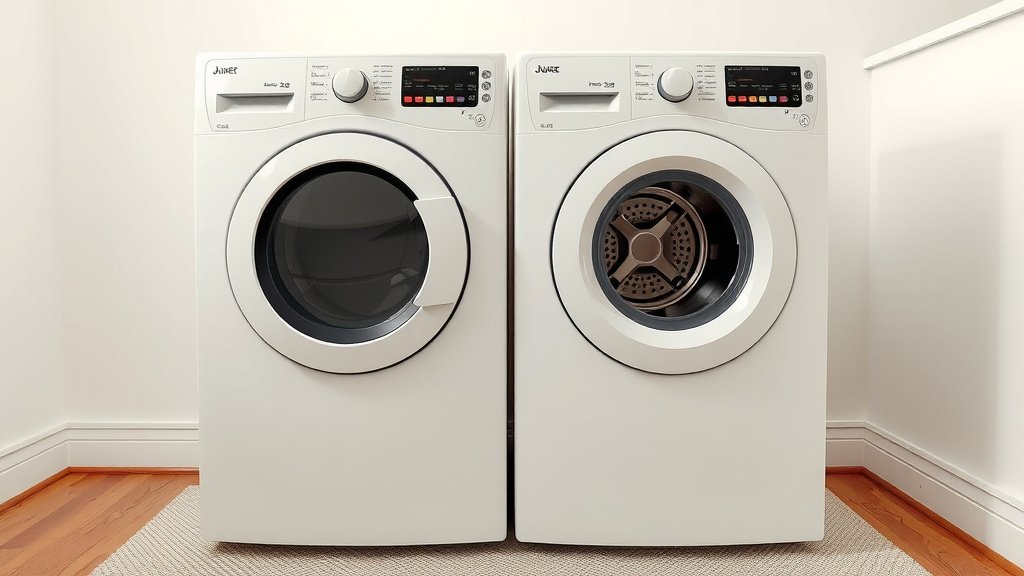
Standard Washer and Dryer Dimensions Explained
Standard washer and dryer dimensions typically range from 27 to 30 inches wide and 30 to 34 inches deep. Height can vary, but most are around 36 inches tall. Knowing these common sizes helps you figure out if a new machine will fit your laundry space.
While these are the usual measurements, you’ll find that models can differ slightly. Some are designed for smaller homes or apartments, while others are extra-large capacity units. It’s wise to measure your doorway and laundry area before you shop.
- Standard washers are about 27-30 inches wide.
- Dryers are generally the same width.
- Depth usually falls between 30-34 inches.
- Check your doorways for clearance before buying.
- Measure your existing laundry space too.
Let’s get into the nitty-gritty of washer and dryer sizes so you can pick the perfect pair for your home.
Understanding Standard Washer and Dryer Sizes
So, you’re ready to upgrade your laundry setup, or perhaps you’re fitting out a new space? Figuring out the right dimensions for your washer and dryer is a big step. It’s not just about fitting them in; it’s about making sure you have enough room to operate them comfortably and get your laundry done without a hitch.
We found that most standard washers and dryers share a similar footprint. This makes buying them as a pair a bit simpler. Let’s break down what “standard” really means for these appliances.
The Typical Footprint: Width and Depth
When we talk about washer and dryer dimensions, we’re usually looking at three main measurements: width, depth, and height. The width is often the most critical for fitting multiple machines side-by-side or ensuring clearance in your laundry room.
Standard Widths for Your Laundry Pair
For a standard washing machine, you’ll commonly see widths falling between 27 and 30 inches. This range covers the majority of top-load and front-load models. Think of it as the “average Joe” size for washers.
And the good news? Most standard dryers are built to match. They also tend to be around 27 to 30 inches wide. This consistency makes it easier to plan your laundry room layout. You can often place a washer and dryer next to each other without a huge gap, assuming your space allows.
How Deep Do They Go? Understanding Depth
Depth is another key measurement, especially for front-load washers and dryers. These machines often have a deeper profile than top-loaders. We found that typical depths range from about 30 inches to 34 inches.
This measurement is crucial for two main reasons. First, you need to ensure the machine doesn’t stick out too far into your walkway. You want to be able to open the door or lid fully without hitting a wall or another appliance. Second, consider the location of your hookups. The depth measurement often includes the space needed for the hoses and cords at the back.
Height Considerations for Your Machines
While width and depth determine if the machine will fit in the space, height can also be a factor, especially if you’re planning on stacking your units or placing them under shelves.
Standard Heights and Stacking Options
Most standard washers and dryers stand around 36 inches tall. This is a comfortable working height for most people. It allows you to load and unload laundry without excessive bending.
If you’re short on floor space, stacking kits are available for many front-load washer and dryer pairs. This doubles your capacity vertically. Keep in mind that stacked units will add significant height. A stacked pair can easily reach 70 inches or more, so measure any overhead cabinets or shelves carefully.
Beyond the Standard: Compact and High-Capacity Models
Not all laundry rooms are created equal, and neither are laundry needs! While standard dimensions are common, manufacturers offer various sizes to fit different lifestyles and spaces.
Compact Washers and Dryers for Tight Spots
For apartments, small homes, or RVs, compact models are a lifesaver. We saw that these typically measure around 24 inches wide. They are also shallower and shorter than their full-sized counterparts. These are perfect when space is extremely limited, but be aware that they often come with smaller capacities. You might find yourself doing more frequent loads. For smaller homes or apartments, you might consider compact models that typically measure around 24 inches wide.
Large Capacity Machines for Big Households
On the other end of the spectrum are the extra-large capacity machines. These are designed for big families or for anyone who wants to get laundry done in fewer loads. They often match the standard width of 27-30 inches but can be deeper and taller to accommodate more clothing.
You might find capacities measured in cubic feet. While there’s no strict “standard” for high-capacity depth, some can push beyond 34 inches. Always double-check the specific model’s dimensions if you’re considering one of these behemoths.
Don’t Forget the Journey: Doorways and Hallways
You’ve measured your laundry room, but have you measured the path to get there? This is a step many people overlook, and it can lead to some real headaches.
Will It Fit Through the Door?
Appliances are bulky. Even standard-sized machines can be tricky to maneuver. We found that you should always measure doorway widths along the delivery path. This includes your front door, any hallways, and the entrance to your laundry room. Remember to account for the actual width of the appliance plus any packaging it might still have on it.
If you have a tight turn or a narrow hallway, a wider machine might simply not make it to its final destination. It’s better to know this upfront than to have a delivery team unable to complete the installation.
A Quick Comparison Table
To make things even clearer, here’s a quick look at typical measurements. Keep in mind these are averages; always check the specific model’s specs!
| Appliance Type | Typical Width (inches) | Typical Depth (inches) | Typical Height (inches) |
|---|---|---|---|
| Standard Washer | 27 – 30 | 30 – 34 | 36 |
| Standard Dryer | 27 – 30 | 30 – 34 | 36 |
| Compact Washer/Dryer | ~ 24 | ~ 24 – 28 | ~ 33 – 35 |
| High-Capacity Washer/Dryer | 27 – 30 | 32 – 36+ | 38 – 40+ |
Your Pre-Purchase Checklist
Before you click “buy” or head to the store, give yourself a final once-over. This checklist ensures you’re making the most informed decision.
- Measure your laundry space width, depth, and height.
- Check the space for door/lid swing clearance.
- Measure all doorways and hallways for delivery access.
- Note the location of water, gas, and electrical hookups.
- Decide if you need standard, compact, or high-capacity.
- Consider if you plan to stack your units.
Conclusion
You’ve learned that standard washers and dryers generally measure 27-30 inches wide, 30-34 inches deep, and around 36 inches tall. We found that while these are common dimensions, compact and high-capacity models exist to suit different needs and spaces. Most importantly, you know to measure your laundry area, doorways, and hallways before buying. This preparation ensures your new appliances will fit and function perfectly.
Your next step is to grab your measuring tape and confirm the exact dimensions of your space and pathways. Then, you can shop with confidence for the perfect washer and dryer pair that fits your home and your laundry routine.
Frequently Asked Questions
What are the most common washer and dryer dimensions?
We found that most standard washers and dryers are about 27 to 30 inches wide. Their depth typically ranges from 30 to 34 inches, and they stand around 36 inches tall. These are the sizes you’ll see most often in homes.
Do I need to measure my doorways if I’m buying a standard-sized machine?
Yes, absolutely. We discovered that even standard machines can be bulky. You need to measure all doorways and hallways along the delivery route to ensure the appliance can physically get to your laundry room.
Are compact washers and dryers much smaller than standard ones?
Yes, compact models are designed for tight spaces. We found they are typically around 24 inches wide, and also shallower and shorter than standard units. They are great for apartments but have smaller capacities.
How much space do I need for the washer and dryer doors or lids to open?
You need enough clearance for the door or lid to open completely without hitting walls or other obstacles. For front-loaders, consider the depth with the door open, and for top-loaders, ensure there’s enough overhead space.
Can I stack a standard dryer on top of a standard washer?
Not all standard models are designed for stacking. You usually need a specific front-load washer and dryer pair along with a compatible stacking kit. We found that stacked units add considerable height, often exceeding 70 inches.

![7 Best Impeller Top Load Washer [In 2026]](https://homeunderstandable.com/wp-content/uploads/2026/08/7-best-impeller-top-load-washer-in-2026-featured-768x432.jpg)
![7 Best Portable Washer For Small Apartment [In 2026]](https://homeunderstandable.com/wp-content/uploads/2026/08/7-best-portable-washer-for-small-apartment-in-2026-featured-768x432.jpg)