Centrifugal Air Compressor: How It Works Explained
A centrifugal air compressor works by spinning air at high speeds using an impeller. This action forces air into a diffuser, where its speed slows down. The slowing air creates higher pressure, effectively compressing it. This is the core principle behind how these compressors generate compressed air for various uses.
You’ll find centrifugal compressors in many industrial settings. They are known for their smooth operation and ability to handle large volumes of air. Unlike positive displacement compressors, they don’t trap air. Instead, they rely on kinetic energy to achieve compression, making them a popular choice for consistent, high-flow applications.
Here’s a quick rundown:
- Centrifugal compressors use spinning impellers.
- Air speed is converted into pressure in a diffuser.
- They excel at moving large air volumes.
- They offer quiet and stable operation.
Ready to dive deeper? Let’s walk through exactly how this process happens, step by step.
How a Centrifugal Air Compressor Works: The Spinning Force
You might be curious about the magic behind these powerful machines. A centrifugal compressor uses a spinning impeller to give air a big burst of speed. Think of it like a merry-go-round for air molecules. This speed is then carefully slowed down, transforming that energy into pressure. This is the fundamental principle that allows it to create the compressed air you need.
The Core Components and Their Roles
To understand how it all comes together, let’s look at the main players in this process. Each part has a specific job to do, working in harmony to compress air efficiently.
The Impeller: The Heart of the Operation
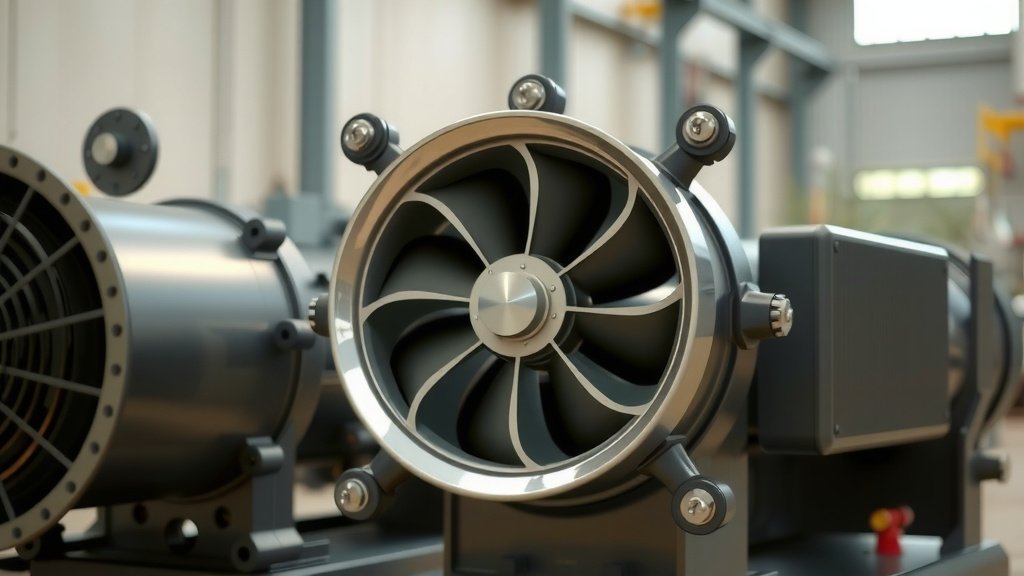
The impeller is the star of the show. It’s a rotating component, often looking like a fan with many curved blades. When it spins at very high speeds, it grabs the air and slings it outwards. This outward motion is what gives the air its kinetic energy, or its speed. The faster the impeller spins, the more energy it imparts to the air.
The Diffuser: Turning Speed into Pressure
Once the air is flung outwards by the impeller, it enters the diffuser. This is a stationary part of the compressor. The diffuser is shaped to gradually slow down the fast-moving air. As the air slows, its kinetic energy is converted into potential energy in the form of increased pressure. Many experts describe this as a reverse nozzle, where expanding space causes slowing and pressure buildup (NASA).
The Volute or Collection Chamber: Gathering the Compressed Air
After passing through the diffuser, the compressed air is collected. This usually happens in a volute, which is a spiral-shaped casing. The volute guides the air towards the compressor’s outlet. It ensures that all the compressed air is channeled efficiently for use. This collection is a critical step to gather the pressurized air.
Step-by-Step: The Compression Cycle in Action
Let’s trace the journey of air as it moves through a centrifugal compressor. It’s a continuous flow, unlike the stop-and-start nature of some other compressor types.
Stage 1: Air Intake
It all begins with air being drawn into the compressor. This usually happens at the center of the impeller, also known as the “eye.” The intake is designed to allow a smooth, steady flow of ambient air into the machine.
Stage 2: Acceleration by the Impeller
As the impeller spins rapidly, its blades catch the incoming air. They accelerate the air particles outwards due to centrifugal force. Think of a spinning a bucket of water; the water gets pushed towards the sides. The air behaves similarly here, gaining significant speed and energy.
Stage 3: Diffusion and Pressure Increase
The high-speed air then enters the diffuser. The diffuser’s passages are designed to widen, creating a larger space for the air to occupy. This widening forces the air to decelerate. As the air slows down, its velocity energy is transformed into pressure energy. We found that this conversion is the primary method of compression in these units (U.S. Department of Energy).
Stage 4: Collection and Discharge
Finally, the now-pressurized air is gathered in the volute or collection chamber. From here, it’s directed to the compressor’s outlet. This is where you get your supply of compressed air ready for your tools or processes.
Understanding Multi-Stage Centrifugal Compressors
Sometimes, a single stage isn’t enough to achieve the desired pressure. For these applications, multiple stages are used. This is where the power and efficiency really ramp up.
How Multiple Stages Work Together
A multi-stage centrifugal compressor essentially has several sets of impellers and diffusers arranged in series. The air is compressed in the first stage, then passed to the second stage, where it’s compressed further. This process repeats for each stage, allowing for much higher discharge pressures than a single stage could achieve. Many industrial applications require these higher pressures.
The Benefit of Staging
Using multiple stages allows for more efficient compression at higher pressure ratios. It also helps manage the heat generated during compression. Each stage does a portion of the work, making the overall process more controlled and efficient for very demanding tasks. This staged approach is common in heavy industry.
Key Characteristics of Centrifugal Compressors
Centrifugal compressors have some distinct advantages that make them popular choices.
Smooth and Quiet Operation
Unlike some other compressor types that have a pulsating output, centrifugal compressors deliver a steady, continuous stream of air. This results in smoother operation and significantly less vibration and noise. You’ll often find them preferred in environments where noise is a concern.
High Airflow Capacity
These compressors are built to handle large volumes of air. They excel in applications where a constant, high flow rate is more important than extremely high pressure. Think of large factories or power plants needing massive amounts of air.
Low Maintenance Needs
Centrifugal compressors have fewer moving parts compared to positive displacement types. They also don’t have pistons or valves that wear out quickly. This typically means they require less maintenance over their lifespan. We found this to be a significant advantage for long-term operational costs (ASHRAE).
Quick Checklist for Centrifugal Compressor Function
To wrap it up, here’s a quick look at the key takeaways:
- Air enters the eye of the impeller.
- Impeller blades spin air to high velocity.
- Diffuser slows air, converting speed to pressure.
- Volute collects and directs compressed air.
- Multi-stage units add further compression levels.
- They offer continuous flow and low maintenance.
Conclusion
You’ve now seen how a centrifugal compressor uses a spinning impeller and a specially shaped diffuser to transform air speed into pressure. It’s a process of continuous flow, efficiently creating the compressed air your applications need. Remember, this type of compressor is ideal for high-volume, steady-state needs and offers a quiet, low-maintenance solution. If you’re looking for a reliable way to handle large air demands, understanding these principles can help you make the right choice for your operations.
Frequently Asked Questions
What is the main advantage of a centrifugal compressor over other types?
The primary advantage is their ability to handle very large volumes of air smoothly and continuously. Research has shown they also offer quieter operation and require less maintenance due to fewer moving parts compared to many positive displacement compressors. This makes them excellent for high-flow industrial settings.
Can a single centrifugal compressor achieve very high pressures?
While a single stage can generate some pressure, achieving extremely high pressures typically requires a multi-stage centrifugal compressor. By arranging multiple impeller-diffuser sets in series, each stage further compresses the air, allowing for significantly higher discharge pressures than a single unit could provide. We found this staged approach is common for demanding industrial tasks.
What happens if the air flow is too low for a centrifugal compressor?
Operating a centrifugal compressor at very low flow rates can cause issues like “surge.” This is an aerodynamic instability where air can actually reverse direction within the compressor. It’s important to operate these compressors within their designed flow range to maintain efficiency and avoid damage. Many manufacturers provide guidelines on this.
How does a centrifugal compressor manage heat during compression?
Heat is generated as air is compressed. Centrifugal compressors manage this through their design and by using multiple stages. In multi-stage units, the air can be cooled between stages, which increases overall efficiency and reduces the thermal stress on the equipment. We’ve seen that this intercooling is a common practice.
Are centrifugal compressors suitable for small workshops or home use?
Generally, no. Centrifugal compressors are designed for large-scale industrial applications due to their high airflow capacity and often larger physical size. For smaller workshops or home use, positive displacement compressors like piston or rotary screw types are usually more practical and cost-effective. Their smaller footprint and ability to deliver air on demand are better suited for these environments.