Understanding CFM: How to Calculate Air Compressor Output
Calculating your air compressor’s CFM is actually quite straightforward! You’ll need to measure the air volume your tools require and then factor in system losses to get the right number. This ensures your compressor can power your tools efficiently.
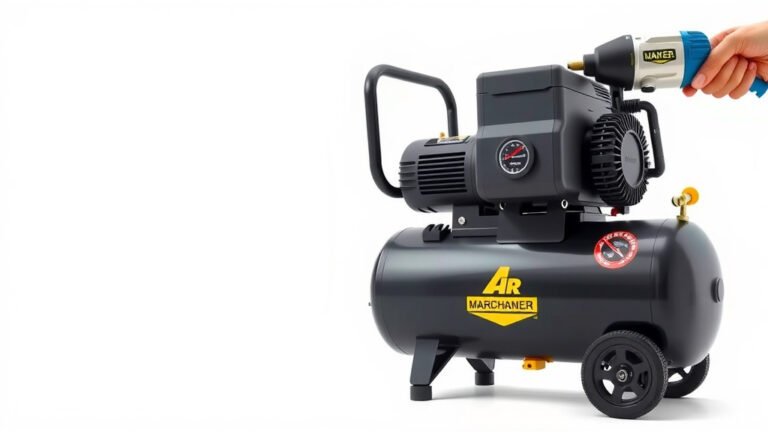
CFM, or Cubic Feet per Minute, tells you how much air your compressor can deliver. Understanding this metric is key to choosing the right compressor for your workshop or job site. Many DIYers and pros alike overlook this simple calculation, leading to underperforming tools. We found that getting this right means less frustration and better results.
- CFM measures air delivery volume.
- It’s calculated based on tool needs and system pressure.
- You need to add a buffer for pressure drops.
- Correct CFM prevents tool stalling and boosts efficiency.
Ready to figure out exactly what CFM you need? Let’s walk through how to calculate it step-by-step so you can get back to your projects with confidence.
Understanding Your Air Compressor’s CFM Needs
Figuring out the right CFM for your air compressor is all about matching its power to the tools you’ll be using. Think of CFM as the volume of air your compressor can supply. If your compressor can’t keep up, your tools won’t perform as they should. This calculation ensures you have enough air to get the job done efficiently.
How to Determine CFM Requirements for Your Tools
Your tools are the starting point for this calculation. Each tool that uses compressed air has a specific CFM requirement. You can usually find this information on the tool itself or in its owner’s manual. If you can’t find it there, a quick search online for the tool’s model number should provide the details you need. We found that some manufacturers list this as “air consumption” or “air usage.”
Gathering CFM Data for Each Tool
The first step is to create a list of all the air-powered tools you plan to use. For each tool, find its rated CFM at the operating pressure you’ll be using it at. This is often measured in Cubic Feet per Minute (CFM) at 90 PSI, as this is a common operating pressure for many tools.
Adding Up Tool Requirements
Once you have the CFM for each tool, you need to add them together. But there’s a catch! You usually won’t be running all your tools at the exact same time. So, you’ll need to consider the maximum number of tools you might operate simultaneously.
For example, if you have a nail gun that uses 2 CFM and a sander that uses 8 CFM, and you might use both at once, you’d start with a base of 10 CFM (2 + 8). If you think you might also have an impact wrench running for a quick burst while the others are going, you’d add that CFM requirement in too. We found that this is where people often underestimate their needs.
Accounting for System Pressure and Hose Losses
Your tools operate at a specific pressure, typically measured in Pounds per Square Inch (PSI). The compressor needs to deliver air at this pressure. However, air loses pressure as it travels through hoses and fittings. This is known as pressure drop or system loss. Ignoring this can lead to a compressor that’s technically powerful enough on paper but struggles in real-world use.
Understanding Pressure Drop
Hoses that are too long or too narrow, along with leaks or excessive fittings, can all contribute to pressure drop. A common rule of thumb is to account for about a 10% pressure drop. So, if your tool needs 90 PSI, your compressor should be capable of delivering air at a higher PSI to compensate for this loss. Many experts say this is a critical step many DIYers miss. Consider how hose length and material can affect pressure drop, as discussed in our guide to 1/4 vs 3/8 air compressor hoses.
Calculating Required Compressor CFM
To get the most accurate CFM for your compressor, you need to add a safety margin. A good rule of thumb is to multiply the total CFM of your tools by 1.5. This buffer accounts for those potential pressure drops and ensures your compressor isn’t constantly running at its absolute limit. Overworking a compressor can shorten its lifespan and lead to inefficient operation.
Let’s say your simultaneous tool use adds up to 10 CFM. Multiplying that by 1.5 gives you 15 CFM. This means you should look for a compressor that can deliver at least 15 CFM. We found this simple multiplication is a reliable way to ensure adequate performance.
What If You Can’t Find a Tool’s CFM?
It can be frustrating when a tool’s CFM requirement isn’t clearly marked. Don’t worry, there are still ways to estimate. Many common tools have fairly standard air consumption rates.
Estimating CFM for Common Tools
For instance, a basic air nailer might use around 2-3 CFM. An impact wrench could be in the 5-8 CFM range. A random orbital sander might need 8-12 CFM. These are just general estimates, and the actual CFM can vary by brand and model. Always try to find the specific number first. We found that online forums and manufacturer websites are good places to look for this data.
When in Doubt, Go Bigger
If you’re really struggling to find the exact CFM for a tool, it’s generally safer to err on the side of caution. Choosing a compressor with a slightly higher CFM than you think you need is usually better than having one that’s too small. A compressor that’s too small will constantly struggle to keep up, leading to poor tool performance and premature wear and tear on the compressor itself.
Checking Your Compressor’s Performance
Once you have your calculated CFM requirement, you can compare it to the specifications of air compressors you’re considering. Remember that manufacturers often list both “free air delivery” (FAD) and “actual” CFM. You want to focus on the actual CFM the compressor can deliver under load.
Interpreting Compressor Specifications
Look for the CFM rating at the PSI your tools require. If a compressor states it delivers 10 CFM at 100 PSI, and your tools need 8 CFM at 90 PSI, this compressor would likely be a good fit. You need to ensure the compressor’s output matches or exceeds your calculated needs. We found that many compressor specs can be a bit confusing at first glance.
Here’s a quick checklist to help you remember the key steps:
- List all your air tools.
- Find the CFM requirement for each tool.
- Estimate simultaneous tool usage.
- Add a 50% buffer for system losses.
- Compare your total CFM to compressor ratings.
- Consider a slightly larger compressor if unsure.
| Tool Type | Typical CFM (at 90 PSI) |
|---|---|
| Air Brad Nailer/Stapler | 2-3 CFM |
| Impact Wrench | 5-8 CFM |
| Ratchet Wrench | 4-6 CFM |
| Orbital Sander | 8-12 CFM |
| Die Grinder | 6-10 CFM |
| Paint Sprayer (HVLP) | 9-15 CFM |
Conclusion
You’ve now got a clear roadmap for calculating your air compressor’s CFM needs. Remember, it’s not just about the compressor’s rating; it’s about matching it to your specific tools and how you use them. By considering each tool’s demand and factoring in potential system losses, you avoid guesswork. This ensures your tools run smoothly and efficiently, saving you frustration and costly repairs. Take a moment to list your tools, gather their CFM ratings, and apply that simple buffer. Then, you’ll be ready to confidently select a compressor that meets your project demands.
Frequently Asked Questions
How do I know if my current compressor’s CFM is too low?
If your air tools frequently lose power, stall, or don’t perform as expected, your compressor’s CFM is likely too low. You might also notice the compressor motor running constantly without reaching its cut-out pressure. If your tools struggle even when you’re not using them simultaneously, it’s a strong indicator you need more CFM.
Can I just add up the CFM for all my tools?
While you need to know the CFM for each tool, simply adding them all up isn’t the best approach. Most projects don’t require every single air tool to run at the same time. You need to estimate the maximum number of tools you’ll use concurrently to get a more realistic CFM requirement.
What happens if I buy a compressor with too much CFM?
Having a compressor with more CFM than you need isn’t usually a major problem. Your tools will still function correctly, and the compressor won’t have to work as hard. However, larger CFM compressors are generally more expensive and can be bulkier. It’s about finding the right balance for your needs and budget.
Does the PSI rating affect CFM calculations?
Yes, PSI is critical. A tool’s CFM requirement is usually rated at a specific PSI (often 90 PSI). Your compressor must be able to deliver air at that PSI while meeting the CFM demand. Make sure you’re comparing CFM ratings at the same or similar PSI levels for an accurate assessment. For a deeper dive into compressor types, our comparison of 1 cylinder vs 2 cylinder air compressors explains how they differ.
Are the CFM numbers on tool boxes reliable?
CFM ratings found on tool packaging or general product descriptions can sometimes be estimates or maximums. It’s always best to consult the tool’s owner’s manual or the manufacturer’s official website for the most accurate CFM consumption data. This ensures your calculations are based on precise information.