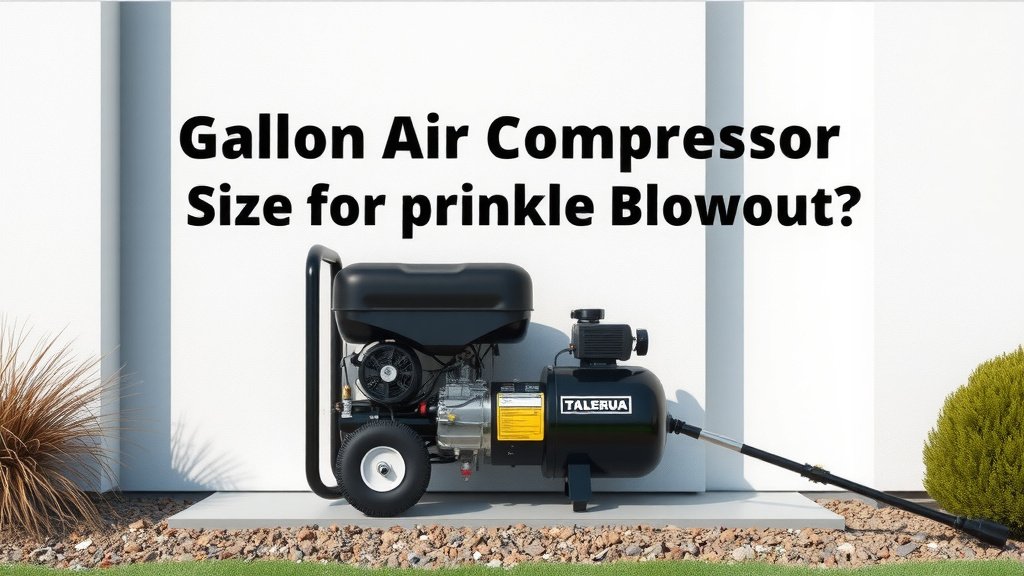
Gallon Air Compressor Size for Sprinkler Blowout
To properly blow out your sprinkler system, you’ll generally need an air compressor that can deliver at least Our guide to 1 gallon vs 2 gallon air compressors can help you decide.10-15 CFM (Cubic Feet per Minute) and maintain a pressure of 30-40 PSI. For larger or more complex systems, you might need a compressor with a higher CFM, closer to 20-30 CFM. This ensures you can move enough air volume to clear all the water without over-pressurizing your pipes.
Choosing the right air compressor size is key to preventing freeze damage to your irrigation system. It’s not just about the tank size, but more importantly, the air delivery rate (CFM). Many homeowners mistakenly think a small compressor will suffice, but we found this often leads to incomplete water removal and potential pipe bursts when winter hits. The right compressor makes winterizing your sprinklers a straightforward task.
- Most home sprinkler systems need 10-15 CFM.
- Larger systems may require 20-30 CFM.
- Pressure should be around 30-40 PSI.
- CFM is more important than tank size for blowing out sprinklers.
- Using the right compressor prevents costly freeze damage.
Let’s dive into how to pick the best air compressor for your specific sprinkler system and get it winter-ready!
Choosing the Right Air Compressor for Your Sprinkler System
Selecting the correct air compressor is like picking the right tool for a specific job. You need one that’s powerful enough to do the work effectively but not so powerful that it causes damage. For blowing out your sprinkler system, the primary factor is not the tank size, but rather the air delivery rate, measured in Cubic Feet per Minute (CFM). Think of CFM as the volume of air the compressor can push out. You want enough volume to move all the water out of your pipes.
We’ve found that most residential sprinkler systems require an air compressor that can deliver at least 10 to 15 CFM. This is the sweet spot for most standard systems. For larger or more elaborate irrigation setups, you might need to step up to a compressor capable of 20 to 30 CFM. This ensures you have enough air volume to push water through longer pipe runs or more zones.
Understanding CFM vs. Tank Size
Many people get tripped up by the tank size of an air compressor. While a larger tank can store more compressed air, it doesn’t necessarily mean it can deliver a continuous, high volume of air. For blowing out sprinklers, you need a steady stream of air. This is where CFM shines. A compressor with a lower CFM, even with a big tank, might run out of air before you finish a zone, leaving water behind.
Research indicates that a compressor with a higher CFM rating, even with a smaller tank, will generally perform better for this task. It can replenish the air needed more quickly. So, when you’re looking at specs, keep your eyes peeled for that CFM number first and foremost. It’s your best indicator of how well the compressor will perform for winterizing your sprinklers.
Key Air Compressor Specifications to Consider
Beyond CFM, there are other specifications that play a role in choosing the right air compressor for your sprinkler system. You want to make sure the compressor can handle the job without causing any harm. It’s about finding that balance between sufficient power and safe operation. Let’s break down what to look for.
CFM: The Most Important Metric
As we’ve discussed, CFM is king for blowing out sprinklers. You need enough air volume to effectively clear water from all the pipes. When you’re looking at compressors, you’ll often see two CFM ratings: one at 40 PSI and one at 90 PSI. For blowing out sprinklers, you’ll typically operate at a lower pressure, so the CFM rating at 40 PSI is often the more relevant number. Aim for that 10-15 CFM range as a starting point for most home systems.
PSI: Pressure Matters (But Less Than CFM)
PSI stands for Pounds per Square Inch, and it refers to the air pressure. While CFM is about air volume, PSI is about the force of that air. For sprinkler systems, you don’t want to use excessively high pressure, as this can damage your pipes and sprinkler heads. Most experts recommend operating between 30 and 40 PSI when blowing out your system. So, ensure the compressor you choose can maintain this pressure range. Many compressors will have a regulator to help you dial in the exact PSI.
Horsepower (HP) and Tank Size
Horsepower (HP) indicates the power of the motor driving the compressor. While important, it’s not the primary spec for this job. A higher HP generally correlates to a higher CFM output, but you should still verify the CFM rating. Tank size, as we touched on, is more about storing air. A larger tank might allow you to go a bit longer between the compressor cycling on, but it won’t compensate for a low CFM rating. For blowing out sprinklers, a tank size of 20 to 30 gallons is often sufficient, provided the CFM is adequate.
| System Type | Recommended CFM (@ 40 PSI) | Recommended Pressure (PSI) | Typical Tank Size (Gallons) |
|---|---|---|---|
| Small Residential (1-2 Zones) | 10-15 CFM | 30-40 PSI | 10-20 Gallons |
| Standard Residential (3-5 Zones) | 15-20 CFM | 30-40 PSI | 20-30 Gallons |
| Large/Complex Residential (6+ Zones) | 20-30 CFM | 30-40 PSI | 30+ Gallons |
How to Determine Your Sprinkler System’s Needs
Figuring out what your specific sprinkler system needs can seem a bit daunting, but it’s really about observing a few key things. You don’t need to be a plumbing engineer to get this right! Thinking about the size of your yard and the number of zones your system has will give you a good starting point. It’s about matching the tool to the task at hand.
Assessing Your Sprinkler System Size
Start by walking around your property and counting how many distinct watering zones your system has. Most systems have between 2 and 6 zones, but some larger properties might have more. The more zones you have, the more pipe there is to clear. Also, consider the size of your yard. A sprawling lawn will naturally have longer pipe runs than a small backyard. Longer pipes require more air volume to push the water through effectively. Many homeowners find that their system’s needs fall into the standard residential category.
When More CFM is Better
If you have a very large property with numerous zones, or if your sprinkler lines run a considerable distance, you’ll definitely want to lean towards a compressor with a higher CFM rating. Trying to get by with an underpowered unit can lead to incomplete water removal. This is a common mistake we’ve seen, and it can result in costly repairs when the water freezes and expands in the pipes. For these situations, a compressor in the 20-30 CFM range is a wise investment.
Operational Tips for a Successful Blowout
Once you have your air compressor, how you use it is just as important as having the right one. It’s not just about turning it on and pointing the hose. You want to be methodical and safe. Think of it like performing a delicate operation; precision and care make all the difference. We’ve compiled some practical tips to help you get the job done right.
Setting the Correct Pressure
This is absolutely critical! Always start by setting your compressor’s regulator to the recommended pressure, typically 30-40 PSI. You don’t want to exceed this. If your compressor only has a gauge for tank pressure, you’ll need an additional regulator or adapter with a gauge to control the output pressure. It’s worth investing in these accessories to protect your system. Always double-check the pressure before you connect to your sprinkler system’s blow-out port.
Working Zone by Zone
Never try to blow out the entire system at once. You’ll want to work one zone at a time. Connect the air compressor to the blow-out valve for that zone. Open the valve slightly and let the air run until you no longer see water spitting out of the sprinkler heads in that zone. Then, shut off the air, move to the next zone, and repeat the process. This methodical approach ensures you clear each section completely.
Listen and Watch for Water
As you’re blowing out a zone, pay attention to what’s happening at the sprinkler heads. Initially, you’ll see a lot of water. You want to continue until the spray from the heads is replaced by a steady stream of air, or just mist. If you hear a sputtering sound, it means there’s still water in the lines. Keep the air on until it’s clear. This attention to detail is what prevents freeze damage.
Final Checklist for Your Blowout
- Confirm your air compressor’s CFM rating meets your system’s needs.
- Verify you can set and maintain output pressure between 30-40 PSI.
- Locate your system’s blow-out port or valve.
- Securely attach the air hose to the blow-out port.
- Work through each zone systematically, clearing all water.
- Turn off water supply and drain any remaining water from the compressor tank.
Conclusion
You’ve learned that selecting the right air compressor is key to a successful sprinkler system blowout. Remember, CFM is king; focus on air delivery volume over tank size. Most home systems need 10-15 CFM, while larger ones benefit from 20-30 CFM, all while maintaining a safe 30-40 PSI. By matching your compressor to your system’s needs and following proper zone-by-zone procedures, you’ll effectively remove water and prevent costly freeze damage. Your next step is to assess your system and find the compressor that fits your needs to get winter-ready!
Frequently Asked Questions
Can I use my small pancake compressor to blow out my sprinklers?
While a small pancake compressor might seem convenient, research and experience show it often lacks the necessary CFM. You need a steady, high volume of air (10-15 CFM minimum) to effectively push water out. A compressor with insufficient CFM might leave water behind, risking freeze damage to your pipes.
How do I know if my sprinkler system is “large” or “complex”?
Your sprinkler system is likely considered large or complex if you have more than five or six distinct watering zones, or if your yard is particularly sprawling with long pipe runs. More zones and longer pipes require a greater volume of air to ensure all water is expelled efficiently. A compressor with 20-30 CFM is often recommended for these larger setups.
What happens if I use too much PSI when blowing out my sprinklers?
Using excessively high PSI can cause serious damage to your sprinkler system. It can lead to cracked pipes, blown-out sprinkler heads, or even damage to your backflow preventer. It’s vital to use a compressor regulator to maintain the recommended 30-40 PSI to protect your investment.
Is it okay to just blow air until the water stops sputtering, or do I need to see perfectly dry pipes?
You don’t need to achieve bone-dry pipes, but you do need to remove the vast majority of the water. Continue blowing air into a zone until the spray is reduced to a fine mist or just air. A sputtering sound indicates remaining water that could freeze and expand. Getting the water out as much as possible is the goal.
Can I rent an air compressor if I don’t own one?
Yes, renting an air compressor is a great option if you don’t plan on using one regularly. When renting, be sure to check the compressor’s CFM rating and ensure it meets the minimum requirements for your sprinkler system. Ask the rental company for assistance if you’re unsure about the specifications.