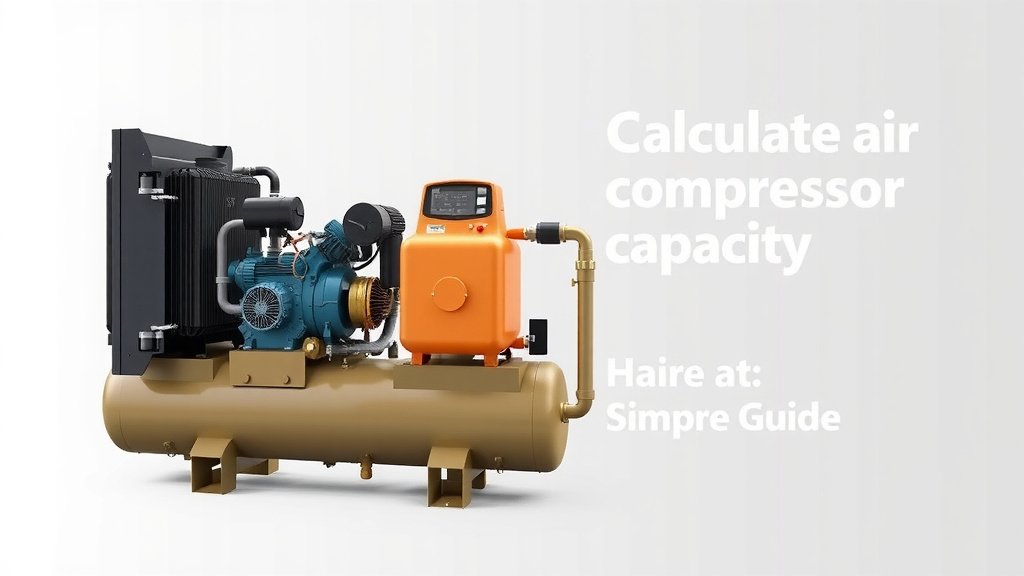
Calculate Air Compressor Capacity: A Simple Guide
Calculating your air compressor’s capacity is simpler than you think. You need to consider the CFM (Cubic Feet per Minute) your tools require and the duty cycle of your compressor. Meeting these needs ensures your tools run smoothly without issues.
Understanding your compressor’s capacity prevents costly mistakes. It helps you choose the right size for your specific jobs. This avoids overspending on a unit that’s too powerful or frustrating delays with one that’s too small. Proper sizing means efficient operation and longer tool life.
- Figure out the CFM needed by your tools.
- Check your air compressor’s CFM rating.
- Factor in the compressor’s duty cycle.
- Add a buffer for future needs.
- Choose a compressor that matches or exceeds your total CFM requirement.
Ready to make sure you’re not running on fumes? Let’s walk through exactly how to calculate your air compressor capacity step by step.
Figuring Out Your Air Compressor’s CFM Needs
So, how much air power do you actually need? It all comes down to the tools you use. Each tool has a specific air requirement. This is measured in CFM, which stands for Cubic Feet per Minute. Think of CFM as the amount of air your tool needs to work properly. Too little CFM, and your tools will sputter. Too much, and you might be wasting energy. The specific tools you use will dictate the CFM requirements.
What is CFM?
CFM is the standard way to measure airflow. It tells you how many cubic feet of air an air compressor can deliver in one minute. For example, a compressor rated at 5 CFM can supply 5 cubic feet of air every minute. Your tools will have their own CFM ratings listed in their manuals or on their casings.
Finding Tool CFM Requirements
Your tools are the best place to start. Most manufacturers clearly list the CFM needed by each tool. You can usually find this information in the owner’s manual. If you can’t find a manual, check the tool itself. Often, there’s a sticker or plate on the tool with its specifications. Online product pages are also a great resource.
Common Tool CFM Needs
Different tools have vastly different air demands. A simple air duster might only need 1-2 CFM. On the other hand, something like a sandblaster or a spray gun can easily use 10-20 CFM or even more. We found that impact wrenches and nail guns typically fall somewhere in the middle, often needing 4-8 CFM.
Gathering Your Tool List
Before you do anything else, make a list of all the pneumatic tools you plan to use with your air compressor. Don’t forget about future tools, either! It’s smart to think ahead. For each tool on your list, jot down its CFM requirement. This list is your foundation for calculating compressor capacity.
Calculating Total CFM Demand
Here’s where we add things up. To find your total CFM demand, you need to consider what tools you might use simultaneously. Will you be running two tools at once? If so, you’ll need to add their CFM requirements together. However, many experts suggest not assuming you’ll run all your tools at the exact same time. Think about your typical workday. What’s the most demanding combination of tools you’d likely use together?
For instance, if your most air-hungry tool needs 10 CFM and you sometimes use a smaller impact wrench that needs 4 CFM at the same time, your peak demand might be around 14 CFM. We found that simply adding up every tool’s CFM is often overkill. Focus on the most likely simultaneous usage.
Understanding Air Compressor Duty Cycle
Now, let’s talk about how long your compressor can run. This is where the duty cycle comes in. Air compressors aren’t designed to run non-stop forever. The duty cycle tells you how much time a compressor can operate within a given period before needing to cool down. This is super important for ensuring your compressor lasts and performs reliably.
What is Duty Cycle?
Duty cycle is usually expressed as a percentage. It’s the ratio of how long the compressor motor can run to the total time in a cycle. A common example is a 50% duty cycle. This means the compressor can run for 5 minutes out of every 10-minute period. It then needs to rest for the remaining 5 minutes to cool down.
We found that compressors often have duty cycles rated over a 10-minute period. So, a 75% duty cycle means it can run for 7.5 minutes and then needs to cool for 2.5 minutes. Some heavy-duty compressors can have higher ratings, even up to 100%. A 100% duty cycle means it can run continuously without needing a rest period. This is usually found in industrial-grade units.
Why Duty Cycle Matters for Your Needs
If your tools require a lot of CFM and you use them for extended periods, you need a compressor with a high duty cycle. Imagine needing 10 CFM for a long sanding job. If your compressor only has a 50% duty cycle, it will spend half its time cooling down. This means it can’t deliver that consistent 10 CFM for the entire duration. You’ll experience pauses and reduced performance. Many recommendations suggest that for continuous use, a 100% duty cycle compressor is ideal (Industrial Air). However, for intermittent use, a 50% or 75% duty cycle might be perfectly fine.
Matching Duty Cycle to Your Tasks
Think about how you’ll be using your tools. Are you doing quick tasks like inflating tires or using a nail gun for a few minutes at a time? Or are you planning longer, continuous jobs like painting a car or running a sander for an hour? For short, intermittent tasks, a lower duty cycle compressor might suffice. For longer, more demanding applications, you’ll want a compressor with a higher duty cycle or even a 100% rating.
Adding a Safety Buffer and Final Selection
Once you have your total CFM requirement and have considered the duty cycle, it’s time to select your compressor. But wait, there’s one more step! We recommend adding a buffer. This ensures your compressor isn’t constantly running at its absolute limit.
The Importance of a Safety Margin
Why add a buffer? Think of it like this: if your car’s engine is always redlining, it won’t last very long. The same applies to your air compressor. Running a compressor at 100% of its capacity puts a lot of strain on the motor and pump. It can lead to overheating and premature wear. Research indicates that operating a compressor at about 75-90% of its rated capacity is a good practice (Compressed Air Best Practices). This margin allows the compressor to breathe and operate more efficiently.
We suggest adding about 25% to your calculated CFM demand. So, if your tools collectively need 15 CFM, you’d aim for a compressor rated around 18-19 CFM (15 CFM * 1.25). This buffer is also great for future-proofing. You might buy a new, more powerful tool down the line.
Comparing Compressor Ratings
Now you’re ready to shop! Look for compressors that meet or exceed your calculated CFM requirement, including that safety buffer. You’ll see CFM ratings listed at different PSI (pounds per square inch) levels. Always check the CFM rating at the highest PSI your tools typically use. This is crucial because CFM output can drop as PSI increases.
For example, a compressor might be rated at 10 CFM at 40 PSI but only 7 CFM at 90 PSI. Make sure the CFM rating at your tool’s working pressure is sufficient. We found that many professional workshops opt for a compressor that is at least 1.5 to 2 times their highest tool requirement to ensure they have ample air supply.
Your Air Compressor Capacity Checklist
Let’s recap the key steps to ensure you get the right compressor:
- List all your pneumatic tools and their CFM needs.
- Estimate the maximum CFM you’ll need if running multiple tools at once.
- Determine the duty cycle required based on how long you use your tools.
- Add a 25% buffer to your total CFM requirement for safety and future use.
- Find a compressor with a CFM rating (at your tool’s working PSI) that meets or exceeds your buffered requirement.
- Consider the compressor’s duty cycle to ensure it can handle your task duration.
Conclusion
You’ve learned how to calculate your air compressor’s capacity by understanding tool CFM needs and compressor duty cycles. Remember to sum up your simultaneous tool demands and always add a 25% buffer for safety and future growth. This careful calculation ensures your tools perform at their best. It also helps extend the life of your air compressor. Now, you’re ready to confidently choose the right compressor for your workshop. Go ahead and make your next purchase with peace of mind!
Frequently Asked Questions
What happens if I buy an air compressor that’s too small?
If your compressor’s CFM rating is too low, your tools will likely perform poorly. You might experience them sputtering, cycling on and off unexpectedly, or not reaching their full power. This can be frustrating and can even damage your tools over time due to inconsistent air supply.
How do I find the CFM rating for an older tool I don’t have the manual for?
For older tools without manuals, check the tool itself for a data plate or sticker. If it’s not there, search online using the tool’s model number and manufacturer. Many older tool specifications are still available on enthusiast forums or manufacturer archives.
Is it ever okay to exceed the recommended duty cycle?
While you might be tempted, exceeding a compressor’s recommended duty cycle is generally not advised. Doing so can cause the motor to overheat, leading to premature wear and potential damage. It’s best to operate your compressor within its specified limits to ensure longevity and reliable performance.
Should I calculate CFM for every single tool I own, even ones I rarely use?
Focus on the tools you use most frequently or those that have the highest CFM demands. It’s more practical to calculate your peak simultaneous usage for your common tasks. If you only use a very specialized tool once a year, you might not need to factor its high CFM into your daily compressor choice.
What’s the difference between CFM at 40 PSI and CFM at 90 PSI?
A compressor’s ability to deliver air (CFM) typically decreases as the pressure (PSI) it’s working against increases. A rating at 90 PSI is usually lower than the rating at 40 PSI because the compressor has to work harder to maintain the higher pressure. Always check the CFM rating at the highest PSI your tools operate at for an accurate comparison.