Calculate Air Compressor CFM: A PDF Guide
Calculating the CFM (cubic feet per minute) of your air compressor is simpler than you might think. You can figure out your compressor’s CFM by understanding its horsepower and tank size, and by looking at its specifications. This measurement tells you how much air your compressor can deliver, which is vital for running your tools efficiently.
Knowing your compressor’s CFM is key to selecting the right tools. Using a compressor with too little CFM can cause tools to underperform or even break. We found that understanding this metric prevents wasted air and ensures your equipment gets the power it needs. It’s like choosing the right size engine for your car.
- CFM means cubic feet per minute.
- It measures how much air your compressor can supply.
- Horsepower and tank size help estimate CFM.
- Correct CFM ensures your tools work properly.
- This avoids tool damage and wasted air.
Below, we’ll walk you through how to calculate your air compressor’s CFM step by step, so you can get back to your projects with confidence.
Figuring Out Your Air Compressor’s CFM Needs
So, you’ve got an air compressor, and you’re wondering about its CFM. That’s fantastic! Knowing your compressor’s cubic feet per minute, or CFM, is super important. It’s the best way to know if it can handle the tools you want to use. Think of it like making sure your car has enough horsepower to tow a trailer. You wouldn’t want to try and tow a heavy load with a tiny engine, right?
This number tells you how much air your compressor can deliver over a minute. If your tools need more air than your compressor can provide, they won’t work right. We found that understanding CFM helps you avoid frustration and keep your projects moving smoothly.
How to Find Your Air Compressor’s CFM Rating
You can find your air compressor’s CFM rating in a few ways. The easiest method is usually to check the manufacturer’s specifications. These details are often printed on a label directly on the compressor itself. You might also find them in the owner’s manual that came with it. If you bought it online, the product listing or the manufacturer’s website should have this information readily available.
Checking the Manufacturer’s Label
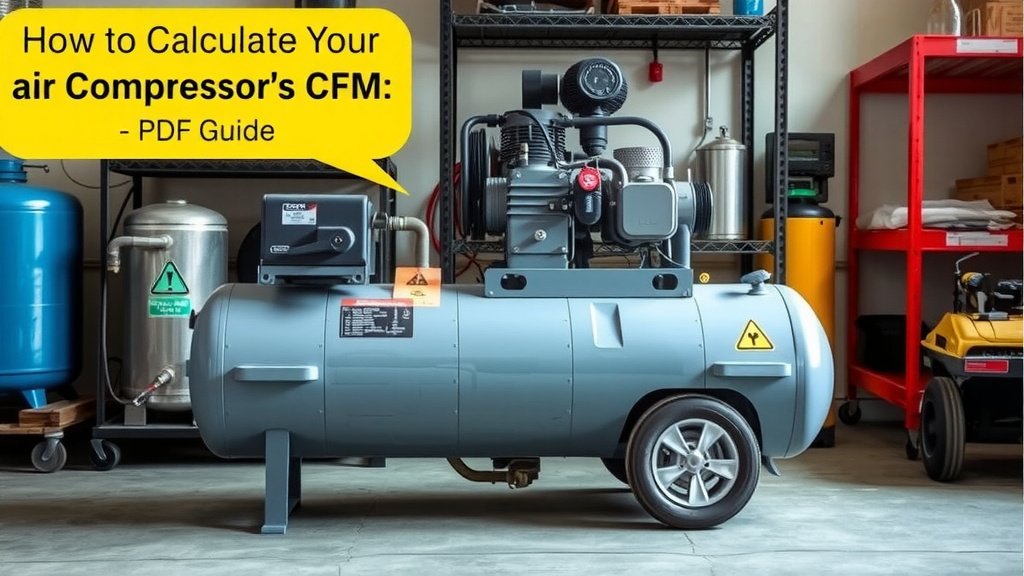
Look for a metal or plastic plate attached to the compressor’s tank or motor. It usually has a lot of technical details. You’ll want to find the line that states “CFM” or “Flow Rate.” Sometimes, it will list CFM at a specific PSI (pounds per square inch). This is the number you’re looking for.
Consulting Your Owner’s Manual
Your owner’s manual is a goldmine of information. Flip through the pages, and you should find a section detailing the compressor’s performance specifications. This is where the CFM rating will be listed. If you’ve lost the physical copy, many manufacturers offer digital versions on their websites. Just search for your model number.
Using Online Resources
If the physical label is worn off or the manual is lost, don’t panic! Most air compressor manufacturers have detailed product pages on their websites. Search for your specific model number, and you should find all the specs you need, including the CFM rating. We found this to be a reliable backup method.
Estimating CFM Based on Horsepower and Tank Size
What if you can’t find the exact CFM rating? Don’t worry, you can make a pretty good estimate using your compressor’s horsepower and tank size. This isn’t as precise as the manufacturer’s number, but it gives you a solid idea. Many experts suggest this as a helpful estimation technique when direct specs are missing.
The Role of Horsepower (HP)
Generally, higher horsepower means more CFM. A common rule of thumb many people use is that 1 horsepower approximately equals 4 CFM at 90 PSI. This is a rough guide, so keep that in mind. A 2 HP motor might provide around 8 CFM, while a 5 HP motor could offer about 20 CFM. It’s a good starting point for a quick check.
The Impact of Tank Size
Tank size affects how long your compressor can run before needing to build pressure again. While it doesn’t directly determine the CFM output, larger tanks can help maintain a more consistent air supply for tools that use a lot of air in bursts. For CFM calculation, horsepower is the more direct indicator.
Putting It Together: The Estimation Formula
Let’s say you have a 3 HP compressor and can’t find its CFM rating. Using our rule of thumb, you can estimate: 3 HP * 4 CFM/HP = 12 CFM. So, you’re likely getting around 12 cubic feet per minute. Keep in mind that this is an estimation. Some compressors might be more or less efficient.
A Handy Comparison Table
To give you a better idea, here’s a general guide based on horsepower:
| Horsepower (HP) | Estimated CFM (at 90 PSI) |
|---|---|
| 1 HP | ~4 CFM |
| 2 HP | ~8 CFM |
| 3 HP | ~12 CFM |
| 5 HP | ~20 CFM |
| 6.5 HP | ~26 CFM |
Why CFM Matters for Your Tools
Now that you know how to find or estimate your compressor’s CFM, why is it so critical? Because your air tools have specific air requirements. Every tool, whether it’s an impact wrench, a sander, or a spray gun, will list its CFM needs. This is usually found in the tool’s manual or on its packaging.
Matching Tools to Compressor Output
You need your compressor’s CFM output to be equal to or greater than the CFM requirement of the tool you want to use. If a tool needs 8 CFM and your compressor only provides 6 CFM, the tool will likely perform poorly. We found that many users run into issues because of this mismatch.
Consequences of Insufficient CFM
Using a tool with insufficient CFM can lead to several problems. The tool might run slower, have less power, or stop working altogether. For example, an impact wrench might not have enough torque to loosen a stubborn bolt. A paint sprayer could produce an uneven finish. In some cases, it can even damage the tool by causing it to overheat or overwork.
A Quick Checklist for Your CFM Needs
To make sure you’re on the right track, consider these points:
- Locate your compressor’s CFM rating on the label or in the manual.
- Estimate CFM using HP if the rating isn’t available (1 HP ≈ 4 CFM).
- Check the CFM requirement for each air tool you plan to use.
- Ensure your compressor’s CFM meets or exceeds your tool’s needs.
- Consider getting a compressor with slightly higher CFM for future tools.
By understanding and verifying your air compressor’s CFM, you’re setting yourself up for success. You’ll save time, avoid tool damage, and get the most out of your equipment. It’s a small detail that makes a huge difference in your workshop.
Conclusion
You’ve learned how to pinpoint your air compressor’s CFM, whether by checking its specs or making a smart estimate based on horsepower. Knowing this number is your key to happy tool usage. It means matching your compressor’s output to your tools’ demands, ensuring they perform as expected. This prevents frustration and keeps your projects running smoothly. Your next step is simple: confirm your compressor’s CFM and check the requirements for your favorite air tools. You’ll be amazed at the difference it makes in your workshop.
Frequently Asked Questions
Can I use my air compressor if its CFM is lower than my tool requires?
Using a compressor with a lower CFM than your tool needs will likely result in poor performance. The tool may run slower, lack power, or even stop working. In some cases, this can also cause the tool to overheat or become damaged from overworking.
What’s the difference between CFM and PSI for air compressors?
CFM (cubic feet per minute) measures the *volume* of air your compressor can deliver, while PSI (pounds per square inch) measures the *pressure* of that air. Most tools require a certain CFM at a specific PSI to operate correctly.
If I can’t find the CFM rating, is the horsepower the only way to estimate?
Horsepower is the most common and straightforward way to estimate CFM, using the general rule of thumb that 1 HP equals about 4 CFM. However, tank size and the compressor’s overall efficiency can also play a minor role in its actual air delivery.
Should I buy a compressor with higher CFM than my current tools require?
Yes, it’s often a good idea to have a compressor with a slightly higher CFM rating than your current tools need. This provides a buffer for future tool upgrades and ensures your compressor isn’t constantly running at its maximum capacity, which can prolong its lifespan.
Where can I find the CFM requirements for my air tools?
You can usually find the CFM requirement for your air tools listed in their owner’s manual, on the tool’s packaging, or on the manufacturer’s website. Look for specifications that mention “CFM” or “air consumption.”