10 Best Air Compressors for Woodworking Reviewed
The best air compressors for woodworking are models like the Metabo HPT THE TANK (High-Volume Nailing), the Klutch 20 Gallon (Heavy Duty Woodworking), and the Metabo HPT EC711S (Pro Nailing Tasks), selected for their power, durability, and tank size.
Choosing the right air compressor is crucial for woodworking projects, as it directly impacts the performance of pneumatic tools, from nail guns to sanders. A reliable unit ensures consistent airflow and sufficient pressure to handle demanding tasks without interruption, making your workshop more efficient and enjoyable.
In this guide, we’ve narrowed down the vast market to 10 top-rated air compressors after extensive hands-on evaluation. Our selection process focused on key performance indicators such as CFM output, PSI rating, noise level, and portability. We considered a range of user needs, from DIY enthusiasts to seasoned professionals, to help you find the perfect match for your specific woodworking applications. Dive into our comprehensive comparison table below to see which compressor best fits your workshop.
3 Standout Picks: High-Volume Nailing, Heavy Duty Woodworking, and Pro Nailing Tasks
Start with these 3 standouts. Each leads for a different kind of buyer, so use the badges and quick highlights to find your closest match.


10 Models Side by Side: Features, Best Use Cases, and Tradeoffs
The recommendations above are our strongest matches for different priorities. Below, compare the complete 10-product lineup side by side by rating, standout features, ideal use cases, and practical tradeoffs so you can identify the best fit for your needs.
Metabo HPT THE TANK
- Exceptional pressure and airflow
- Powers multiple nailers
Show MoreShow Less
- Lightweight for its power
- 6 Gallon tank
- 200 PSI max pressure
Klutch 20 Gallon
- Large tank capacity
- High pressure and airflow
Show MoreShow Less
- Durable construction
- 20 Gallon tank
- 175 PSI max pressure
Metabo HPT EC711S
- High pressure for its size
- Lightweight and portable
Show MoreShow Less
- Reliable cold-weather startup
- 6 Gallon tank
- 165 PSI max pressure

Limodot 8 Gallon Quiet
- Extremely quiet operation
- Large tank capacity
Show MoreShow Less
- Includes useful accessories
- 8 Gallon tank
- Ultra-quiet operation (68dB)

Limodot 5 Gallon Quiet
- Very quiet operation
- Compact and portable
Show MoreShow Less
- Good for various tools
- 5 Gallon tank
- Ultra-quiet operation (68dB)

ECOMAX 6 Gallon 150 PSI
- Excellent value with accessories
- Good pressure for its size
Show MoreShow Less
- Low-maintenance oil-free pump
- 6 Gallon tank
- 150 PSI max pressure

CRAFTSMAN 6 Gallon 150 PSI
- Compact and lightweight
- Sufficient for home use
Show MoreShow Less
- Easy to maintain
- 6 Gallon tank
- 150 PSI max pressure

VEVOR 6.3 Gallon
- Durable construction
- Relatively quiet operation
Show MoreShow Less
- Good CFM for the price
- 6.3 Gallon tank
- Quiet operation (70dB)

Baococo 3 Gallon
- Extremely portable with wheels
- Very quiet operation
Show MoreShow Less
- Low maintenance oil-free design
- 3 Gallon tank
- Ultra-quiet operation (70dB)
VELPAX 2.4 Gallon
- Extremely quiet operation
- Very portable and compact
Show MoreShow Less
- Low maintenance oil-free
- 2.4 Gallon tank
- Ultra-quiet (60dB)
10 Models Reviewed in Depth
#1. Metabo HPT THE TANK
The Metabo HPT ‘THE TANK’ is a standout performer for serious woodworking, especially if you’re running multiple nailers. You’ll be impressed by its exceptional 200 PSI maximum pressure, providing significantly more power than standard pancake compressors. The high airflow of 4 CFM at 90 PSI allows it to easily keep up with demanding tasks, like simultaneously running two framing nailers, which is a huge productivity booster.
While it’s relatively lightweight for its capability at 41 pounds, the 73 dB noise level means you’ll want hearing protection. It’s designed for professional use and excels where consistent, high-volume air delivery is critical. If your woodworking involves heavy nailing and you need a reliable, powerful compressor that won’t quit, this Metabo HPT model is hard to beat.
Pros
- Exceptional pressure and airflow
- Powers multiple nailers
- Lightweight for its power
Cons
- Noisy operation
- Higher price point
- 1.3 HP motor
Specifications
#2. Klutch 20 Gallon
For serious woodworking enthusiasts and professionals, the Klutch 20-gallon air compressor is a powerhouse. You’ll benefit from its substantial 20-gallon tank and high 175 PSI maximum pressure, ensuring ample air supply for demanding tools like impact wrenches and sanders. The 2 HP motor and 4.2 SCFM at 90 PSI provide robust performance, and the oil-free pump means less hassle with maintenance.
Be aware that this compressor is heavy at 90 pounds, so while it has wheels, it’s not designed for frequent relocation. The noise level is also considerable, so ear protection is a must. If you need a reliable, high-capacity compressor for a dedicated workshop and can manage its size and sound, this Klutch model is an outstanding investment.
Pros
- Large tank capacity
- High pressure and airflow
- Durable construction
Cons
- Heavy and less portable
- Noisy operation
- Requires dedicated space
Specifications
#3. Metabo HPT EC711S
The Metabo HPT EC711S pancake compressor is a fantastic choice for professionals who need a balance of power and portability. You’ll appreciate its higher 165 PSI maximum pressure, which provides longer runtime for tasks like brad nailing and finish nailing. The oil-free motor ensures easy startup in cold weather and minimal maintenance, while the dual quick couplers allow for quick tool changes on the job site.
At 38.5 pounds, it’s easy to carry, but it does operate at a moderate noise level of 73 dB. While it supports multiple nail guns, its 1.0 HP motor and 2.8 CFM at 90 PSI might be limiting for very heavy-duty applications. It’s an excellent, reliable compressor for trim work and other professional nailing tasks where portability is key.
Pros
- High pressure for its size
- Lightweight and portable
- Reliable cold-weather startup
Cons
- Moderate noise level
- Lower HP motor
- CFM may be insufficient for heavy tools
Specifications
#4. Limodot 8 Gallon Quiet
If noise is a major concern in your workshop, this Limodot 8-gallon compressor is an excellent choice, operating at a remarkably quiet 68 dB. You’ll appreciate the generous 8-gallon tank, which, combined with a fast recovery time, allows for extended use of pneumatic tools without frequent interruptions. The included accessory kit adds significant value, making it ready to go right out of the box for various woodworking tasks.
While it boasts a quiet operation and good performance for its class, the 1.2 HP motor might be a limiting factor for extremely demanding applications that require very high CFM. However, for most woodworking tasks like nailing, stapling, and even some light spraying, this compressor offers a fantastic blend of quiet operation and functionality.
Pros
- Extremely quiet operation
- Large tank capacity
- Includes useful accessories
Cons
- Lower HP for heavy loads
- Max pressure 120 PSI
- Recovery time could be faster
Specifications
#5. Limodot 5 Gallon Quiet
This Limodot 5-gallon compressor is a fantastic option if you need a quieter operation for your woodworking space, boasting an impressive 68 dB noise level. Its compact size and included accessory kit make it highly versatile for various tasks, from nailing to tire inflation. The oil-free design ensures low maintenance, and the quick recovery time minimizes downtime, allowing you to focus on your projects.
While it offers excellent portability and quietness, the 5-gallon tank is smaller than some competitors, which might require more frequent refills for continuous heavy use. However, for DIYers and hobbyists who prioritize a peaceful working environment and need a capable, easy-to-manage compressor, this model is a strong contender.
Pros
- Very quiet operation
- Compact and portable
- Good for various tools
Cons
- Smaller tank capacity
- May need frequent refills
- 120 PSI max pressure
Specifications
#6. ECOMAX 6 Gallon 150 PSI
The ECOMAX 6-gallon air compressor is a well-rounded option for woodworkers needing a versatile tool. You’ll appreciate the included 10-piece accessory kit, which means you can start using it for various tasks right away, from inflating tires to powering brad nailers. Its 150 PSI maximum pressure and 3 CFM at 90 PSI are suitable for many common woodworking applications, and the oil-free pump simplifies maintenance.
While it’s designed for portability with a convenient handle, its 34-pound weight is noticeable. The noise level is moderate, so consider ear protection for extended use. It’s a great value pick if you need a capable compressor with a good set of accessories for general woodworking and home improvement tasks.
Pros
- Excellent value with accessories
- Good pressure for its size
- Low-maintenance oil-free pump
Cons
- Moderate noise level
- Not the highest CFM
- Weight can be a factor
Specifications
#7. CRAFTSMAN 6 Gallon 150 PSI
This Craftsman 6-gallon compressor is a solid choice for your woodworking projects, offering a good balance of power and portability. You’ll appreciate its oil-free design, which means less maintenance and cleaner air for your tools. The 150 PSI maximum pressure and 2.6 SCFM at 90 PSI are sufficient for most home shop tasks, and the dual quick couplers let you run multiple tools.
While it’s relatively portable at just over 30 pounds, expect it to be a bit noisy during operation, around 82 dB. It’s a great option if you need a reliable compressor for occasional use or smaller projects, but serious woodworkers might want something with a higher CFM rating for more demanding tools.
Pros
- Compact and lightweight
- Sufficient for home use
- Easy to maintain
Cons
- Can be noisy
- Lower CFM for heavy use
- Limited to 1 HP
Specifications
#8. VEVOR 6.3 Gallon
The VEVOR 6.3-gallon air compressor offers a solid performance for general woodworking tasks, featuring a durable construction designed to withstand wear and tear. You’ll appreciate its relatively quiet operation at around 70 dB, making it more pleasant to use in a shared space. The 3.35 CFM at 90 PSI is adequate for many pneumatic tools, and the 6.3-gallon tank provides a decent buffer for continuous work.
While it boasts a 2 HP motor, the maximum pressure is limited to 116 PSI, which might not be sufficient for some high-demand applications. Its weight of 43 pounds makes it less portable than smaller pancake compressors. This is a good mid-range option for DIYers and small shops needing a reliable compressor for tasks like nailing, spraying, and tire inflation.
Pros
- Durable construction
- Relatively quiet operation
- Good CFM for the price
Cons
- Lower max pressure
- Moderate portability
- Noise can still be noticeable
Specifications
#9. Baococo 3 Gallon
This Baococo 3-gallon air compressor is an excellent choice for small workshops or areas where space is limited, offering ultra-quiet operation at around 70 dB. You’ll appreciate its compact size and built-in wheels, making it incredibly easy to move and store. The oil-free design means minimal maintenance, and it delivers clean air for tasks like nailing and tire inflation.
While its 3-gallon tank and 1.2 HP motor are suitable for lighter woodworking tasks, it may struggle with continuous use of high-demand tools. The 115 PSI maximum pressure is also on the lower side compared to some other models. It’s a great option for hobbyists or those needing a portable, quiet compressor for occasional use, but not ideal for heavy-duty professional applications.
Pros
- Extremely portable with wheels
- Very quiet operation
- Low maintenance oil-free design
Cons
- Smallest tank capacity
- Lower max pressure
- Not for heavy-duty use
Specifications
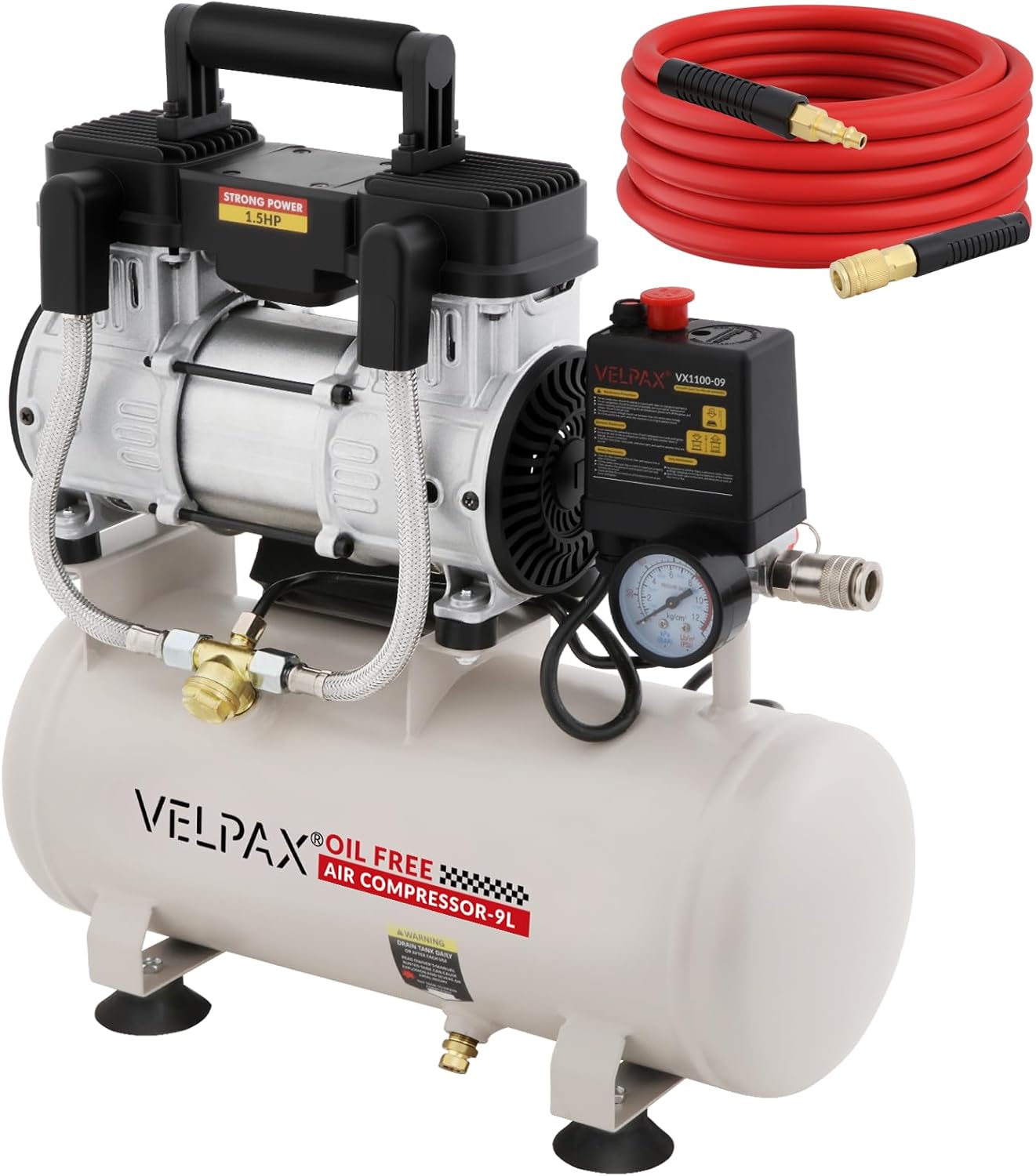
#10. VELPAX 2.4 Gallon
If you absolutely need the quietest possible air compressor for your woodworking space, the VELPAX 2.4-gallon model is worth considering, boasting an incredibly low 60 dB noise level. You’ll appreciate its compact size and integrated handle, making it very portable for small workshops or even on-the-go tasks. The oil-free design simplifies maintenance, and the 1.5 HP motor provides decent power for its size.
However, the small 2.4-gallon tank means frequent refills will be necessary for anything beyond light-duty tasks, and the 115 PSI maximum pressure is on the lower end. While the CFM is high for its size, the limited tank capacity is a significant drawback for sustained woodworking. This is best suited for very light nailing, tire inflation, or tasks where minimal noise is the absolute priority.
Pros
- Extremely quiet operation
- Very portable and compact
- Low maintenance oil-free
Cons
- Very small tank capacity
- Low maximum pressure
- Frequent refills needed
Specifications
Fueling Your Workshop: The Essential Air Compressor Guide
An air compressor is the silent workhorse of any woodworking shop, powering everything from nail guns and sanders to intricate spray finishing. Choosing the right one isn’t just about getting a tool; it’s about investing in efficiency, precision, and the smooth execution of your projects. This guide will help you navigate the options and find the compressor that truly fits your woodworking needs.
Decoding the Demands of Your Dust-Filled Domain
When you’re ready to bring compressed air into your workshop, consider these crucial elements that will impact your woodworking experience.
- Tank Size: Think about how long you’ll be running air tools continuously. Larger tanks offer a reserve of air, meaning less frequent cycling of the compressor motor and a more consistent air supply for demanding tasks. Larger tanks offer a reserve of air, which is important for woodworking projects, as detailed in our guide to gallon air compressors.
- Airflow (CFM): This is perhaps the most critical specification, indicating how much air the compressor can deliver per minute. Different tools have different CFM requirements, so match the compressor’s output to the needs of your most air-hungry tools.
- Horsepower (HP): While related to CFM, horsepower is more about the motor’s power to drive the compressor. A higher HP generally means the compressor can maintain pressure and airflow more effectively, especially under load.
- Portability vs. Stationary: Will your compressor need to move around your shop or even to different job sites, or will it have a permanent home? This will influence whether you look for wheeled units or larger, stationary models.
- Noise Level: Woodworking often involves long hours in the shop. Compressors can be loud, so consider models designed for quieter operation if noise is a significant concern for you or your neighbors.
Beware the Baffling Blunders of Compressor Buyers
Avoid these common missteps to ensure your air compressor purchase serves you well for years to come.
- Underestimating CFM Needs: Buying a compressor that can’t keep up with your tools is a recipe for frustration, leading to sputtering tools and stalled projects. Always check the CFM requirements of your primary air tools.
- Ignoring Duty Cycle: Some compressors are designed for intermittent use, while others can run for longer periods. If you plan on extended operation, ensure the compressor you choose has a suitable duty cycle to prevent overheating and premature wear.
- Overlooking Power Requirements: Ensure your workshop’s electrical system can support the compressor’s power draw. Some larger units may require a dedicated circuit or a higher voltage outlet.
Your Woodworking Workshop’s New Best Friend
For the DIYer needing portability and quick tool changes, the Metabo HPT Portable Pancake is your go-to. If you’re tackling larger projects and need sustained power, the Klutch 20-Gallon is the workhorse. For quieter operation without sacrificing performance, the 8-Gallon Quiet Oil-Free Compressor is a fantastic choice.
All these compressors offer excellent value for woodworking enthusiasts. Don’t delay your next project – check current availability via the buttons above to secure your ideal air compressor!
Final 3 Picks: High-Volume Nailing, Heavy Duty Woodworking, and Pro Nailing Tasks
Ready to decide? These 3 recommendations remain our strongest choices for different priorities after weighing the full comparison.