How Many Watts Does Your Air Compressor Need
The wattage an air compressor needs depends entirely on the tool you’re powering. For most DIY jobs, like inflating tires or using small nail guns, a compressor between 1 to 6 horsepower (HP) is usually enough. Higher HP models are needed for more demanding tasks like powering impact wrenches or spray painting.
Understanding compressor power is key to avoiding frustration. Too little power, and your tools will sputter. Too much, and you’re wasting electricity and money. We found that matching your compressor’s output, measured in HP and CFM, to your tools’ requirements is essential for efficient operation. Many experts agree that a little upfront research saves a lot of headaches later.
- Compressor wattage depends on the tool you use.
- 1-6 HP is common for DIY tasks.
- Higher HP is needed for heavy-duty jobs.
- Match compressor output to tool requirements for best results.
- This prevents tool sputtering or wasted energy.
Below, we’ll break down the different factors that determine how much power your air compressor needs so you can make the right choice for your projects.
How Much Power Does Your Air Compressor Need?
Choosing the right air compressor isn’t just about its horsepower rating; it’s about matching its capabilities to the tools you plan to use. You don’t want a compressor that’s too weak to keep up, leaving your tools sputtering. Neither do you want one that’s overkill, wasting electricity and potentially damaging delicate tools. We found that understanding a few key metrics helps make this decision much clearer.
Understanding Air Compressor Power Metrics
Air compressors are usually rated in horsepower (HP), but that’s not the whole story. Other factors like CFM (cubic feet per minute) and PSI (pounds per square inch) are just as important. Think of it like buying a car: horsepower is exciting, but you also need to consider its fuel efficiency and towing capacity for your specific needs.
Horsepower (HP): The Raw Muscle
Horsepower indicates the motor’s power. A higher HP generally means a more powerful compressor. For most home garages and DIY projects, a compressor between 1 to 6 HP is usually sufficient. We found that smaller tasks often don’t need the brute force of a very high HP unit.
CFM: The Airflow Capacity
CFM measures how much air the compressor can deliver. This is arguably more important than HP for determining tool performance. Your tools have specific CFM requirements. If your compressor can’t meet that demand, the tool won’t function correctly. Many experts say to find a compressor with a CFM rating at least 1.5 times higher than your most demanding tool’s requirement. This buffer ensures smooth operation even under load.
PSI: The Pressure Push
PSI tells you how much force the air is delivered with. Most air tools operate within a specific PSI range. Your compressor needs to be able to reach and maintain that pressure. Most common compressors can deliver between 90 to 150 PSI, which covers a wide range of applications. Always check your tool’s manual for its optimal PSI range.
Matching Compressor Power to Your Tools
The best way to determine the wattage or power your air compressor needs is to look at the tools you intend to use. Different tools demand different amounts of air volume and pressure. We researched common tools and their typical requirements.
Low-Demand Tools (DIY & Hobbyist)
These are the everyday tools many homeowners and hobbyists use. They generally don’t consume a lot of air. You might use these for tasks like inflating tires, powering a small brad nailer for trim work, or using an air duster.
- Tire Inflators: Usually require very little air, often under 1 CFM and 50 PSI.
- Brad Nailers/Staplers: Typically need 1-2 CFM at 70-90 PSI.
- Air Dusters/Blow Guns: Demand can vary but is usually under 2 CFM.
For these tools, we found that a portable compressor with a 1 to 3 HP motor, a small tank (2-6 gallons), and a CFM output of around 3-5 CFM at 90 PSI is often more than enough. These are generally more affordable and easier to move around.
Medium-Demand Tools (General Workshop & Automotive)
If you’re working on more involved projects, like auto repair or using more robust woodworking tools, you’ll need a compressor with a bit more oomph. These tools use air more rapidly and may require higher pressure.
- Impact Wrenches: Can require 4-6 CFM at 90 PSI.
- Ratchet Wrenches: Usually need 3-5 CFM at 90 PSI.
- Chipping Hammers/Sanders: Might need 5-7 CFM at 90 PSI.
- Grease Guns: Typically require 2-3 CFM at 90 PSI.
For this category, you’ll want to look at compressors in the 3 to 6 HP range. Tank sizes often jump to 20-60 gallons, providing a larger air reserve. Aim for a CFM rating of at least 8-12 CFM at 90 PSI. We found that this level of power prevents the compressor from constantly cycling, making your work more efficient.
High-Demand Tools (Professional & Industrial)
Professionals and serious enthusiasts tackling demanding jobs need serious air power. This includes tasks like spray painting, running multiple tools simultaneously, or operating large sanders.
- Spray Guns (HVLP): Can need 8-12 CFM at 40-60 PSI.
- Sandblasters: Might require 10-20+ CFM at 90 PSI.
- Large Grinders: Can demand 8-10+ CFM at 90 PSI.
- Multiple Tools Running: Requires summing the CFM needs of all tools in use.
For these applications, you’re looking at larger stationary compressors, often 5 HP and above, with tank sizes of 60 gallons or more. The CFM output needs to be significantly higher, often 15-25+ CFM at 90 PSI. We found that professionals often opt for two-stage compressors, which are more efficient for continuous high-volume air delivery.
What About the Actual Wattage?
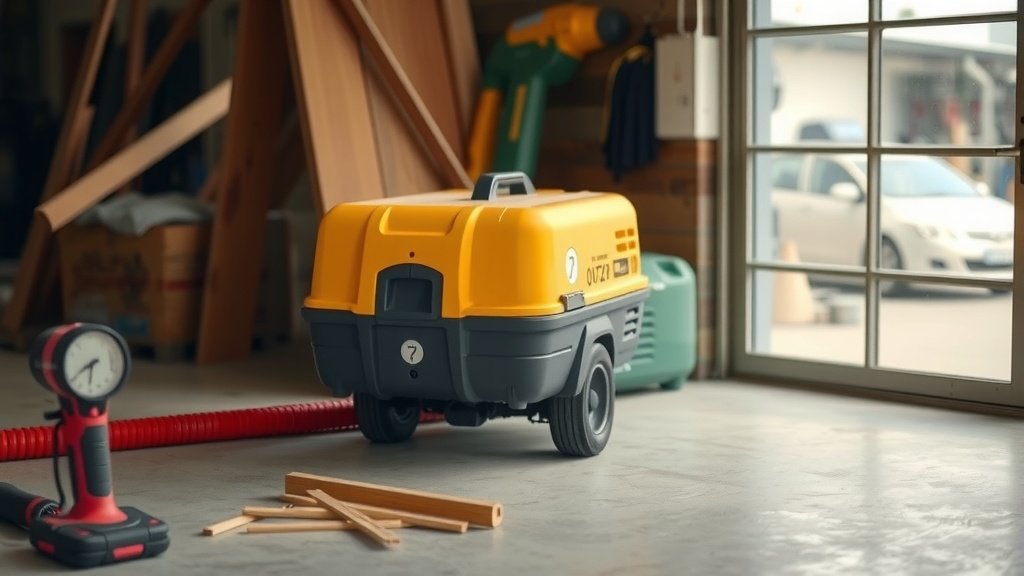
While HP and CFM are the primary indicators for choosing a compressor for your tools, you might still be curious about the electrical draw (watts). The actual wattage an air compressor uses can vary greatly depending on its HP, efficiency, and how hard it’s working. A general rule of thumb is that 1 HP is roughly equivalent to 746 watts.
However, this is a simplification. A 3 HP compressor might draw anywhere from 1,500 to 2,500 watts, especially when the motor first starts up. The surge wattage during startup can be significantly higher than the running wattage. We found that checking the manufacturer’s specifications for both running and startup wattage is the most accurate way to understand its electrical demand. This is important if you’re concerned about your circuit breaker capacity or electricity bills.
| Application Type | Typical HP Range | Typical CFM @ 90 PSI | Common Tank Size (Gallons) |
|---|---|---|---|
| Light DIY (Tires, small nailer) | 1-3 HP | 3-5 CFM | 2-6 |
| General Workshop/Auto (Impact wrench, sander) | 3-6 HP | 8-12 CFM | 20-60 |
| Heavy-Duty/Professional (Spray painting, sandblasting) | 5+ HP | 15-25+ CFM | 60+ |
Making the Right Choice: A Quick Checklist
To make sure you’re getting the right compressor, consider these points:
- List all the air tools you plan to use.
- Check the CFM and PSI requirements for each tool.
- Identify the tool with the highest CFM demand.
- Choose a compressor with a CFM rating 1.5x higher than that tool.
- Ensure the compressor can meet or exceed the tool’s PSI needs.
- Consider the tank size – larger tanks provide more air reserve.
Conclusion
You’ve learned that the “wattage” of an air compressor is best understood by its horsepower (HP), CFM, and PSI. Matching these specs to your tools is the real key to success. Don’t just guess; check your tool’s requirements and aim for a compressor that provides a little extra CFM. This approach ensures your tools run smoothly without you needing to worry about wasted energy or frustration. Your next step? Make a list of your tools and their air needs, then confidently shop for a compressor that’s the perfect fit for your workshop or garage projects.
Frequently Asked Questions
What’s the difference between HP and watts for an air compressor?
Horsepower (HP) is a measure of the motor’s power output, while watts measure electrical power consumption. While you can roughly estimate watts from HP (1 HP ≈ 746 watts), it’s not a direct conversion. Your compressor’s actual wattage draw, especially startup surge, can vary. Always check the manufacturer’s specs for precise electrical needs.
Do I need a high-wattage compressor for just inflating tires?
Definitely not. Inflating tires is a low-demand task for an air compressor. You’ll only need a small, portable compressor, typically in the 1-3 HP range. These use much less wattage than larger models and are perfectly suited for simple jobs like topping off car or bike tires.
How can I tell if my compressor’s wattage is too low for a tool?
If your tool sputters, runs weakly, or stops working intermittently, your compressor likely isn’t providing enough air volume (CFM) or pressure (PSI). This often means the compressor is running at its maximum capacity and can’t keep up, which indirectly relates to its power output not meeting the tool’s demands.
Will a higher CFM compressor always use more watts?
Not necessarily directly. A higher CFM compressor is generally more powerful and likely has a higher HP motor, which will consume more watts when running. However, an efficient high-CFM compressor might use less wattage than an inefficient lower-CFM model struggling to meet demand. It’s about matching the tool’s needs to a compressor that can meet them efficiently.
What if my compressor’s wattage is too high for my home’s electrical outlet?
Most portable air compressors designed for home use will plug into a standard 15-amp or 20-amp household outlet. However, if you’re considering a large, stationary unit, or if your compressor has a very high HP rating, you’ll need to check its wattage and amperage draw against your circuit’s capacity. Some high-power compressors may require a dedicated 240V circuit.