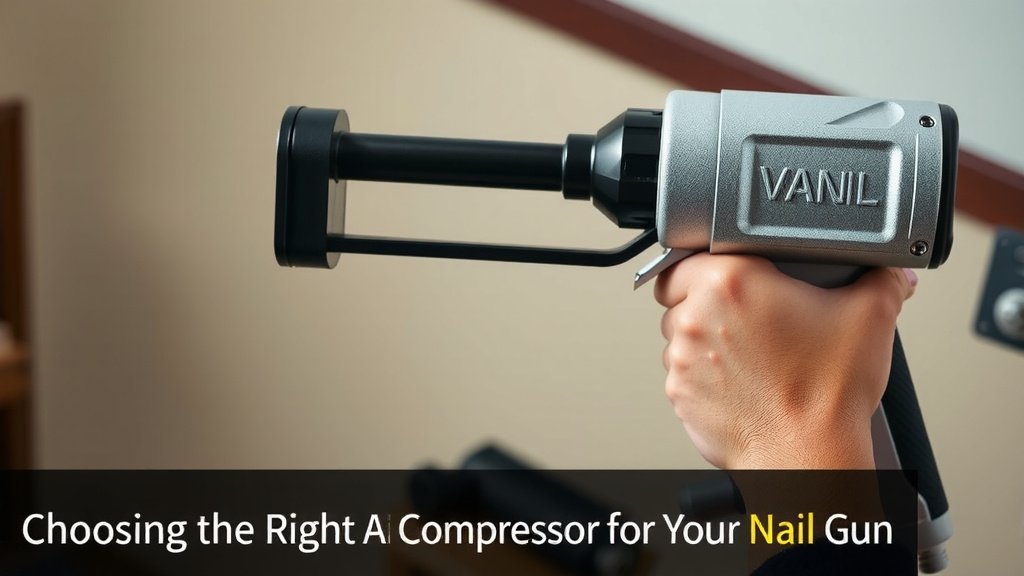
Choosing the Right Air Compressor for Your Nail Gun
When choosing an air compressor for your nail gun, look for one that delivers at least 2.5 CFM (Cubic Feet per Minute) at 90 PSI. This is usually enough for most common nail gun tasks. A compressor with a tank size of 6 gallons or more will also prevent frequent cycling, giving you a more consistent air supply. This ensures your nail gun fires reliably every time you pull the trigger.
The right air compressor is key to a frustration-free nailing experience. Too small, and your nail gun will sputter and struggle, especially during longer projects. Too big, and you might be dealing with unnecessary bulk and power. We found that matching compressor specs to your nail gun’s needs is essential for optimal performance and tool longevity.
- CFM at 90 PSI is the most important number.
- Aim for at least 2.5 CFM for most nail guns.
- A 6-gallon tank or larger is recommended for continuous use.
- Matching your compressor to your nail gun prevents issues.
Let’s break down exactly what you need to consider when selecting an air compressor for your nail gun, so you can get the job done right. Consider the air compressor hose size, as a larger diameter moves more air for better tool performance.
Choosing the Right Air Compressor for Your Nail Gun
Finding the perfect air compressor for your nail gun doesn’t have to be a puzzle. You want a tool that reliably powers your nailer, making your projects a breeze. This guide will help you understand the key specs and make the best choice for your needs.
Understanding Air Compressor Basics for Nail Guns
Air compressors are essentially air pumps. They store compressed air in a tank, ready to be released. This stored air is what powers your nail gun. Think of it like a portable air supply. The more air your compressor can provide, and the faster it can do it, the better your nail gun will perform.
What Does CFM Really Mean?
CFM stands for Cubic Feet per Minute. This is perhaps the most important specification when pairing an air compressor with a nail gun. It tells you how much air the compressor can deliver. More specifically, it’s measured at a certain pressure, usually 90 PSI (pounds per square inch).
Why 90 PSI? Most pneumatic nail guns operate optimally around this pressure. So, when you see a compressor rated at 2.5 CFM at 90 PSI, it means it can supply 2.5 cubic feet of air every minute while maintaining 90 PSI pressure. You’ll see this number on the compressor’s label.
Tank Size Matters: How Much Air Can It Hold?
The tank is where the compressed air is stored. A larger tank means the compressor can hold more air. This is important because nail guns use a lot of air in short bursts. A bigger tank acts like a buffer. It allows your nail gun to fire multiple nails without the compressor constantly having to run and refill the tank.
If your tank is too small, the compressor will cycle on and off frequently. This can lead to **uneven air pressure**. Your nail gun might sputter or struggle to drive nails consistently. We found that a tank size of 6 gallons or more is generally a good starting point for most common nailing tasks.
Matching Your Nail Gun’s Needs to the Compressor
Not all nail guns are created equal, and neither are their air requirements. Some nail guns, like framing nailers, use a lot of air. Others, like brad nailers or finish nailers, are more gentle.
The CFM Requirement for Different Nail Guns
Here’s a general guideline based on research and manufacturer recommendations. Your nail gun’s manual will often specify its CFM needs.
We found that for light-duty tasks with brad nailers or pin nailers, a compressor delivering around 1.5 to 2.0 CFM at 90 PSI might suffice. However, these tools are often used for trim work or crafts, where frequent nailing isn’t the norm.
For more demanding jobs, such as using a finish nailer for cabinetry or baseboards, you’ll want a compressor that provides at least 2.0 to 2.5 CFM at 90 PSI. This ensures consistent power for driving nails into slightly harder woods.
Framing nailers, which drive larger nails for construction, are the biggest air users. They typically require a compressor capable of at least 3.0 to 4.0 CFM at 90 PSI, sometimes even more. If you plan on doing heavy framing work, you’ll need a more robust compressor.
Beyond CFM: Other Factors to Consider
While CFM is king, other features can enhance your experience. Oil-lubricated compressors tend to be more durable and quieter than oil-free models. However, they require more maintenance. Oil-free compressors are lighter and require less upkeep, making them popular for DIYers.
You’ll also want to consider the maximum PSI the compressor can produce. While nail guns typically operate around 90 PSI, the compressor’s maximum PSI needs to be higher to build up enough pressure. Most compressors offer a maximum of 125 to 175 PSI, which is plenty.
Portable vs. Stationary Compressors: Which is Right for You?
The type of compressor you choose often depends on your workspace and project needs.
Portable Compressors: The DIYer’s Friend
Portable compressors are designed for mobility. They are often smaller and lighter, making them easy to carry around a job site or your garage. Many models feature wheels and handles for transport.
These are excellent choices if you frequently move between different work areas or if you have limited storage space. We found that for most home improvement projects, a portable compressor with a 2 to 6-gallon tank A 2 to 6-gallon tank is very practical for most home improvement projects, as discussed in our comparison of 1 and 2-gallon compressors. is very practical. They offer enough air capacity without being overly bulky.
Stationary Compressors: For Heavy-Duty Use
Stationary compressors are larger and more powerful. They are typically bolted down or placed in a dedicated spot. These units are designed for continuous operation and higher air demands.
If you have a dedicated workshop and plan on using your nail gun for extended periods or with demanding tools, a stationary unit might be a better fit. They often come with much larger tanks, offering a more consistent air supply for professional-grade tasks. However, they require a more significant space commitment and often need a dedicated electrical circuit.
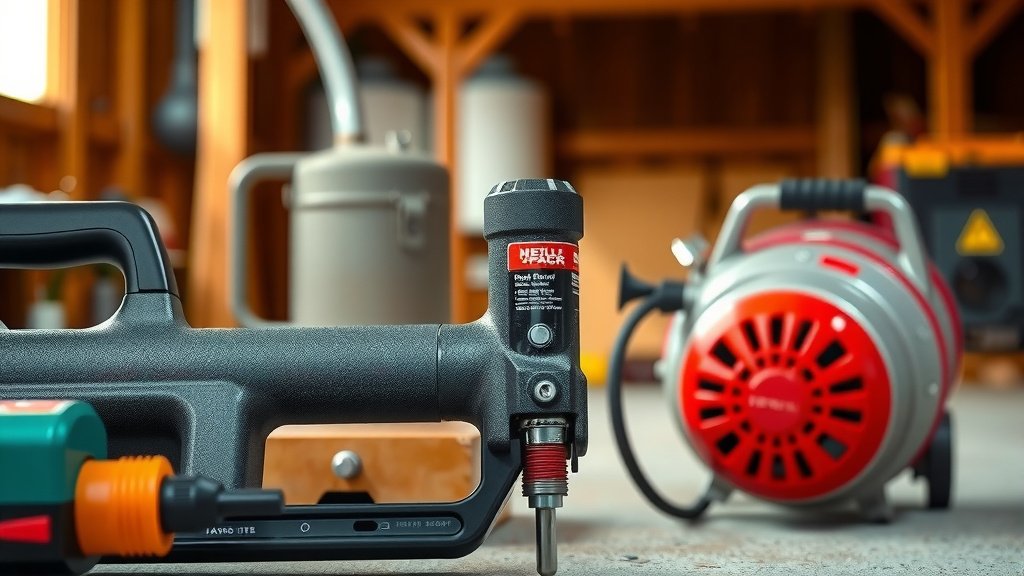
Essential Compressor Features to Look For
Beyond the core specs, a few extra features can make using your air compressor a much better experience. Think about what would make your DIY life easier.
Automatic Shut-off and Pressure Regulator
Most compressors have an automatic shut-off feature. This means the motor will stop when the tank reaches its maximum pressure. It’s a safety feature that prevents over-pressurization. Look for a built-in pressure regulator. This lets you dial in the exact PSI needed for your nail gun.
Oil-Free vs. Oil-Lubricated
We’ve touched on this, but it’s worth reiterating. Oil-free compressors are low-maintenance. You don’t need to worry about oil levels. They tend to be noisier and may have a shorter lifespan under heavy use. Oil-lubricated compressors are generally quieter and more durable, but they require regular oil checks and changes.
Noise Level Considerations
Air compressors can be loud. If you’re working in a residential area or a shared space, noise level is a factor. Manufacturers often list the decibel (dB) rating. We found that models rated below 70 dB are considered relatively quiet. Some “quiet” models aim for around 60 dB, which is closer to normal conversation volume.
Quick Checklist for Buying Your Nail Gun Compressor
Ready to make a decision? Keep this simple checklist handy:
- Confirm your nail gun’s CFM requirement at 90 PSI.
- Choose a compressor with at least that CFM rating, plus a little extra.
- Select a tank size that matches your project length (6 gallons+ is a good start).
- Decide if portability or stationary power is more important.
- Consider noise levels and maintenance needs (oil-free vs. oil).
- Look for safety features like auto shut-off and a pressure regulator.
Putting It All Together: Finding Your Ideal Match
Selecting the right air compressor is about matching its capabilities to your nail gun’s demands and your personal workflow. By focusing on CFM at 90 PSI and considering tank size, portability, and those extra features, you’ll set yourself up for success.
Remember, a little research upfront saves a lot of frustration down the road. A well-matched compressor means your nail gun fires consistently, drives nails accurately, and lasts longer. Happy nailing!
Conclusion
You’ve learned that choosing the right air compressor for your nail gun is all about matching CFM and tank size to your specific tool and project needs. Remember, a minimum of 2.5 CFM at 90 PSI and a 6-gallon tank or larger is your baseline for most common tasks. Don’t forget to consider portability and noise levels too. By following these guidelines, you’re setting yourself up for consistent performance and a frustration-free nailing experience on your next DIY project. Take a moment to check your nail gun’s manual and then confidently select a compressor that fits perfectly.
Frequently Asked Questions
What happens if my air compressor’s CFM is too low for my nail gun?
If your compressor’s CFM is too low, your nail gun won’t receive enough air to operate effectively. You’ll likely experience inconsistent firing, weak nail drives, or the nailer may struggle to reset between shots. This can slow down your work and lead to frustrating project delays.
Do I need a bigger tank for framing nailers compared to brad nailers?
Yes, absolutely. Framing nailers use air much more rapidly than brad nailers. You’ll want a larger tank (often 10 gallons or more for serious framing) on your compressor to keep up with the demand. A smaller tank will cycle constantly, leading to pressure drops and incomplete nail sets.
Can I use a small pancake compressor for occasional nail gun use?
For very light-duty tasks with brad or pin nailers used infrequently, a small pancake compressor might work if it meets the minimum CFM requirement. However, its small tank size will mean frequent cycling. We found that for anything more than very occasional trim work, a slightly larger compressor offers a much better experience.
Does the maximum PSI rating of the compressor matter if my nail gun uses 90 PSI?
Yes, it does. While your nail gun operates around 90 PSI, the compressor needs a higher maximum PSI capability to build up and maintain that pressure in the tank. Most compressors offer 125-175 PSI, which is more than enough to reliably supply the 90 PSI your nailer needs.
How does oil-free vs. oil-lubricated affect my choice for a nail gun compressor?
Oil-free compressors are generally lighter, require less maintenance, and are great for portability and DIY use. Oil-lubricated compressors tend to be quieter and more durable for heavy, continuous use, but they need regular oil checks. For typical DIY nailing, an oil-free model is often sufficient and convenient.