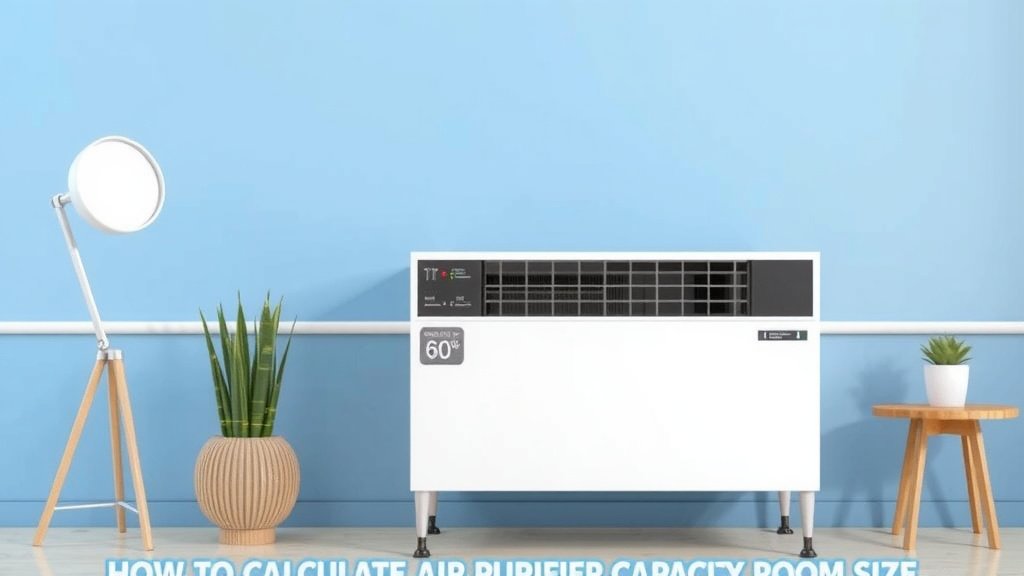
How to Calculate Air Purifier Capacity for Your Room Size
Calculating air purifier capacity is simple when you know the formula. You need to know your room’s square footage and the purifier’s Clean Air Delivery Rate (CADR). A higher CADR means the purifier cleans air faster. You want a CADR that matches your room size for effective air cleaning.
Understanding air purifier capacity helps you make a smart purchase. It ensures you get the right size unit for your needs. A purifier that’s too small won’t clean your air well. One that’s too big might be overkill and waste energy. We want you to find the perfect fit for your home.
- Know your room’s square footage.
- Find the CADR for your air purifier.
- Match CADR to room size for best results.
- Avoid purifiers that are too small or too big.
Let’s walk through exactly how to calculate air purifier capacity so you can breathe easier.
Figuring Out Your Air Purifier’s Capacity Needs
Choosing the right air purifier can feel like a big decision. You want to make sure it actually helps your air quality. Understanding how to match a purifier’s power to your room is key. It’s not about buying the biggest or most expensive unit. It’s about finding the one that’s just right. Let’s break down how to calculate the capacity you need. This way, you’ll know exactly what to look for.
Understanding the Key Numbers: CADR and Room Size
There are two main pieces of information you need. First, you need to know the size of your room. Second, you need to know the Clean Air Delivery Rate (CADR) of the air purifier. These two numbers work together. They tell you if a purifier can handle the job.
Measuring Your Room’s Square Footage
This is the easiest part. You just need to know the length and width of the room. Multiply the length by the width. This will give you the room’s square footage. For example, if your living room is 10 feet wide and 15 feet long, its square footage is 150 sq ft (10 x 15 = 150).
Do this for every room where you plan to use an air purifier. Some rooms are L-shaped or have unusual layouts. In those cases, you can break the room into smaller rectangles. Calculate the square footage of each section. Then, add them all together. This gives you the total area.
What is CADR?
CADR stands for Clean Air Delivery Rate. It’s a rating system developed by the Association of Home Appliance Manufacturers (AHAM). It measures how quickly an air purifier can clean the air in a room. Think of it like the speed limit for clean air. A higher CADR means the purifier works faster.
CADR ratings usually come in three forms:
- Dust CADR
- Pollen CADR
- Smoke CADR
The smoke CADR is often the most important to look at. This is because smoke particles are very small. A purifier that can handle smoke can likely handle dust and pollen too. When comparing purifiers, you’ll see these numbers clearly marked. Look for the one that best suits your needs.
Matching Purifier Power to Your Space
Now that you know your room’s square footage and what CADR means, let’s connect them. AHAM provides general guidelines for matching CADR to room size. These are based on a standard air change rate. A good rule of thumb is to aim for a CADR that is at least two-thirds of your room’s square footage. For example, in a 150 sq ft room, you’d want a CADR of at least 100 (150 x 0.67 = 100.5).
The AHAM Recommendation for Air Changes Per Hour (ACH)
Air changes per hour (ACH) is another important concept. It tells you how many times the air purifier can cycle all the air in a room each hour. For general use and good air quality, experts recommend at least 4 ACH (CDC). This means the purifier can clean all the air in the room four times every hour. For allergies or asthma, you might want even more air changes, perhaps 5 or even 8 ACH.
When looking at a purifier’s specifications, they often list the room size it’s best suited for. This usually assumes a certain ACH. If a manufacturer says a purifier is for a 300 sq ft room, they often mean it can achieve about 4-5 ACH in that space.
Calculating Required CADR for a Target ACH
You can calculate the exact CADR you need for a specific ACH. The formula is:
CADR = Room Square Footage x ACH x 0.5
Let’s use our 150 sq ft room example. If you want 4 ACH, you’d calculate:
CADR = 150 sq ft x 4 ACH x 0.5 = 300
So, for a 150 sq ft room where you want 4 air changes per hour, you’d look for a purifier with a smoke CADR of at least 300.
When Bigger Isn’t Always Better
What happens if the numbers suggest a super high CADR? Or what if you have a smaller room? You don’t necessarily need the absolute highest CADR available. Using a purifier that’s too powerful for your room can be wasteful. It might use more energy than needed.
It can also be noisier. Air purifiers often have different fan speeds. On lower settings, a powerful unit might run quietly. But if you need it to work hard, it might be loud. A unit that is sized correctly for your room will likely perform best on its medium settings. This balances effectiveness with noise and energy use.
Special Considerations for Your Home
While the basic calculation is straightforward, other factors can influence your choice. Think about what you’re trying to remove from the air.
Dealing with Specific Pollutants
Are you concerned about pet dander? Or perhaps cooking odors? Maybe you live in an area with a lot of wildfire smoke. Different pollutants might require different filter types or higher CADR ratings.
For instance, if wildfire smoke is a frequent problem in your area, you’ll want a purifier with a high smoke CADR. Many sources suggest a CADR of at least 200 for effective smoke removal (EPA). If you have pets, look for a model with a good pre-filter to capture larger particles like pet hair. People with severe allergies or asthma may benefit from a higher ACH rate.
Open Floor Plans and Multiple Rooms
What if you have an open-concept living space? Calculating for one large area might not be enough. You might need to think about the total square footage of that connected space. Alternatively, you could use multiple smaller units.
If you have very high ceilings, this can also affect air circulation. More air needs to be cleaned to achieve the desired ACH. Manufacturers’ room size recommendations often assume standard 8-foot ceilings. If your ceilings are 10 feet or higher, you might need a purifier rated for a slightly larger room.
Quick Checklist for Your Air Purifier Calculation
Here’s a simple way to remember what to do:
- Measure the length and width of your room.
- Calculate the total square footage.
- Find the smoke CADR rating for the purifier.
- Check the purifier’s recommended room size.
- See if the recommended room size matches yours.
- Aim for at least 4 ACH for general use.
Conclusion
You’ve learned how to match an air purifier’s power to your specific room size. Knowing your room’s square footage and understanding CADR are the key steps. Aiming for the right Clean Air Delivery Rate ensures your purifier works effectively. This prevents wasted energy and noise from an oversized unit. It also guarantees better air quality than an undersized one. Now you can confidently choose an air purifier that truly helps you breathe cleaner air.
Frequently Asked Questions
What if my room has an irregular shape?
For oddly shaped rooms, break them down into smaller rectangular sections. Calculate the square footage for each section individually. Then, add up the square footage of all sections to get your total room area. This ensures an accurate measurement for capacity calculation.
How important is the Smoke CADR rating?
The Smoke CADR is often the most important rating to consider. Smoke particles are very small, meaning a purifier with a high smoke CADR can effectively capture other airborne particles like dust and pollen. It generally indicates a stronger overall cleaning capability.
Do I need a different calculation for open-concept living spaces?
For open-concept areas, calculate the total square footage of the entire connected space. Alternatively, consider using multiple smaller air purifiers strategically placed throughout the area. This can provide more targeted air cleaning.
What if the recommended CADR seems much higher than the room size suggests?
If your calculation suggests a very high CADR, don’t feel pressured to buy the most powerful unit available. While a higher CADR isn’t necessarily bad, it might be overkill. A properly sized unit will likely run more quietly and efficiently on its medium settings.
How do high ceilings affect the air purifier I need?
Rooms with high ceilings contain more air volume. This means your air purifier needs to work harder to achieve the desired air changes per hour (ACH). You may need to choose a purifier rated for a slightly larger room than its square footage alone would suggest.