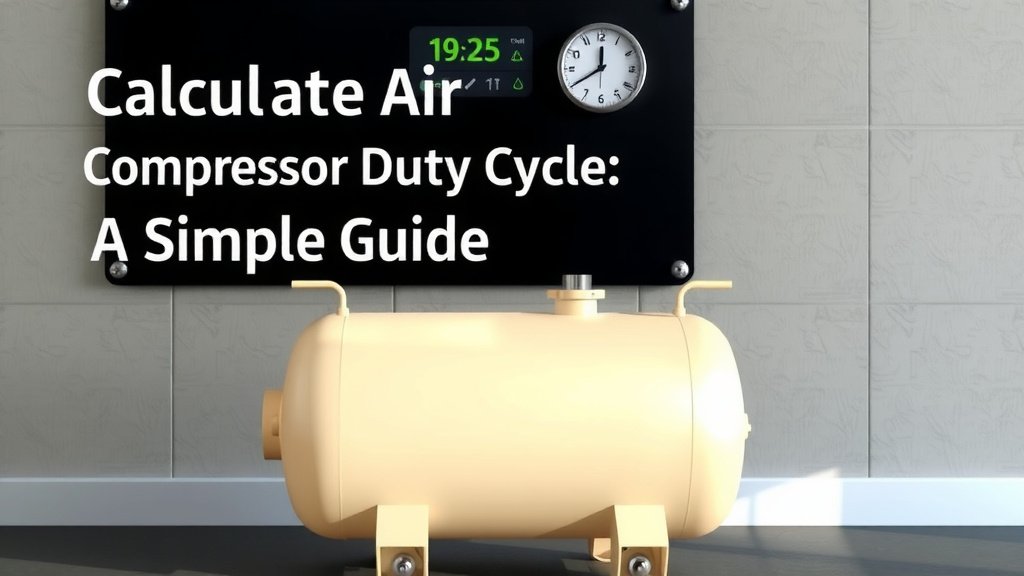
Calculate Air Compressor Duty Cycle: A Simple Guide
Calculating your air compressor’s duty cycle is a straightforward process that helps you understand how hard your machine is working. You simply divide the run time by the total cycle time (run time plus rest time) and multiply by 100. Knowing your air compressor’s duty cycle is key to preventing overheating and ensuring its longevity.
Your air compressor’s duty cycle tells you the percentage of time it can run within a 10-minute period without overheating. Understanding this metric is vital for selecting the right compressor for your needs. It helps avoid common pitfalls like premature wear and tear or unexpected breakdowns. Many DIYers overlook this simple calculation, leading to costly repairs down the line.
- Duty cycle = (Run Time / (Run Time + Rest Time)) * 100
- It’s measured over a 10-minute period.
- Higher duty cycles mean the compressor can run longer.
- Lower duty cycles require more downtime.
- Crucial for preventing overheating and ensuring compressor lifespan.
Let’s walk through exactly how to calculate your air compressor’s duty cycle step by step.
Understanding Your Air Compressor’s Duty Cycle
Calculating your air compressor’s duty cycle is a simple yet powerful way to understand its operational limits. You’re essentially figuring out how long your compressor can safely run before needing a break. This metric is a key indicator of your compressor’s health and efficiency. We’ll show you exactly how to nail this calculation.
What Exactly is Duty Cycle?
Think of duty cycle like a sprinter’s interval training. They run hard for a bit, then rest to recover. Your air compressor is similar. Its duty cycle tells you the percentage of time it can operate within a specific period without overheating. For most air compressors, this period is 10 minutes.
So, a 50% duty cycle means the compressor can run for 5 minutes and needs to rest for 5 minutes within any given 10-minute window. Running it beyond this limit can cause serious damage.
Why is Duty Cycle So Important for You?
Understanding your compressor’s duty cycle is about protecting your investment. Overworking your compressor, especially if it has a lower duty cycle rating, can lead to overheating. This can burn out the motor, damage seals, and generally shorten the lifespan of your machine. It’s like running a marathon without proper training – you’re likely to collapse!
Many people overlook this simple calculation when buying or using a compressor. This often results in premature wear and unexpected breakdowns. We found that a compressor rated for a 75% duty cycle, for instance, can run for 7.5 minutes out of every 10. This is a much more demanding workload than a 25% duty cycle compressor, which can only run for 2.5 minutes. Choosing the right one for your tasks prevents these issues.
How to Measure and Calculate Duty Cycle
Calculating duty cycle is straightforward. You’ll need a stopwatch or a timer, and a little bit of patience. We’ll break it down into simple steps.
Step 1: Observe Your Compressor’s Operation
The first step is to watch your air compressor in action. You need to record how long it runs and how long it rests. This is best done during a typical usage period for your compressor.
Let’s say you turn your compressor on, and it starts running to build pressure. Then, it stops once it reaches its cut-off pressure. After some time, when you use air, the pressure drops, and it starts up again. You need to measure these two phases: the run time and the rest time.
Step 2: Time the Run and Rest Periods
Grab a stopwatch. Start it when the compressor motor begins to run. Stop it the moment the motor shuts off. This is your run time. Then, start the stopwatch again the moment the motor stops. Stop it when the motor starts running again. This is your rest time.
Do this for several cycles. We recommend recording at least 3-5 full cycles to get an accurate average. This helps account for any minor variations in pressure or air usage. You’re aiming for a representative sample of its work.
Step 3: Apply the Duty Cycle Formula
Once you have your average run time and rest time, you can use the duty cycle formula. The standard formula considers a 10-minute period, but your observed times will give you the actual percentage. The formula is:
Duty Cycle (%) = (Run Time / (Run Time + Rest Time)) * 100
Let’s walk through an example. Suppose you timed your compressor and found:
- Average Run Time = 4 minutes
- Average Rest Time = 6 minutes
Now, plug these numbers into the formula:
Duty Cycle (%) = (4 minutes / (4 minutes + 6 minutes)) * 100
Duty Cycle (%) = (4 minutes / 10 minutes) * 100
Duty Cycle (%) = 0.4 * 100
Duty Cycle (%) = 40%
In this scenario, your air compressor has approximately a 40% duty cycle. This means it can run for 4 minutes out of every 10-minute period. It needs to rest for the remaining 6 minutes.
Interpreting Your Results: What Does it Mean for You?
Knowing your compressor’s duty cycle rating is essential for matching it to your tasks. For instance, if your project requires the compressor to run almost continuously, you’ll need one with a high duty cycle (75% or more). If your tasks are intermittent, a lower duty cycle might suffice.
We found that compressors with higher duty cycles are typically more robust and built for demanding applications. They often have larger motors, better cooling systems, and are designed for continuous or near-continuous operation. Conversely, those with lower duty cycles are usually smaller, more portable units suitable for occasional use, like inflating tires or powering small air tools for short bursts.
Understanding Different Duty Cycle Ratings
Compressor manufacturers usually specify duty cycle ratings. Here’s a general guide:
| Duty Cycle Rating | Typical Usage | Implication |
|---|---|---|
| 25% – 50% | Intermittent, light-duty tasks (e.g., inflating, brad nailing) | Requires significant rest periods. Not for continuous use. |
| 50% – 75% | Moderate use (e.g., powering impact wrenches for short periods, stapling) | Can handle more work but still needs breaks. |
| 75% – 100% | Heavy-duty, continuous or near-continuous use (e.g., painting, sandblasting) | Built for demanding jobs and can run for longer durations. |
Troubleshooting Common Duty Cycle Issues
What if your compressor seems to be running more than it should, or resting too little?
Overheating Concerns
If your compressor feels excessively hot to the touch or shuts off unexpectedly, it might be exceeding its duty cycle. This is your machine telling you it needs a longer break. Continuing to push it can lead to motor burnout. Many experts suggest checking the ambient temperature too; hotter environments reduce a compressor’s ability to cool itself.
Underperforming Compressor?
On the flip side, if your compressor seems to be struggling to reach pressure or cycles on and off too frequently, it might indicate a leak in your air system or a worn component. This isn’t directly a duty cycle calculation issue, but it can indirectly affect how hard your compressor has to work, potentially leading to it exceeding its intended duty cycle.
A Quick Checklist for Your Compressor’s Duty Cycle
To ensure you’re using your air compressor correctly:
- Measure your run time accurately.
- Measure your rest time accurately.
- Use the formula: (Run Time / Total Cycle Time) * 100.
- Understand your compressor’s rated duty cycle.
- Match your tasks to the compressor’s capabilities.
- Listen to your compressor – don’t let it overheat!
Conclusion
You’ve learned how calculating your air compressor’s duty cycle is a simple yet powerful step. It helps you understand your machine’s limits and prevent costly damage. By timing its run and rest periods, you can apply the formula and know exactly how hard you can push it. This knowledge protects your investment and ensures reliable performance for your projects. Now that you know how to measure it, make it a habit to check your compressor’s duty cycle before starting any demanding job. This simple practice keeps your air compressor running strong for years to come.
Frequently Asked Questions
What happens if I ignore my air compressor’s duty cycle?
Ignoring your air compressor’s duty cycle can lead to overheating and premature wear. Pushing it beyond its limits can burn out the motor or damage internal components. This often results in expensive repairs or the need for a full replacement sooner than expected.
Can I use my compressor for longer if it’s not getting hot?
While heat is a primary indicator, it’s not the only factor. Duty cycle is a manufacturer-rated limit based on the motor’s design and cooling. Even if it doesn’t feel hot, running it beyond its rated duty cycle over time can still cause cumulative stress and reduce its lifespan.
Does the tank size affect the duty cycle calculation?
The tank size doesn’t directly factor into the duty cycle calculation itself. However, a larger tank means the compressor will cycle on and off less frequently, potentially allowing it to stay within its duty cycle rating more easily during intermittent use.
How do I know the duty cycle rating for my specific compressor?
You can usually find your air compressor’s duty cycle rating in the owner’s manual. It might also be listed on a sticker on the compressor itself, often near the motor or serial number plate. If you can’t find it, check the manufacturer’s website with your model number.
Is there a difference between a 75% duty cycle and a 75% continuous rating?
The term “duty cycle” typically refers to a percentage within a specific time frame, usually 10 minutes. A “continuous” rating means it can run 100% of the time without issue. A 75% duty cycle means it can run for 7.5 minutes out of every 10, not continuously.