Choosing the Right Air Purifier Size for Your Room
Determining the right size air purifier for your space involves looking at the room’s square footage and the purifier’s CADR rating. A larger room needs a purifier with a higher clean air delivery rate (CADR) to effectively clean the air. It’s essential to match these two factors for optimal performance and cleaner air.
Choosing the correct size isn’t just about avoiding wasted money; it’s about effective air purification. An undersized unit will struggle to keep up, leaving pollutants lingering. An oversized one might be unnecessarily noisy and costly to run. We’ve found that matching specs to your room is key to breathing easier.
- Match room size (sq ft) to purifier coverage.
- Check the Clean Air Delivery Rate (CADR) for allergens, smoke, and dust.
- Consider ceiling height and how often you run the purifier.
- Don’t forget about noise levels and energy efficiency.
Ready to find your perfect air purifier match? Let’s walk through exactly how to figure out what size you need, step by step.
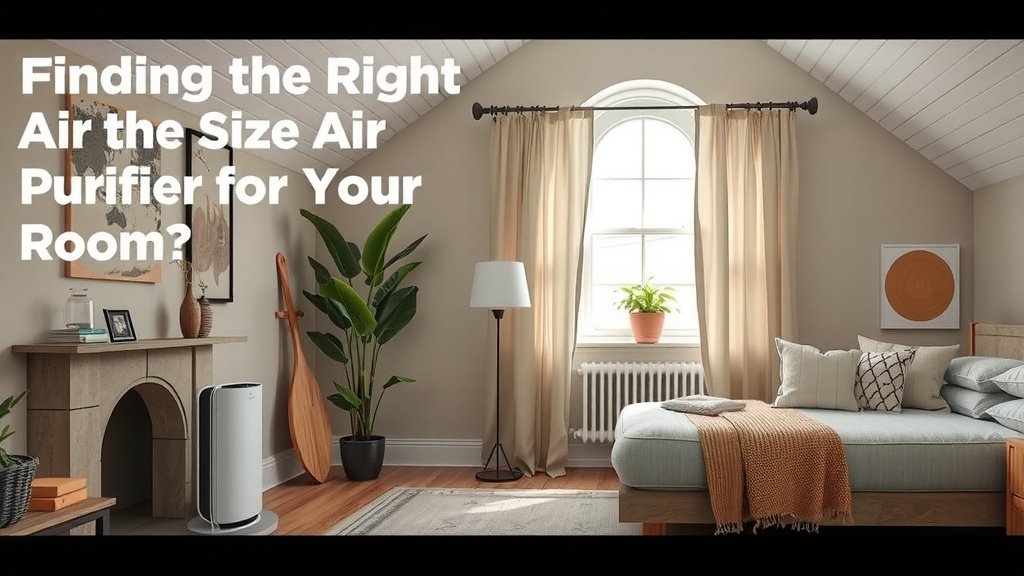
Finding the Right Air Purifier Size for Your Home
Selecting an air purifier that’s the correct size for your space is key. It’s not about getting the biggest one you can find. We’ve found that matching a purifier’s capabilities to your room’s dimensions ensures it works efficiently. This means cleaner air for you and your family.
Understanding Room Size and Purifier Coverage
The first step is to measure your room. You need to know its square footage. This is the most important factor in choosing an air purifier. Think of it like buying a couch; you wouldn’t buy a giant sectional for a tiny studio apartment, right?
How to Measure Your Room
Grab a tape measure. Measure the length of your room and the width. Multiply these two numbers together to get the square footage. For example, if your room is 10 feet long and 12 feet wide, its square footage is 120 sq ft.
Finding the Purifier’s Coverage Area
Air purifier manufacturers usually list a “coverage area” or “room size” on their packaging. This is the maximum square footage the unit is designed to clean effectively. Always check this specification before buying. It’s usually listed in square feet.
Matching Your Room to the Purifier
Aim for an air purifier whose listed coverage area is equal to or slightly larger than your room’s actual square footage. Why slightly larger? It gives the purifier a little extra power. This is especially helpful in rooms with higher ceilings or if you plan to run it on a lower, quieter setting most of the time.
Decoding the Clean Air Delivery Rate (CADR)
Beyond just room size, there’s another important rating: the Clean Air Delivery Rate, or CADR. This tells you how quickly an air purifier can clean the air in a room. Many experts say this is a more precise measure of performance.
What is CADR?
CADR is a standardized rating system. It measures how much clean air an air purifier produces. It’s specifically measured for three common pollutants: dust, pollen, and smoke. A higher CADR number means the purifier is faster and more effective at removing these particles.
Understanding the Different CADR Ratings
You’ll typically see three CADR numbers for an air purifier:
- Dust CADR: How quickly it removes dust particles.
- Pollen CADR: How quickly it removes pollen.
- Smoke CADR: How quickly it removes smoke particles (and the associated odors).
The smoke CADR is often the lowest. This is because smoke particles are very fine. Many guidelines recommend looking at the smoke CADR when choosing a purifier for allergies or general air quality improvement (Association of Home Appliance Manufacturers).
How CADR Relates to Room Size
The Association of Home Appliance Manufacturers (AHAM) provides recommendations for matching CADR to room size. A general rule of thumb is that the smoke CADR should be at least two-thirds of the room’s square footage. For example, for a 150 sq ft room, you’d want a smoke CADR of at least 100 (150 x 2/3 = 100).
However, for faster air cleaning or if you have significant pollution concerns, you might want a higher CADR. We found that many users benefit from a CADR that is closer to the room’s square footage for quicker results.
Other Factors to Consider
Room size and CADR are the big ones. But a few other things can influence your choice. These details can make a real difference in your daily experience with the unit.
Ceiling Height and Air Changes Per Hour (ACH)
Most manufacturer ratings assume standard 8-foot ceilings. If you have higher ceilings, the volume of air in the room is greater. This means the purifier has more air to clean. You might need a purifier with a higher CADR or one rated for a larger room than you initially calculated.
Air Changes Per Hour (ACH) is another metric. It tells you how many times the purifier can cycle all the air in a room per hour. For general use, 2-3 ACH is often sufficient. If you have allergies or asthma, aiming for 4-5 ACH can be more beneficial (American Lung Association).
Noise Levels and Energy Efficiency
Air purifiers have fans, and fans make noise. Check the decibel (dB) rating, especially if you plan to use the purifier in a bedroom or living area. Lower dB ratings mean a quieter operation. Many units have multiple fan speeds, with the lowest being the quietest.
Energy consumption is also a consideration. Look for ENERGY STAR certified models. These units meet strict energy efficiency guidelines set by the EPA. They can save you money on your electricity bill over time without sacrificing performance.
Your Specific Air Quality Needs
Do you have pets? Are you sensitive to pollen? Do you live in an area prone to wildfires? These factors can influence the type and size of purifier you need. For heavy-duty cleaning (like smoke from wildfires), you’ll want a higher CADR. For pet dander and odors, look for units with robust pre-filters and carbon filters.
Quick Checklist for Sizing Your Air Purifier
Ready to narrow down your options? Use this quick checklist:
- Measure your room to get its square footage.
- Find the purifier’s rated room coverage and CADR.
- Ensure the CADR is appropriate for your room size.
- Consider ceiling height and desired ACH.
- Check noise levels for your intended use.
- Look for ENERGY STAR certification for efficiency.
Conclusion
Finding the right-sized air purifier is simpler than you might think. By understanding your room’s square footage and checking an air purifier’s CADR rating, you can make a smart choice. Remember, an undersized unit won’t do the job, while an oversized one can be overkill. Matching the purifier’s coverage area and CADR to your room’s needs ensures you get the cleanest air possible. You’ve got this! Now, take those measurements and confidently pick the purifier that will help you breathe easier.
Frequently Asked Questions
Do I need a bigger air purifier if I have high ceilings?
Yes, you likely will. Standard air purifier ratings often assume 8-foot ceilings. If your ceilings are higher, there’s more air volume for the purifier to clean. You should look for a unit with a higher CADR or one rated for a larger room size than your floor plan suggests.
What does it mean if an air purifier has multiple CADR ratings?
You’ll usually see CADR ratings for dust, pollen, and smoke. These numbers tell you how quickly the purifier removes each specific type of particle. For general air cleaning and allergy concerns, experts often suggest paying attention to the smoke CADR.
Is it better to get an air purifier that’s rated for a larger room than I have?
It can be beneficial. Choosing a purifier with a coverage area slightly larger than your room gives it more power. This allows it to clean the air more effectively, especially if you prefer to run it on a quieter, lower setting.
How often should an air purifier cycle the air in my room?
This is measured by Air Changes Per Hour (ACH). For general use, 2-3 ACH is often enough. If you or someone in your household has allergies or asthma, aiming for 4-5 ACH is recommended by organizations like the American Lung Association for better air quality.
Can I use a smaller, quieter air purifier and just run it longer?
While running a smaller unit for longer can help, it’s generally more effective to match the purifier’s size to the room. A unit that’s too small will struggle to keep up, even if run continuously, and may not achieve the desired air purity.


![What Is The Best Home Air Purifier for Pets And Dust [In 2026]](https://homeunderstandable.com/wp-content/uploads/2025/05/best-home-air-purifier-for-pets-and-dust-enhance-indoor-air-quality-768x432.jpg)