
Choose the Right Air Purifier for Your Home
Selecting the right air purifier for your home is all about understanding a few key features. To pick the best one, you’ll want to focus on the CADR rating for the room size, the filter type (like HEPA), and additional features such as noise level and smart capabilities. A good air purifier can make a noticeable difference in your home’s air quality.
You’re likely looking to breathe easier, reduce allergens, or combat odors. Many experts agree that the HEPA filter is a top choice for capturing tiny particles. Also, consider the energy efficiency to keep your electricity bills from going sky-high, and check reviews for real-world performance on noise reduction.
- Match purifier CADR to your room size.
- Prioritize true HEPA filters for particle capture.
- Consider noise levels for bedrooms and quiet spaces.
- Look for energy efficiency ratings to save on costs.
- Smart features can add convenience, but aren’t essential.
Let’s walk through exactly how to choose the perfect air purifier for your needs, step by step.
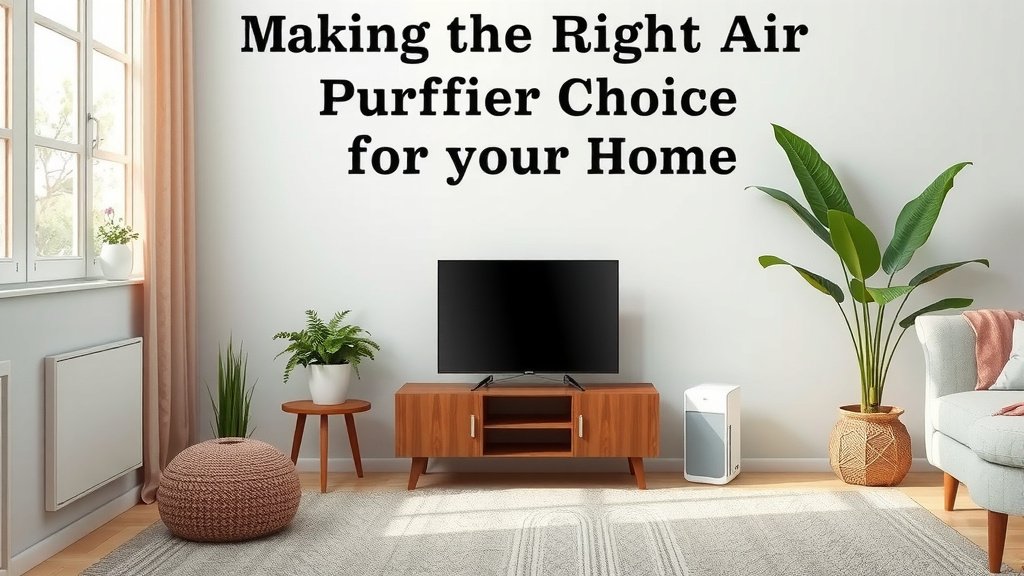
Here is the main body content for your blog post:Making the Right Air Purifier Choice for Your Home
Picking an air purifier can feel overwhelming. You want cleaner air, but where do you start? We’ve broken it down to help you find the perfect fit. Focus on a few key factors, and you’ll be breathing easier in no time.
Understanding Air Purifier Ratings: What Do They Mean?
Air purifiers have ratings that tell you how well they perform. These numbers are your guide to finding a unit that fits your space and needs.
The Power of CADR: Cleaning Your Air Quickly
CADR stands for Clean Air Delivery Rate. It measures how quickly an air purifier removes pollutants. Think of it like the speed of a car. A higher CADR means it cleans the air faster.
There are three main CADR ratings: one for smoke, one for dust, and one for pollen. These ratings help you match a purifier to your room size. A unit that’s too small won’t do much. A unit that’s too big might be overkill and waste energy.
We found that many experts recommend choosing a CADR that is at least two-thirds of the room’s square footage. So, for a 200-square-foot room, aim for a smoke CADR of at least 133.
ACH: How Often Does it Clean the Air?
ACH means Air Changes per Hour. This tells you how many times the air purifier can cycle all the air in a room. For general use, an ACH of 4 or 5 is usually good. This means it cleans the air four to five times every hour.
If you have severe allergies or asthma, you might want a higher ACH. Some units offer up to 10 ACH. This can be really helpful for removing allergens quickly. We found that higher ACH ratings provide more frequent air cleaning.
Filter Types: The Heart of Your Air Purifier
The filter is the most important part of your air purifier. It’s what actually captures the tiny particles. Different filters do different jobs.
HEPA Filters: The Gold Standard
When we talk about air purifiers, HEPA filters often come up. HEPA stands for High-Efficiency Particulate Air. These filters are designed to capture 99.97% of particles that are 0.3 microns in size. That’s incredibly small!
What does this mean for you? It means HEPA filters are great at trapping things like dust mites, pet dander, mold spores, and even some bacteria and viruses. If you’re looking to reduce allergens, a true HEPA filter is your best bet. Be wary of terms like “HEPA-type” or “HEPA-like.” These are not the same as true HEPA filters.
Activated Carbon Filters: Tackling Odors and Gases
Activated carbon filters are different from HEPA filters. They don’t capture particles as well. Instead, they are excellent at absorbing odors, smoke, and volatile organic compounds (VOCs). VOCs can come from cleaning products, paints, and even furniture.
If your main concern is smoke from cooking, pet odors, or chemical smells, an activated carbon filter is a must. Many air purifiers combine a HEPA filter with an activated carbon filter. This gives you the best of both worlds: particle removal and odor control.
Pre-filters: The First Line of Defense
Most air purifiers have a pre-filter. This is usually a washable mesh screen. It captures larger particles like hair and lint. This helps protect the more delicate HEPA and carbon filters.
By trapping the big stuff first, the pre-filter extends the life of your other filters. This can save you money on replacements. Cleaning the pre-filter regularly is easy and keeps your unit running efficiently.
Key Features to Consider for Your Needs
Beyond the core filtering technology, other features can make a big difference in your daily life with an air purifier.
Noise Levels: For Peaceful Living
Air purifiers have fans, and fans make noise. This noise can range from a gentle hum to a noticeable whir. You’ll want to consider where you plan to place the air purifier.
For a bedroom or a quiet office, you’ll want a unit with a low decibel (dB) rating, especially on its lower settings. Many manufacturers provide noise level ratings. We found that units under 50 dB on their highest setting are generally considered quiet enough for most living spaces. Some even go down to 20-30 dB on their lowest fan speeds, which is barely audible.
Energy Efficiency: Saving Power and Money
Air purifiers run for many hours a day, so energy consumption is something to think about. Look for units that have an Energy Star certification. This means they meet strict energy efficiency guidelines set by the U.S. Environmental Protection Agency.
While a high-efficiency unit might cost a bit more upfront, it can save you money on your electricity bill over time. We found that checking the wattage of different models can also give you an idea of their energy use.
Smart Features and Convenience
Some modern air purifiers come with smart capabilities. This can include Wi-Fi connectivity, app control, and voice command integration. You might be able to adjust settings, check filter life, or set schedules from your smartphone.
While these features can add convenience, they aren’t essential for air purification. Decide if these extras are worth the potential extra cost for you. For some, the ability to control the purifier remotely is a huge plus.
Room Size and Placement Considerations
It’s crucial to match the air purifier’s capacity to the size of the room where you’ll use it. A unit designed for a small bedroom won’t be effective in a large living area. Always check the manufacturer’s recommended room size.
Think about where you spend the most time. Is it the bedroom, living room, or kitchen? Placing an appropriately sized unit in that area will give you the most benefit. Remember that air purifiers work best when placed in open areas, away from walls and furniture that can block airflow.
Your Air Purifier Checklist
Here’s a quick checklist to help you narrow down your choices:
- Does the purifier have a true HEPA filter?
- Is the CADR rating suitable for your room size?
- Are the noise levels acceptable for where you’ll use it?
- Does it include an activated carbon filter if odors are a concern?
- Is it Energy Star certified or reasonably energy efficient?
- Does it meet your budget for both the unit and replacement filters?
Conclusion
You’ve now got a clear roadmap for choosing the right air purifier. Remember to focus on matching the CADR rating to your room size and prioritizing a true HEPA filter for effective particle capture. Don’t forget to consider noise levels for your comfort and look for energy-efficient models to save on costs. By keeping these key factors in mind, you can confidently select a unit that will significantly improve the air quality in your home.
Your next step is to measure your room and start comparing models based on these essential criteria. Happy breathing!
Frequently Asked Questions
How do I know which CADR rating I need?
To determine the right CADR, we recommend matching it to your room’s square footage. A common guideline is to choose a smoke CADR that is at least two-thirds of your room’s square footage. For instance, a 200 sq ft room needs a CADR of at least 133.
Are “HEPA-type” filters as good as true HEPA filters?
No, they are not. A true HEPA filter is certified to capture 99.97% of particles 0.3 microns in size. Filters labeled “HEPA-type” or “HEPA-like” do not meet these strict standards and will not be as effective at removing tiny allergens and pollutants from your air.
How loud is too loud for an air purifier?
Noise levels vary by model and fan speed. For bedrooms or quiet areas, aim for a unit that operates below 50 decibels (dB) on its highest setting. Many units offer very quiet operation, often in the 20-30 dB range on their lowest settings, which is barely noticeable.
Should I look for an air purifier with an activated carbon filter?
An activated carbon filter is especially useful if you are concerned about odors, smoke, or chemical fumes. While HEPA filters capture particles, activated carbon absorbs gases and smells. Many people find a combination HEPA and carbon filter offers the best all-around air purification.
How often do I need to replace air purifier filters?
Filter replacement frequency depends on the unit, filter type, and how often you run it. Pre-filters often just need regular cleaning. HEPA and carbon filters typically need replacement every 6 to 12 months. Always check your manufacturer’s recommendations for the most accurate schedule.

![What Is The Best Air Purifier for Chemical Sensitivity [In 2026]](https://homeunderstandable.com/wp-content/uploads/2025/06/best-air-purifier-for-chemical-sensitivity.jpg)