Choosing the Right Air Compressor for Your Air Tools
Choosing the right size air compressor for your air tools is all about matching its power to what your tools need. To run most common air tools effectively, you’ll typically need an air compressor with a tank size of at least 20-30 gallons and a flow rate (CFM) of 4-7 CFM at 90 PSI. Getting this right means your tools won’t run out of air when you need them most.
The air compressor’s job is to store compressed air. Air tools use this stored air to function. Different tools have different appetites for air. Some need a lot of air all at once, while others sip it slowly. Understanding your tools’ needs is key to avoiding frustration and ensuring you have enough air power for any job, whether it’s a simple inflation task or a demanding continuous-use tool.
- Match compressor CFM and PSI to your tools.
- Consider tank size for continuous use.
- Smaller tools need less air.
- Larger tools demand more air.
- Don’t guess – check your tool’s requirements!
Let’s figure out exactly what size air compressor will keep all your air tools happy and humming. We’ll break down what those numbers actually mean for you.
Choosing the Right Air Compressor Size for Your Tools
So, you’ve got some awesome air tools ready to go, but is your air compressor up to the task? Picking the correct size is like getting the right key for a lock. Too small, and it won’t turn. Too big, and it might be overkill. We’re here to help you find that perfect fit so your tools run smoothly without any air shortages.
The magic numbers on an air compressor are its CFM (Cubic Feet per Minute) and PSI (Pounds per Square Inch). Think of CFM as the volume of air the compressor can deliver, and PSI as the pressure at which it delivers it. Your tools don’t just need air; they need a specific amount of air at a certain pressure to work their best.
Understanding Air Tool Air Requirements
Every air tool is different. Some are like thirsty camels, gulping down air quickly. Others are more like hummingbirds, taking small sips. You need to know what your tools are asking for. If you hook up a tool that demands a lot of air to a compressor that can’t keep up, you’ll experience frustrating pauses or weak performance. It’s like trying to fill a swimming pool with a garden hose; it’ll take forever, if it ever fills at all!
What is CFM? Your Tool’s Air Thirst
CFM is arguably the most important spec when sizing your compressor. It tells you how much air the tool uses per minute. If your air hammer needs 5 CFM, and your compressor only puts out 3 CFM, you’re going to have a bad time. The compressor simply can’t supply enough air to keep the tool running continuously.
We found that many DIYers overlook CFM. They might focus on tank size or PSI, but CFM is the true measure of a compressor’s ability to power your tools. Always look for the CFM rating of your tools. This is usually found on the tool itself, in its manual, or on the manufacturer’s website.
What is PSI? The Force Behind the Air
PSI measures the force or pressure of the air. Most common air tools operate effectively between 70 and 100 PSI. Your compressor needs to be able to deliver this pressure. However, most compressors can reach high PSI levels, so it’s usually less of a limiting factor than CFM for typical air tools. The key is that the compressor can maintain the required PSI while delivering the necessary CFM.
Matching Compressor CFM to Tool Needs
This is where you become a detective! You need to gather intel on your air tools. For intermittent-use tools like nail guns or staplers, the compressor doesn’t need to supply the full CFM constantly. It can “catch up” between uses. For tools that run continuously, like sanders or grinders, you need a compressor that can meet or exceed their CFM demand.
Continuous vs. Intermittent Use Tools
Let’s break this down. Tools like impact wrenches for tire changes or a nail gun for framing are used in short bursts. They might have a high CFM requirement, but only for a few seconds at a time. A compressor with a decent tank size can supply the initial burst and then refill the tank while you reposition or reload.
Tools like orbital sanders, grinders, or spray guns are different. They run for longer periods. If you’re sanding a whole car or painting a room, the air demand is steady. For these, you need a compressor that can deliver the required CFM without faltering. Many experts recommend adding a buffer of 30-50% to the tool’s CFM requirement for continuous use. This ensures your compressor won’t be straining itself.
How to Calculate Your Needs
Here’s a simple way to figure out what you need. List all the air tools you plan to use. Find the CFM requirement for each tool. If you plan to run multiple tools at once (which is rare for most home users), add their CFM requirements together. Most importantly, when in doubt, look at the tool with the highest CFM demand. Your compressor needs to be able to handle your most demanding tool.
For example, if your impact wrench needs 5 CFM at 90 PSI and your orbital sander needs 8 CFM at 90 PSI, and you’ll only use one at a time, you need a compressor rated for at least 8 CFM at 90 PSI. If you plan to run them both simultaneously (again, uncommon), you’d need one capable of 13 CFM. Many sources suggest aiming for a compressor that offers at least 1.5 times the CFM of your most demanding tool, especially for demanding jobs.
The Role of Tank Size
While CFM is king for how much air your tools use, the tank size is like the tool’s personal air reserve. A larger tank means more stored compressed air. This is especially helpful for tools that use air in short, powerful bursts, like nail guns or impact wrenches.
A bigger tank allows your compressor motor to cycle less frequently. Instead of kicking on every few seconds, it can run for longer periods to fill the tank. This is easier on the motor and provides a more consistent air supply. For intermittent use, a larger tank is a definite plus. For continuous use, it still helps, but CFM becomes the primary concern.
We found that for home or garage use with common air tools, a tank size between 20 to 60 gallons is generally a good starting point. If you’re doing heavy-duty work or have a very air-hungry tool, you might look into 80-gallon or larger tanks, but these are quite substantial and often require more powerful motors and dedicated circuits.
Understanding Compressor Types and Power
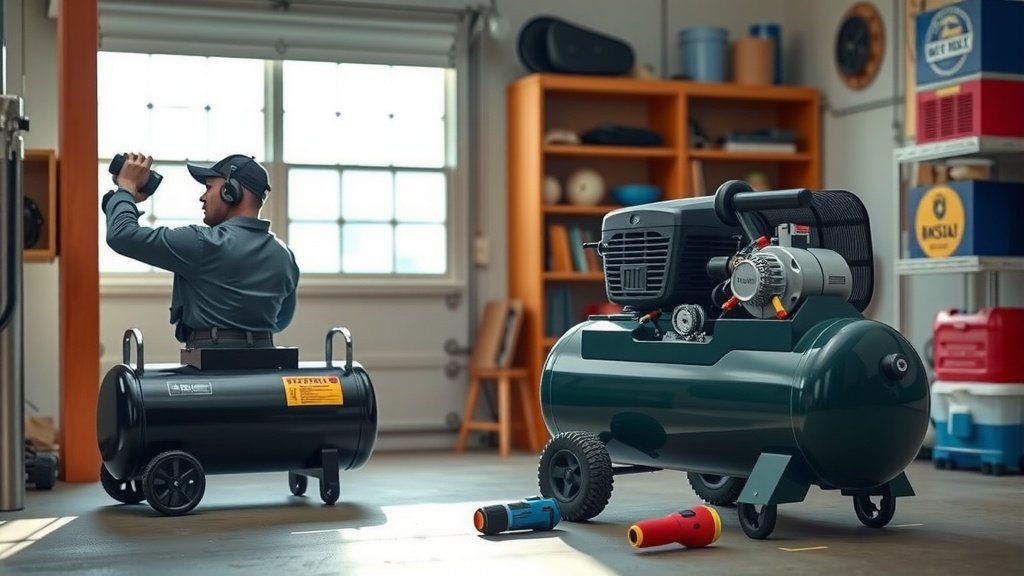
Air compressors come in different flavors: portable, stationary, electric, and gas-powered. Your choice impacts where and how you can use it. You’ll also find compressors described by their cylinder count, like 1 cylinder vs 2 cylinder models, which impacts their performance.
Electric vs. Gas-Powered
Electric compressors are common for home use. They’re quieter and don’t produce exhaust, making them ideal for garages or indoor workshops. However, they require a suitable electrical outlet, and larger ones might need a 240V circuit. Gas-powered compressors are portable and powerful, perfect for job sites away from power sources, but they are noisy and require ventilation.
Horsepower (HP) and Amps
You’ll also see HP and Amps listed. While they give an idea of the motor’s power, don’t let them be your sole decision-makers. A high HP motor doesn’t guarantee high CFM if the pump design isn’t efficient. Always prioritize CFM and PSI ratings over HP alone.
Putting It All Together: A Simple Checklist
Ready to make a decision? Let’s recap with a quick checklist. This will help you pinpoint what you truly need:
- Identify Your Tools: List every air tool you own or plan to buy.
- Find CFM Requirements: Look up the CFM at 90 PSI for each tool.
- Determine Peak Demand: What’s the highest CFM your most demanding tool needs?
- Consider Usage: Will you use tools continuously or in short bursts?
- Check PSI Needs: Ensure your compressor can meet the required PSI (usually 70-100 PSI).
- Aim for a Buffer: For continuous use, add a 30-50% margin to the highest CFM.
By following these steps, you can confidently select an air compressor that won’t leave you sputtering for air when you’re in the middle of a project. Getting this right means less frustration and more time actually getting things done!
Conclusion
You’ve got the roadmap now to pick the right air compressor. Remember, it’s all about matching your tools’ air demands, especially their CFM needs, with what the compressor can deliver. Don’t get caught short! For most DIYers, focusing on a compressor with at least 4-7 CFM at 90 PSI and a 20-30 gallon tank is a solid starting point. Always check your most demanding tool’s requirements and add a buffer if you use tools continuously. Your next step? Take that list of your tools and their CFM needs to the store or your favorite online retailer. Happy air toolin’!
Frequently Asked Questions
What’s the biggest mistake people make when buying an air compressor for tools?
The most common error we see is focusing too much on horsepower (HP) or tank size alone. While important, they don’t tell the whole story. The true measure of an air compressor’s ability to run your tools is its CFM (Cubic Feet per Minute) rating at 90 PSI. This is what your tools actually consume.
How do I know if I need a large tank or high CFM?
Think about how you use your tools. If you have tools like nail guns or impact wrenches that use air in short bursts, a larger tank helps provide that initial power and reduces motor cycling. For tools used continuously, like orbital sanders or grinders, high CFM is the priority. Your compressor must keep up with the steady air demand.
Can a smaller compressor with a large tank run a tool that needs high CFM?
Generally, no. While a large tank offers a reserve, it can’t magically create more air. If your tool demands 8 CFM and your compressor only outputs 5 CFM, the tank will deplete quickly, and the tool will perform poorly or stop working. You need the compressor’s *output* to meet or exceed the tool’s consumption.
What does “90 PSI” mean on an air compressor rating, and why is it important?
PSI (Pounds per Square Inch) measures the air pressure. Most common air tools operate efficiently between 70-100 PSI. Compressors are rated for CFM at a specific PSI, usually 90 PSI, because that’s a common working pressure. Ensure your compressor can *deliver* the required CFM *at* the pressure your tool needs.
Do I need to add CFM if I plan to use multiple air tools at once?
If you realistically plan to run two or more air tools *simultaneously*, you absolutely need to. Add up the CFM requirements of all the tools you intend to use at the same time. For home use, this is rare, but if you plan for it, ensure your compressor’s CFM output meets that combined total, plus a buffer.