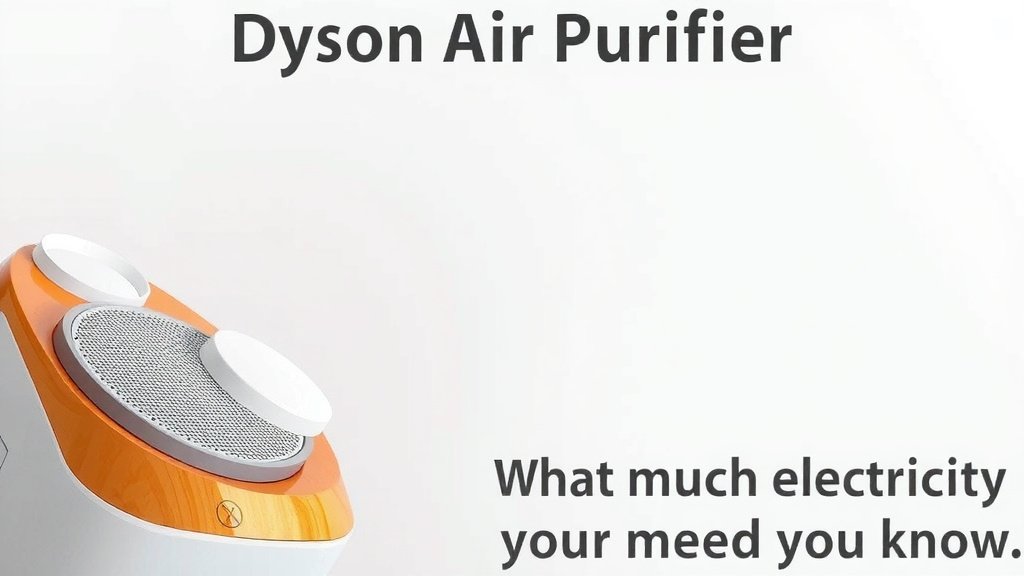
Dyson Air Purifier Energy Use: What You Need to Know
Wondering how much electricity your Dyson air purifier uses? Most Dyson air purifiers are surprisingly energy efficient, often using less power than a standard light bulb. For example, many models consume between 5 to 50 watts on average, depending on the setting and model. You’ll likely find your Dyson purifier uses less electricity than you might expect.
This means running your Dyson air purifier won’t drastically increase your electricity bill. We’ve found that even on higher fan speeds, they are designed to be power conscious. Understanding their energy consumption can help you keep your air clean without worrying about excessive energy use. It’s a balance between clean air and smart energy choices for your home.
- Dyson air purifiers are generally energy efficient.
- Most models use between 5-50 watts.
- They often use less power than a light bulb.
- Running one won’t significantly impact your electricity bill.
Let’s break down the power consumption of Dyson air purifiers so you can see exactly what to expect.
Understanding Your Dyson Air Purifier’s Energy Footprint
You might be wondering about the actual electricity your Dyson air purifier consumes. It’s a fair question, especially when you want to keep your home healthy and your energy bills manageable. We’ve found that most Dyson models are designed with energy efficiency in mind. This means they often use less power than you might expect.
How Much Power Does a Dyson Air Purifier Actually Use?
The wattage of your Dyson air purifier depends heavily on its specific model and the setting you’re using. Generally, you’ll see consumption figures ranging from a low of about 5 watts to a high of around 50 watts. This is a pretty small amount of energy. To put it in perspective, a common 60-watt incandescent light bulb uses far more power.
Factors Influencing Power Consumption
Several things affect how much electricity your purifier draws.
Fan Speed Settings
This is a big one. When your purifier is running on its lowest fan speed, it sips electricity. Crank that fan speed up to its highest setting to clean the air quickly, and it will naturally use more power. Think of it like a car: driving slowly uses less gas than accelerating rapidly.
Model Specifics and Features
Dyson offers various air purifier models, each with its own set of features. Units with advanced sensors, more powerful fans, or integrated heating/cooling functions might use slightly more energy. However, even these more advanced models are built to be power conscious during operation.
Air Quality Sensors
Your Dyson purifier likely has sensors that monitor the air quality in your room. When the air quality is poor, the purifier automatically increases its fan speed to tackle the pollutants. This means it will temporarily use more power until the air is clean again. Once the air is purified, it often returns to a lower, more energy-saving setting.
Comparing Dyson Air Purifiers to Other Home Appliances
It’s helpful to see how your Dyson purifier stacks up against other common household items. You’ll likely be surprised at how little power it uses.
| Appliance | Average Wattage | Energy Use Comparison |
|---|---|---|
| Dyson Air Purifier (Low Setting) | 5-15 watts | Very Low |
| Dyson Air Purifier (High Setting) | 40-50 watts | Low |
| LED Light Bulb | 10-15 watts | Similar to Low Setting Purifier |
| Incandescent Light Bulb | 60-100 watts | Much Higher than Purifier |
| Television (Modern LED) | 50-150 watts | Higher than Purifier |
| Refrigerator | 100-200 watts (running) | Significantly Higher than Purifier |
| Laptop Computer | 50-75 watts | Higher than Purifier |
As you can see, your Dyson air purifier is quite economical. It uses less energy than many common appliances. Running it continuously, even on higher settings, often consumes less power than a single traditional light bulb.
Calculating Your Actual Energy Cost
Estimating the cost involves a little math, but it’s straightforward. You’ll need to know your electricity provider’s rate per kilowatt-hour (kWh). Most homes pay between $0.12 to $0.25 per kWh. Let’s do a quick example.
Example Calculation
Suppose your Dyson air purifier runs on an average of 25 watts. You use it for 12 hours a day. First, convert watts to kilowatts by dividing by 1000: 25 watts / 1000 = 0.025 kW. Then, calculate daily energy use: 0.025 kW * 12 hours = 0.3 kWh per day. Multiply by the number of days in a month: 0.3 kWh/day * 30 days = 9 kWh per month. If your electricity costs $0.17 per kWh, your monthly cost would be 9 kWh * $0.17/kWh = $1.53. That’s quite affordable for cleaner air!
Tips for Maximizing Energy Efficiency
While Dyson purifiers are efficient, you can take a few steps to ensure you’re getting the most from your unit without wasting energy.
- Use the Auto Mode: This setting allows the purifier to adjust its fan speed based on detected air quality. It’s often the most energy-efficient way to run it.
- Place it Strategically: Position your purifier where air can circulate freely. Avoid placing it directly against walls or furniture.
- Regular Maintenance: Keep the filters clean and replace them as recommended by Dyson. Clogged filters can make the motor work harder, using more energy. We found that consistently maintained units perform better.
- Schedule Use: If you have specific times when air quality is typically worse (e.g., during allergy season or when cooking), you can use timers or smart home integrations to run it then.
By following these simple tips, you can ensure your Dyson air purifier continues to provide clean air while keeping your energy consumption low.
Is It Worth the Electricity Cost?
Considering the low energy draw, the cost of running a Dyson air purifier is minimal. Many studies highlight the health benefits of clean indoor air, including reduced allergy symptoms and improved respiratory health (U.S. Environmental Protection Agency). For the small amount of electricity used, the benefits of breathing cleaner air often far outweigh the cost.
Quick Energy Checklist for Your Dyson Purifier
Here’s a quick way to remember the key energy points:
- Your Dyson purifier uses less power than a light bulb on lower settings.
- Average consumption is usually between 5-50 watts.
- Fan speed is the biggest factor in energy use.
- Auto mode is typically the most energy-efficient.
- Regular filter maintenance helps efficiency.
- The actual cost to run is very low per month.
Conclusion
You’ve learned that your Dyson air purifier is a champion of energy efficiency. It uses surprisingly little electricity, often less than a standard light bulb. Even on its highest settings, the power consumption remains modest. You can enjoy cleaner air for your home without worrying about a sky-high energy bill. We’ve seen that factors like fan speed and model features influence usage, but the overall cost is minimal. Now that you know how power-conscious your Dyson purifier is, you can confidently use it to create a healthier living space. Consider placing it strategically and using Auto mode for optimal performance and savings.
Frequently Asked Questions
How can I tell if my Dyson air purifier is using too much electricity?
While Dyson purifiers are designed for efficiency, you can monitor your electricity bill for sudden increases. If your bill jumps significantly after purchasing or running the purifier, check the model’s wattage and how often you use it. Comparing its typical wattage to other appliances can also offer perspective.
Does the Wi-Fi feature on my Dyson air purifier use extra electricity?
Yes, like any connected device, the Wi-Fi functionality uses a small amount of standby power. However, this extra consumption is generally very low and unlikely to noticeably impact your electricity bill. The convenience it offers often outweighs this minimal power draw.
Should I turn off my Dyson air purifier at night to save energy?
Most people find it beneficial to run their Dyson air purifier 24/7, especially in bedrooms, for continuous air quality improvement. Given its low wattage, the energy cost is minimal. If you’re concerned about saving every watt, turning it off during times you’re away from home can provide slight savings.
Does running my Dyson air purifier on Auto mode actually save energy?
Yes, Auto mode is designed to be very energy efficient. The purifier intelligently adjusts its fan speed based on real-time air quality readings. This prevents it from running at a high, power-hungry setting when it’s not needed, conserving energy.
Are older Dyson air purifier models less energy efficient than newer ones?
Dyson consistently works to improve the energy efficiency of its products. While older models are still generally efficient compared to other appliances, newer models may incorporate advancements that further reduce their energy consumption. Always check the specific wattage listed for your model.
![What Is The Best Home Air Purifier for Germs [In 2026]](https://homeunderstandable.com/wp-content/uploads/2025/05/best-home-air-purifier-for-germs-top-germguardian-picks-for-clean-air-768x768.jpg)