Bostitch vs Ridgid Air Compressor: Which is Best
When choosing between Bostitch and Ridgid air compressors, think about your specific project needs and budget. While both brands offer reliable tools, one might be a better fit for your workshop. We found that Bostitch often excels in portability and lighter tasks, whereas Ridgid is known for its power and durability for heavy-duty use.
The right air compressor can transform your DIY projects. You’ll want something that can keep up with your tools without breaking the bank. We’ve looked at what makes each brand stand out, considering factors like tank size, CFM output, and overall construction.
- Bostitch: Great for DIYers and portability.
- Ridgid: Excellent for professional use and heavy applications.
- Consider your project demands.
- Think about your budget.
Below, we’ll break down the key differences between Bostitch and Ridgid air compressors to help you make the best choice for your home or job site.
Comparing Bostitch and Ridgid Air Compressors for Your Needs
Deciding between a Bostitch and a Ridgid air compressor can feel like a big choice. We know you want the right tool for the job. Both brands have a solid reputation. But they often cater to slightly different users and tasks. Let’s dive into what makes each one a contender.
You’re likely looking for a compressor that won’t quit on you. It needs to power your tools reliably. We’ve found that Bostitch often leans towards portability and lighter duty. Think of tasks around the house or smaller workshop projects. Ridgid, on the other hand, frequently positions itself for heavy-duty work and professional environments. This means it’s built to withstand more demanding, continuous use.
Understanding Air Compressor Basics: What to Look For
Before we compare the brands head-to-head, let’s quickly touch on what matters most in an air compressor. Knowing these basics will help you see why certain features are important for each brand.
Tank Size Matters: How Much Air Do You Need?
The tank is like the reservoir for your compressed air. Larger tanks mean you can run tools longer without the motor kicking on as often. This is great for tools that use a lot of air. Our guide to 1 gallon vs 2 gallon air compressors explains how tank size impacts tool run time.
- Smaller tanks (under 10 gallons): Good for portability. Perfect for quick jobs like nailing or inflating tires.
- Medium tanks (10-30 gallons): A good balance for many DIYers. Can handle tasks like impact wrenching for a decent amount of time.
- Larger tanks (30+ gallons): Better for continuous use. Ideal for paint spraying or running multiple tools.
CFM: The Real Measure of Power
CFM stands for Cubic Feet per Minute. This tells you how much air the compressor can deliver at a specific pressure. Your tools have CFM requirements. You need a compressor that meets or exceeds these. This is perhaps the most critical specification to match your tools.
Horsepower and PSI: Still Important, But CFM is King
Horsepower (HP) often indicates the motor’s power. Pounds per Square Inch (PSI) is the maximum pressure the compressor can reach. While these numbers are advertised, CFM is the true indicator of how well your compressor will keep up with your tools.
Bostitch: The Portable Powerhouse for Everyday Tasks
When we look at Bostitch air compressors, their focus often seems to be on making your life easier, especially if you’re moving around a lot.
Portability Features
Many Bostitch models are designed with lightweight construction and integrated handles. Some even come with wheels, making them easy to transport from your garage to your driveway or a job site. If you don’t have a dedicated workshop space, this is a big plus.
Ideal Applications for Bostitch
Bostitch excels in applications where you might not need constant, high air volume. Think about:
- Nail guns: Perfect for framing, trim work, and general carpentry.
- Inflating: Tires, sports equipment, and air mattresses are no problem.
- Light stapling tasks: Upholstery or craft projects.
We found that for these types of jobs, Bostitch often provides a fantastic balance of performance and convenience.
Considerations for Bostitch
While great for many tasks, you might find that smaller Bostitch compressors struggle with high-demand tools. If you plan to do a lot of painting or use heavy-duty impact wrenches for extended periods, you might need to look at larger options or consider a different brand.
Ridgid: Built Tough for Demanding Work
Ridgid has a strong reputation in the professional trades. Their air compressors often reflect this focus on durability and sustained performance.
Durability and Construction
Ridgid tools are often built with robust materials. We’ve seen models featuring cast iron pumps and reinforced housings. These are designed to withstand the rigors of daily use on construction sites or in busy workshops. They tend to be heavier but feel incredibly solid.
Performance for Heavy-Duty Needs
When your project demands more, Ridgid often steps up. Many of their compressors offer higher CFM ratings and larger tanks. This means they can keep up with tools like:
- Impact wrenches: For automotive work or heavy assembly.
- Sanders: Belt sanders or orbital sanders can chew through air.
- Paint sprayers: Especially HVLP or larger spray guns need a consistent air supply.
If you’re working on extensive projects or run a small business, the power and longevity of a Ridgid compressor are major advantages.
What to Expect with Ridgid
The trade-off for this power and durability is often portability. Ridgid compressors can be bulkier and heavier. While some models have wheels, they might not be as easy to maneuver as their lighter counterparts. You’re paying for robust performance, which often means a higher price point too.
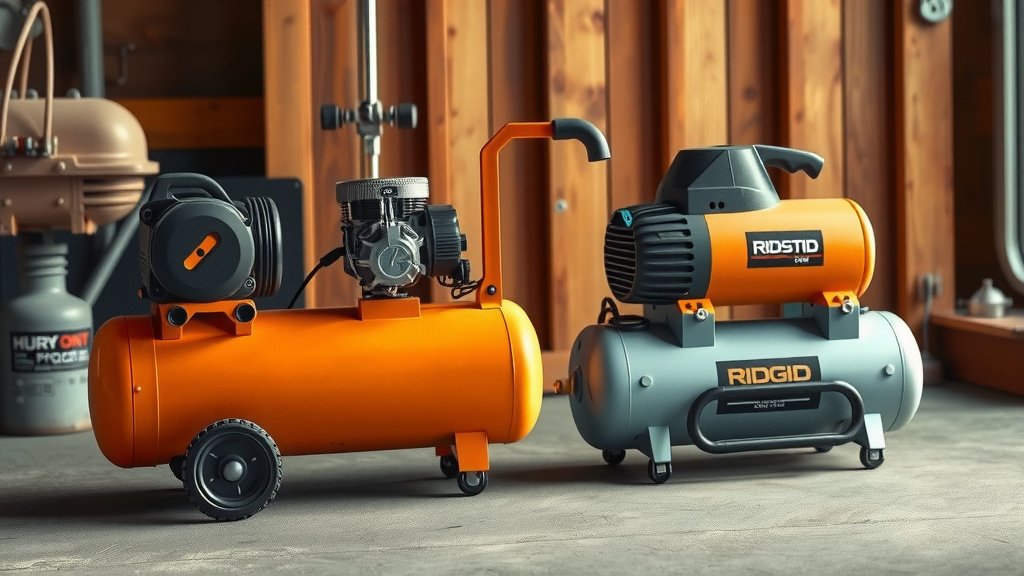
Head-to-Head Comparison: Key Features
Let’s put some of the typical differences side-by-side. Remember, specific models will vary, but this gives you a general idea of where each brand tends to shine.
| Feature | Bostitch (Typical) | Ridgid (Typical) |
|---|---|---|
| Primary Focus | Portability, DIY, lighter tasks | Durability, professional, heavy-duty tasks |
| Tank Size Range | Often smaller to medium (e.g., 1-30 gallons) | Often medium to larger (e.g., 20-60+ gallons) |
| CFM Output | Good for lighter tools, may be lower for heavy demands | Often higher CFM for sustained tool use |
| Portability | Generally higher, lighter, easier to move | Generally lower, heavier, more stationary |
| Durability | Good for home use, may not withstand daily professional stress | Built for tough, continuous use |
| Noise Level | Can vary, some models are designed for quieter operation | Can be louder due to powerful motors and pumps |
| Price Point | Often more budget-friendly | Typically a higher investment |
Making Your Decision: A Checklist for Success
To help you narrow it down, ask yourself these questions. They’ll guide you toward the compressor that fits your life.
- What are your primary tools? List them out.
- How often will you use the compressor? Daily, weekly, or occasionally?
- Do you need to move it often? Or will it stay in one spot?
- What’s your budget? Be realistic about what you can spend.
- Do you prioritize portability or power? This is often the biggest trade-off.
- Are you looking for a long-term investment for professional work?
By thinking through these points, you can feel much more confident about your choice between a Bostitch and a Ridgid air compressor.
Conclusion
You’ve learned that choosing between Bostitch and Ridgid air compressors boils down to your specific needs. If you prioritize moving your compressor often for lighter tasks like nailing or inflating, Bostitch offers excellent portability and convenience. For those tackling demanding jobs that require sustained power, like heavy-duty auto work or continuous painting, Ridgid’s robust construction and higher CFM output make it a more suitable, durable choice. Carefully consider your most frequent projects and how much air your tools require. By matching the compressor’s capabilities to your workload, you’ll invest in a tool that truly serves your workshop well.
Frequently Asked Questions
Which brand is better for a beginner DIYer?
For most beginner DIYers, a Bostitch compressor is often a great starting point. We found they offer a good balance of affordability and performance for common household tasks and smaller projects. Their focus on portability also makes them easier to manage in various spaces.
Can a Bostitch compressor handle framing nailers?
Yes, many Bostitch compressors, especially those with tank sizes around 10-20 gallons and adequate CFM, can handle framing nailers for intermittent use. You’ll want to check the specific CFM requirement of your nailer and ensure the compressor meets or exceeds it to avoid constant cycling.
Is a Ridgid compressor too much for a home garage workshop?
Not necessarily! If your home workshop involves tasks like using impact wrenches frequently, sanders, or larger spray paint setups, a Ridgid can be an excellent investment for its durability and power. It might be overkill for simple inflating or occasional nailing, but it’s built to last.
Are Ridgid compressors generally louder than Bostitch?
In our research, Ridgid compressors, due to their powerful motors and heavy-duty pumps, can often be louder than their Bostitch counterparts. Some Bostitch models are specifically designed for quieter operation, which might be a consideration if noise is a major concern for your workspace.
Which brand offers a better warranty?
Both Bostitch and Ridgid typically offer solid warranties, but it’s essential to check the specifics for the model you’re considering. Ridgid often stands out with its industry-leading lifetime service agreement on many of their tools, which can be a significant factor for long-term buyers.