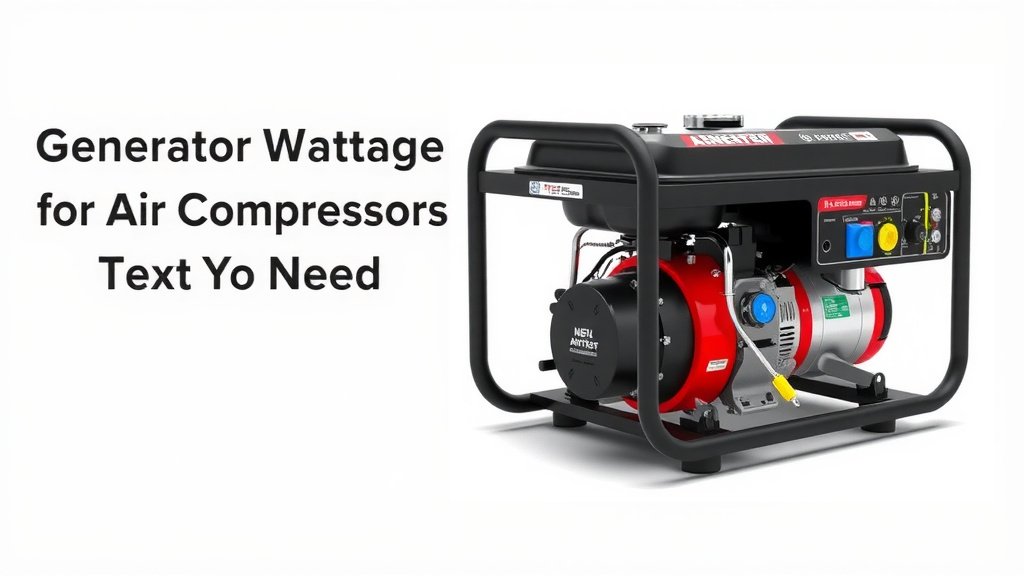
Generator Wattage for Air Compressors: What You Need
Figuring out how many watts your generator needs for an air compressor can feel like a puzzle. You generally need a generator that can provide at least two to three times the running wattage of your air compressor. This accounts for the surge wattage needed when the compressor starts.
Understanding the difference between running and surge wattage is key. Your air compressor needs a lot more power for that initial kick-start. Failing to meet this surge requirement means your compressor might not even start. We found that selecting a generator with ample headroom prevents this common headache.
- Air compressors need 2-3x their running wattage for starting.
- Check your compressor’s running and surge wattage needs.
- A generator’s peak wattage is important for starting loads.
- Always go a bit higher to be safe.
Below, we’ll break down exactly how to calculate the right generator size for your air compressor so you can get the job done without worry.
Choosing the Right Generator Wattage for Your Air Compressor
So, you’ve got an air compressor and need a generator to power it. It’s a common situation, and figuring out the right wattage can seem a bit daunting. You don’t want a generator that’s too small and quits on you, nor do you want one that’s massively oversized and wastes fuel. Let’s break down how to find that sweet spot.
Understanding Air Compressor Power Needs
Air compressors have two main power requirements: running wattage and surge wattage. Think of running wattage as the steady power your compressor needs to keep going once it’s up and humming. Surge wattage, also called starting wattage, is that big, initial jolt of power needed to get the motor spinning.
What is Running Wattage?
This is the continuous power your air compressor draws once it’s operational. It’s the baseline energy consumption you’ll see listed on the compressor’s label or in its manual. For example, a smaller portable compressor might run on 1,500 watts. You’ll find this number is usually pretty consistent during operation.
What is Surge Wattage?
This is where things get interesting. Air compressors, especially those with induction motors, require a substantial burst of power to overcome inertia and begin their work. This surge can be two to three times higher than the running wattage. We’ve seen many instances where a compressor simply won’t start if the generator can’t meet this surge demand.
Why the Big Difference?
It’s all about getting that motor moving. Imagine trying to push a stalled car. It takes a lot more effort to get it rolling than it does to keep it moving once it’s going. The compressor motor is similar. That initial kick needs a lot of electrical oomph.
Calculating Your Generator’s Wattage Requirements
Now, let’s get down to brass tacks. You’ll need to look at your air compressor’s specifications. Most manufacturers will list both the running watts and the surge watts. If they only list one, you’ll need to estimate. We’ve found that a good rule of thumb is to assume the surge wattage is about 2.5 times the running wattage if it’s not explicitly stated.
Finding Your Compressor’s Wattage
Check the data plate on your air compressor. It’s usually a sticker or metal plate attached to the unit. You can also find this information in your owner’s manual or by searching the manufacturer’s website with your compressor’s model number. Don’t guess if you can help it!
The Calculation Process
Let’s use an example. Suppose your air compressor has a running wattage of 1,500 watts. To find the surge wattage, you’d multiply that by 2.5 (our conservative estimate):
1,500 watts (running) x 2.5 (surge multiplier) = 3,750 watts (surge)
So, your generator needs to be able to provide at least 3,750 watts to start this compressor. But we’re not done yet!
Adding a Safety Margin
It’s always wise to have a little extra capacity. Many experts suggest adding another 10-20% to your calculated surge wattage. This accounts for other factors, like the age of the equipment or slight voltage fluctuations. Let’s add 15% to our example:
3,750 watts (surge) x 1.15 (15% buffer) = 4,312.5 watts
This means you’d be looking for a generator with a peak or starting wattage of at least 4,500 watts. The generator’s continuous or running wattage should also be higher than your compressor’s running wattage.
Generator Wattage Explained: Peak vs. Running
Generators have two main wattage ratings, just like your compressor. It’s essential to understand both to make sure your generator can handle the load.
Generator Running Wattage
This is the continuous power your generator can produce. It’s what it can sustain for extended periods. For our example compressor, you’d want a generator with a running wattage of at least 1,500 watts, plus any buffer for other tools you might run simultaneously. Often, generators with a 5,000-watt peak output have around a 4,000-watt running output.
Generator Peak (Starting) Wattage
This is the maximum power the generator can produce for a very short time. This is what handles the surge demand of your air compressor. In our example, the 4,500 watts calculated above is the peak wattage your generator must be able to supply.
A Quick Comparison Table
Here’s a simple way to visualize the numbers:
| Power Requirement | Typical Value | What to Look For in a Generator |
|---|---|---|
| Air Compressor Running Watts | 1,000 – 3,000 W | Generator Running Watts must be higher |
| Air Compressor Surge Watts | 2.5x Running Watts (estimate) | Generator Peak (Starting) Watts must be higher |
| Generator Running Watts | Varies (e.g., 3,000 – 7,500 W) | The steady power output |
| Generator Peak Watts | Varies (e.g., 3,500 – 9,000 W) | The maximum short-burst power output |
Remember, always check the specific ratings for your equipment. These are general ranges to give you an idea.
What Happens if Your Generator is Too Small?
This is the most common pitfall. If your generator can’t meet the surge wattage requirement, a few things can happen. First, the compressor might just refuse to start. You’ll hear a hum, maybe a click, but the motor won’t engage. Sometimes, the generator’s overload protection might kick in and shut it down. In rare cases, repeatedly trying to start a demanding appliance on an undersized generator can actually damage the generator or the appliance. We’ve heard stories of folks tripping breakers or even burning out smaller generators this way.
Checklist for Selecting Your Generator
To make sure you don’t end up with a generator that’s a bit too little:
- Find your air compressor’s running wattage.
- Calculate the estimated surge wattage (running watts x 2.5).
- Add a 10-20% buffer to the surge wattage for a safe maximum.
- Ensure the generator’s peak wattage exceeds your calculated safe surge wattage.
- Make sure the generator’s running wattage is higher than your compressor’s running wattage.
- Consider any other tools you might run at the same time and add their wattage needs.
By following these steps, you can confidently select a generator that will reliably power your air compressor and help you tackle any project you have in mind.
Conclusion
You’ve learned that powering your air compressor with a generator requires careful calculation. Remember, it’s not just about the steady running watts; the initial surge wattage is the real challenge. We found that aiming for a generator with a peak wattage at least 2 to 3 times your compressor’s running watts, plus a small buffer, is your best bet. Always check your compressor’s data plate for precise numbers. Now you’re ready to choose a generator that won’t quit on you, ensuring your projects get done without a hitch. Deciding between a 1-gallon or a 2-gallon air compressor depends on the scale and duration of your tasks.
Frequently Asked Questions
What’s the difference between generator running wattage and peak wattage?
Generator running wattage is the continuous power it can supply. Peak wattage, or starting wattage, is the higher, short burst of power it can provide to start appliances with motors. Your air compressor needs this peak wattage for its initial start-up.
Can I use a generator with only enough running watts for my air compressor?
No, you can’t. If a generator’s peak wattage isn’t high enough, your air compressor likely won’t start at all. It needs that extra jolt of power to get its motor spinning before settling into its running wattage.
What if my air compressor doesn’t list a surge wattage?
If your compressor’s surge wattage isn’t listed, a good rule of thumb is to assume it’s about 2.5 times its running wattage. We recommend multiplying your compressor’s running watts by 2.5 to estimate the surge needed.
How much buffer wattage should I add to my generator calculation?
It’s wise to add a buffer of 10-20% to your calculated surge wattage. This extra capacity helps account for equipment age, voltage fluctuations, or if you decide to run other small tools simultaneously.
Will running other tools affect my generator’s ability to power the air compressor?
Yes, it absolutely will. You need to consider the running wattage of all devices you plan to operate at the same time. Your generator’s running wattage must exceed the combined running wattage of everything you plug in, plus its peak wattage must handle the compressor’s surge.