Calculate Air Compressor Requirements: A Step-by-Step Guide
To calculate your air compressor requirements, you need to understand two main things: the total cubic feet per minute (CFM) your tools use and the required pressure (PSI). Summing up the CFM of all tools you’ll run simultaneously, then adding a buffer for efficiency losses, will give you the minimum CFM your compressor needs. Always aim for a compressor rated higher than your calculated needs to ensure consistent performance.
Choosing the right air compressor is key for any workshop or project. Running out of air can be frustrating and slow down your work. Many people overlook the importance of matching compressor capacity to tool demand. We found that understanding these two metrics, CFM and PSI, is the most important step in avoiding common pitfalls and ensuring you buy a compressor that actually gets the job done efficiently.
- Figure out the CFM your tools need.
- Know the PSI (pressure) required for your tools.
- Add a buffer to your total CFM calculation.
- Don’t buy a compressor that’s too small.
- Match the compressor to your biggest tool’s needs.
Let’s get your air compressor needs calculated so you can get back to building, fixing, or creating without interruption.
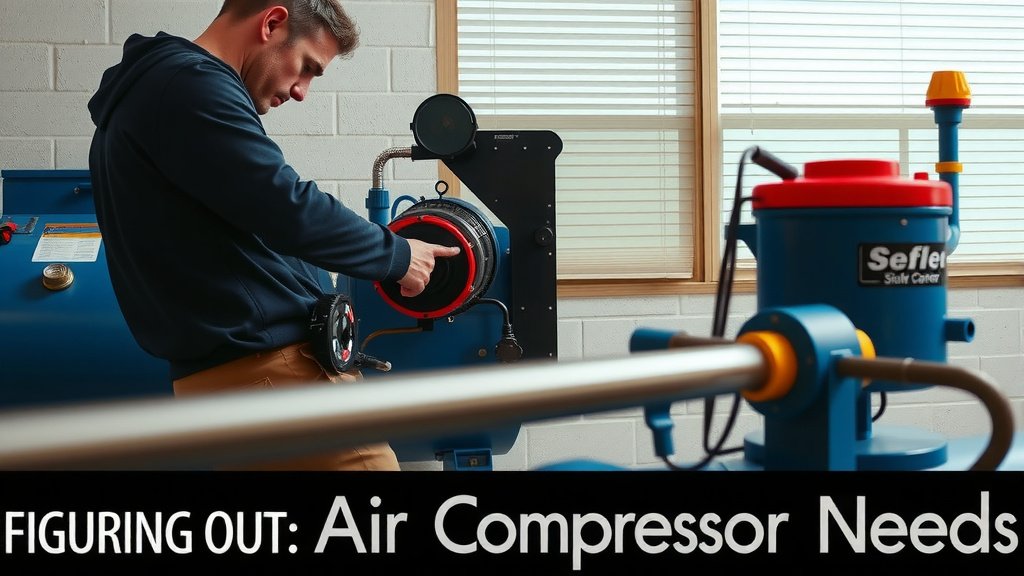
Figuring Out Your Air Compressor Needs
Selecting the right air compressor feels like a big decision. You want one that powers your tools without sputtering out. Let’s break down how to figure out exactly what you need.
Understanding CFM: The Airflow Factor
CFM stands for cubic feet per minute. It measures how much air a tool uses. Think of it like the water flow from your faucet. More CFM means more air volume for your tools.
Why CFM is King for Tool Performance
Your tools need a steady supply of air to work properly. If your compressor can’t keep up with the CFM demand, your tools will perform poorly. A nail gun might not drive nails fully. A sander could lose power.
Finding Your Tools’ CFM Ratings
You can usually find the CFM rating on the tool itself. Look for a sticker or plate. It might also be in the owner’s manual. We found that many users overlook this simple step. Don’t let that be you!
What If My Tool Doesn’t Have a CFM Rating?
This happens more often than you’d think. For older tools or less common ones, you might need to do a little research. Online forums and manufacturer websites can be helpful. Sometimes, a good rule of thumb is to check similar modern tools. We found that looking up the tool’s model number online is often the quickest solution.
Calculating Total CFM Demand
The most important part is knowing how many tools you’ll use at the same time. Imagine you’re painting and need an air duster to clean up. You’ll need to add their CFM ratings together. Never just add up all your tools if you only use one or two at a time. This is a common mistake.
The “Simultaneous Use” Rule
If you only ever use one tool at a time, you only need to consider the CFM of your most demanding tool. However, most projects involve multiple tools. Consider your typical workflow. Will you be using an impact wrench while also needing an air ratchet? Add them up.
Determining Required Pressure: PSI Matters
PSI stands for pounds per square inch. It’s the force or pressure of the air. Different tools need different levels of pressure to operate correctly. Think of it like the water pressure in your home plumbing.
How PSI Affects Tool Function
Too little PSI means your tools won’t have enough power. An impact wrench won’t have the torque to loosen bolts. Too much PSI can damage your tools or even be dangerous. Always match the tool’s requirement.
Finding Your Tools’ PSI Requirements
Like CFM, the required PSI is usually listed on the tool or in its manual. Most common air tools operate between 70 to 100 PSI. Some specialized tools might need more. Always check your tool’s specifications.
Which PSI is the “Right” PSI?
For calculating compressor needs, you’ll want to know the highest PSI requirement among the tools you plan to run simultaneously. If one tool needs 90 PSI and another needs 100 PSI, your compressor must be capable of delivering at least 100 PSI. Many experts say it’s wise to aim slightly higher than the highest tool requirement.
Adding a Safety Buffer: Don’t Cut It Close
Now that you have your total CFM and highest PSI, it’s time to add a buffer. This is super important for reliable performance. Think of it as a little extra wiggle room.
Why a Buffer is Essential
Compressors rarely operate at 100% efficiency. Hoses, fittings, and the compressor itself can cause air leaks or pressure drops. Also, your tools might have higher peak demands than their continuous ratings. Many guidelines suggest adding a buffer of 30-50% to your CFM. We found this is a safe bet.
Calculating Your Buffered CFM
Take your total simultaneous CFM and multiply it by 1.3 (for a 30% buffer) or 1.5 (for a 50% buffer). For example, if your tools need a combined 10 CFM, aim for a compressor that delivers 13-15 CFM.
When to Go Even Higher
If you plan on using your compressor for demanding tasks like automotive repair or extensive spray painting, you might want to increase that buffer. Some professionals suggest as high as a 100% buffer for these applications. It’s better to have a little too much air than not enough.
Putting It All Together: Your Compressor Specs
So, you’ve added up your simultaneous CFM, identified your highest PSI need, and applied a buffer. Now you know what your compressor needs to deliver.
The CFM Rating on the Tank vs. Delivered CFM
Be careful when looking at compressor specs. Some might list a higher CFM rating at a lower PSI (like 90 PSI) and a much lower CFM at their maximum PSI. Always check the CFM rating at the required PSI for your tools. This is critical for proper performance. We found that many manufacturers are clear about this on their spec sheets.
Matching Compressor Type to Your Needs
Beyond CFM and PSI, consider the type of compressor. Are you working in a home garage or a professional shop? For intermittent use, a smaller portable compressor might be fine. For heavy, continuous use, a stationary, two-stage compressor is usually better. Think about how much air you’ll need, and for how long.
| Tool | Typical CFM @ 90 PSI |
|---|---|
| Air Nailer (Finish) | 0.5 – 1.0 CFM |
| Air Sander (Orbital) | 4.0 – 6.0 CFM |
| Impact Wrench | 5.0 – 7.0 CFM |
| HVLP Paint Sprayer | 8.0 – 10.0 CFM |
| Air Die Grinder | 5.0 – 7.0 CFM |
Remember to always add your buffer to these numbers and consider simultaneous use.
Your Air Compressor Checklist
Here’s a quick rundown to make sure you’ve got it all:
- List all tools you’ll use at once.
- Find the CFM for each of those tools.
- Find the PSI for each of those tools.
- Add the CFM of simultaneous tools.
- Note the highest PSI required.
- Add a 30-50% buffer to your total CFM.
Conclusion
Calculating your air compressor needs is all about understanding your tools’ demands. You’ve learned how CFM and PSI are your key metrics. Remember to sum the CFM of tools you’ll run simultaneously and note the highest PSI required. Don’t forget that essential buffer—adding 30-50% to your CFM ensures your compressor won’t struggle. By following these steps, you’ll avoid buying an underpowered unit and ensure your tools perform at their best. Now, you’re ready to confidently choose the right air compressor for your projects.
Frequently Asked Questions
What’s the difference between tank size and CFM?
Tank size (measured in gallons) is how much air the compressor can store, like a reservoir. CFM (cubic feet per minute) is how much air the compressor can produce over time. For most tools, CFM is more important than tank size because it dictates how long a tool can run before the compressor needs to catch up.
How do I calculate CFM if my tool doesn’t have a rating?
If you can’t find a CFM rating, check your tool’s manual or the manufacturer’s website. Sometimes, you can find a similar, modern tool’s CFM rating online and use that as an estimate. Doing a quick web search with your tool’s model number is often the quickest solution.
Is it okay to buy a compressor with a slightly lower CFM than my calculation?
It’s generally not recommended. Buying a compressor with a CFM rating below your calculated need, even slightly, will likely lead to performance issues. Your tools might run weakly, or the compressor will constantly struggle to keep up. Always aim to meet or exceed your calculated, buffered CFM requirement.
Do I need to add a buffer for PSI as well as CFM?
You don’t typically add a percentage buffer to PSI in the same way you do for CFM. Your primary goal is to ensure the compressor can deliver the highest PSI your tools require. Most compressors list their maximum PSI, and you just need to make sure this meets or slightly exceeds your most demanding tool’s needs.
Will a higher CFM compressor always be better for my needs?
Not necessarily. While having enough CFM is vital, an excessively high CFM compressor can be overkill and might be more expensive to purchase and operate. It’s best to aim for the CFM calculated with your buffer, rather than simply buying the biggest one you can find. Matching your needs precisely is key.