CFM vs Tank Size: Choosing the Right Air Compressor
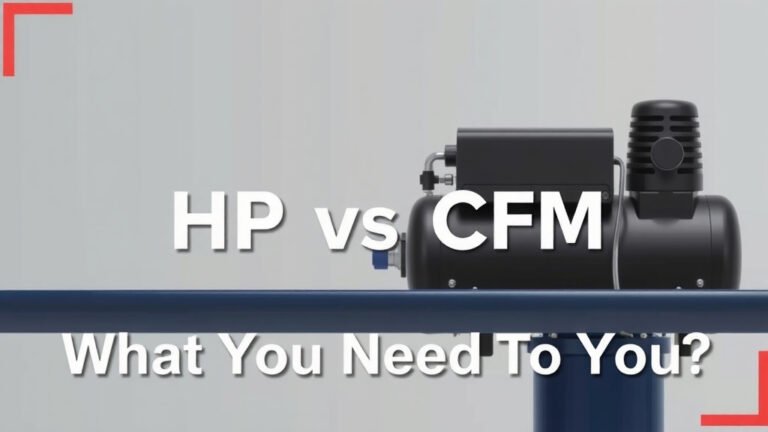
When choosing an air compressor, understand that CFM (Cubic Feet per Minute) is king. It tells you how much air the compressor can deliver, which is far more important than the tank size for running tools. Think of CFM as the engine’s horsepower and tank size as its fuel tank – you need enough power (CFM) for your job.
Many DIYers get this backward, focusing on a big tank. While a larger tank can provide a buffer, it won’t magically give you more air. Your tools will only run as well as the compressor’s ability to *replenish* that air. We found that matching CFM to your tool’s needs is the biggest predictor of success.
TL;DR:
- CFM is how much air your compressor delivers.
- Tank size is how much air it stores.
- Your tools need enough CFM to run properly.
- CFM matters more than tank size for tool performance.
- Match CFM to your tool’s requirements.
So, how do you make sure you’re getting the right air compressor for your projects? Let’s break down why CFM and tank size matter, and how to pick the best combo for your needs.
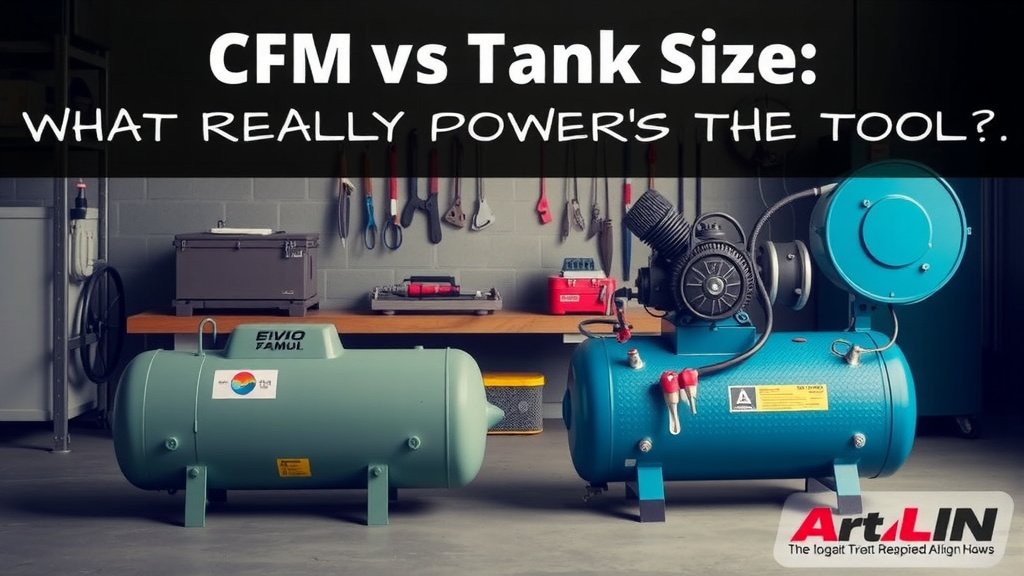
CFM vs. Tank Size: What Really Powers Your Tools?
You’re probably wondering what CFM and tank size actually mean for your air tools. Think of CFM as the volume of air your compressor can deliver over time. Tank size is simply how much air it can store. You need enough CFM to keep your tools running without interruption. We’ve found that focusing on the right CFM is the most important step for tool performance.
Understanding CFM: Your Air Compressor’s Powerhouse
CFM stands for Cubic Feet per Minute. This is the most critical spec for any air compressor. It tells you how much compressed air the compressor can produce. Higher CFM means more air delivered per minute. This is essential for tools that use a lot of air.
How CFM Affects Tool Performance
Many tools have a CFM requirement listed on them. This is not a suggestion; it’s a performance guideline. If your compressor’s CFM is lower than what your tool needs, the tool will likely struggle. It might work slowly or stop altogether. We found that using a compressor with lower CFM than a tool requires leads to frustration.
Finding Your Tool’s CFM Needs
You can usually find the CFM requirement on the tool itself, in its manual, or on the manufacturer’s website. Look for the CFM rating at a specific PSI (pounds per square inch). For example, a sander might need 5 CFM at 90 PSI. This is the number you need to match with your compressor’s output.
Decoding Tank Size: The Air Buffer
The tank size, measured in gallons, is how much compressed air the compressor can hold. A larger tank can store more air. This means it can supply air for a longer period before the compressor motor has to turn on again to refill it.
When Tank Size Comes into Play
Tank size is helpful for short bursts of air usage. If you’re using a tool that only runs for a few seconds at a time, like an air nailer or staple gun, a larger tank can provide a good buffer. It lets you fire off multiple nails before the compressor needs to catch up. However, if your tool needs a constant flow of air, the tank size becomes less important than the CFM.
The Tank Size Fallacy
Some people believe that a bigger tank automatically means a better compressor. This isn’t true. A huge tank on a compressor with low CFM is like a big fuel tank on a car with a tiny engine. It will run out of “power” (CFM) quickly. We found that many DIYers overlook their tool’s CFM needs and buy a compressor with a large tank, only to be disappointed.
Matching CFM and Tank Size to Your Projects
Choosing the right combination of CFM and tank size depends entirely on the tools you plan to use. Don’t buy a compressor based on tank size alone. Let’s look at how to make the right choice.
Assessing Your Air Tool Needs
Before you even look at compressors, make a list of the air tools you own or plan to buy. For each tool, find its CFM requirement at 90 PSI. This is the standard measurement most manufacturers use. Add up the CFM requirements if you plan to run multiple tools at once, but most home users won’t.
Understanding the 1.5x Rule of Thumb
A common recommendation is to choose a compressor that offers at least 1.5 times the CFM required by your most demanding tool. For example, if your tool needs 5 CFM at 90 PSI, look for a compressor that delivers at least 7.5 CFM at 90 PSI. This buffer ensures your compressor won’t be constantly running at its absolute limit. We found this rule of thumb helps prevent performance issues.
How Tank Size Supports CFM
Once you’ve determined your required CFM, consider tank size. For intermittent tools like nail guns, a 10-25 gallon tank might suffice if your CFM is met. For continuous use tools like sanders or grinders, a larger tank (30+ gallons) can help provide a steadier supply of air, but only if the CFM is high enough.
| Project Type | Typical Tools | Required CFM (approx. at 90 PSI) | Recommended Tank Size |
|---|---|---|---|
| Light Duty (Inflating tires, Brad Nailer) | Tire inflator, Brad nailer, Stapler | 0.5 – 3 CFM | 1-6 Gallons |
| Medium Duty (Air Ratchet, Impact Wrench) | Air ratchet, Impact wrench, HVLP paint sprayer | 3 – 7 CFM | 10-30 Gallons |
| Heavy Duty (Sandblasting, Sanding, Grinding) | Orbital sander, Grinder, Air hammer, Sandblaster | 7 – 15+ CFM | 30-80+ Gallons |
Choosing the Right Compressor for Your Needs: A Checklist
To make sure you get the best air compressor for your workshop, run through this quick checklist:
- List all the air tools you intend to use.
- Find the CFM requirement for each tool at 90 PSI.
- Identify the tool with the highest CFM need.
- Select a compressor with at least 1.5 times that CFM.
- Consider tank size based on whether your tools run intermittently or continuously.
- Don’t be swayed by tank size alone; CFM is the real power.
Conclusion
You now understand that CFM is the true measure of an air compressor’s capability, not just its tank size. While a larger tank offers a buffer, it’s the CFM that ensures your tools perform as they should. Always prioritize matching your compressor’s CFM output to your most demanding tool’s requirements. Think of the 1.5x rule of thumb to give your compressor a little extra breathing room. Take a moment to list your tools and their CFM needs before you shop; this simple step will save you frustration and money down the line. Get the CFM right, and your projects will run smoothly.
Frequently Asked Questions
Can I use a compressor with a smaller tank if it has enough CFM?
Yes, in many cases, you can. If your compressor’s CFM output meets or exceeds your tool’s requirement, a smaller tank is often fine. The compressor motor will just need to cycle on more frequently to maintain pressure. However, for tools used in very short bursts, a slightly larger tank can still offer convenience.
Will a higher PSI compressor make my tools run better if the CFM is low?
No, not typically. While PSI (pounds per square inch) indicates the pressure, CFM is the volume of air. Most tools have a specific CFM requirement at a certain PSI. If your compressor can’t deliver the necessary volume (CFM), even high pressure won’t allow the tool to function optimally.
What happens if I consistently run my compressor at its maximum CFM limit?
Running your compressor at its absolute limit for extended periods can cause it to overheat and wear out faster. It also means the motor is constantly running, which can be inefficient. Following the 1.5x rule helps prevent this constant strain, ensuring longer compressor life.
How does an oil-lubricated compressor differ from an oil-free one in terms of CFM and tank size needs?
The type of lubrication (oil vs. oil-free) primarily affects durability and noise level, not the CFM or tank size you need for your tools. You’ll find both types across a range of CFM outputs and tank sizes. Always check the CFM rating and matching it to your tools is still the priority.
Can I connect two smaller air compressors together to increase CFM?
While you can connect tanks to increase storage capacity, directly linking the CFM output of two separate compressors to run a single tool is usually not practical or recommended without specialized equipment. It’s generally more effective to invest in a single compressor that meets your CFM needs.