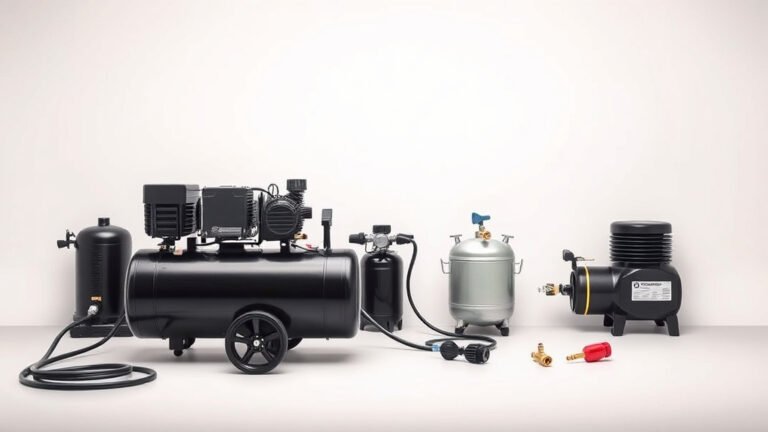
Air Compressor Size for Impact Wrench: What You Need
To power an impact wrench effectively, you generally need an air compressor that can deliver at least 5 cubic feet per minute (CFM) at 90 PSI. This is the sweet spot most common impact wrenches perform best at. Too little CFM means your wrench will be weak and slow. Too much is usually overkill for most DIY tasks.
Choosing the right air compressor is key for getting the most out of your impact wrench. It’s not just about the tank size; the CFM rating is what truly matters for sustained power. We found that many people overlook this detail, leading to disappointing performance when they need it most.
- Impact wrenches need about 5 CFM at 90 PSI to work well.
- CFM is more important than tank size for wrench power.
- Check your wrench’s manual for its specific air needs.
- A compressor that’s too small will make your wrench weak.
- We’ll help you figure out the right size for your needs.
Let’s break down exactly what CFM and PSI mean for your impact wrench and help you find the perfect air compressor.
Finding the Right Air Compressor for Your Impact Wrench
So, you’ve got an impact wrench and you’re ready to tackle some tough bolts. But what kind of air compressor will actually give it the juice it needs? It’s a common question, and the answer isn’t as simple as picking the biggest tank. You need to look at the air flow, measured in CFM, and the pressure, measured in PSI.
Understanding the Core Metrics: CFM and PSI
Let’s get these two terms straight because they are super important. Think of your air compressor like a water hose. The PSI (pounds per square inch) is like the water pressure coming out of the faucet. It’s how hard the air is being pushed.
The CFM (cubic feet per minute) is like the width of the hose. It tells you how much air is actually flowing. Your impact wrench needs both enough pressure to do its job and enough volume of air to keep going strong without sputtering. Understanding cubic feet per minute (CFM) is crucial, as it relates to the width of the hose and the volume of air flowing.
Why CFM is King for Impact Wrenches
Many people focus on the tank size of an air compressor, thinking bigger is always better. But for an impact wrench, CFM is usually the more critical factor. Why? Because an impact wrench uses a lot of air in short bursts. If the compressor can’t keep up with that demand, your wrench will lose power quickly.
Imagine trying to fill a bucket with a tiny trickle of water. No matter how big the bucket is, it’s going to take forever. Similarly, if your compressor’s CFM rating is too low for your impact wrench, it’s like that tiny trickle. Your wrench will feel weak and sluggish, and you’ll be frustrated.
The Magic Number: 90 PSI
Most air tools, including impact wrenches, are designed to operate at a standard pressure of 90 PSI. This is the pressure they are tested at and calibrated for. While some compressors can go much higher, your impact wrench likely won’t benefit from extreme PSI. It just needs that consistent 90 PSI to perform its best.
So, when you’re looking at compressor specs, you’ll almost always see a CFM rating listed at 90 PSI. This is the number you want to match or exceed for your impact wrench. We found that looking for a compressor that delivers at least 5 CFM at 90 PSI is a safe bet for most common DIY tasks.
Matching Your Impact Wrench’s Needs
Not all impact wrenches are created equal, and they don’t all have the same appetite for air. The best way to know exactly what your tool needs is to check its manual. Seriously, it’s right there!
Reading Your Tool’s Specifications
Impact wrenches will usually list their air requirements. You’ll see something like “5.0 CFM @ 90 PSI” or “8.0 CFM @ 90 PSI.” This tells you the minimum airflow your compressor needs to supply at that specific pressure. If your wrench has higher requirements, you’ll need a more powerful compressor.
We found that many DIYers skip this step. They assume all impact wrenches are the same. But if you’re using a high-torque model for heavy-duty work, it will definitely need more air than a smaller, lighter-duty one. Don’t guess; know your tool’s needs!
Considering Your Tasks: Light vs. Heavy Duty
Are you just changing a tire now and then, or are you rebuilding an engine? Your intended use makes a big difference.
Light-duty tasks, like occasional home garage use, might be fine with a compressor that just meets the 5 CFM @ 90 PSI requirement. Think changing a few bolts on your car or doing some light assembly.
Heavy-duty tasks, such as working on suspension components, stubborn rusted bolts, or constant use in a professional setting, will demand more. For these, you’ll want a compressor that can comfortably exceed the minimum, perhaps offering 6-8 CFM or even more at 90 PSI. This ensures consistent power, even when the going gets tough.
Compressor Tank Size: Still Relevant?
While CFM is king for powering your impact wrench, the tank size does play a supporting role. Think of the tank as a reserve of compressed air.
The Role of the Air Tank
A larger tank means your compressor can store more air. This is helpful because it allows the motor to run less frequently. If you have a small tank and a high-demand tool, the compressor will be constantly cycling on and off, which can be annoying and put more wear on the motor.
For impact wrenches, a larger tank can provide a brief boost of power if you need a very quick burst. However, it cannot compensate for low CFM. If the compressor can’t generate enough air, the tank will just empty faster, and your tool will still lose power. We found that a tank size between 20 and 60 gallons is generally a good range for most DIY users with impact wrenches, providing a decent buffer without being overly bulky.
Interpreting Compressor Specifications: What to Look For
When you’re shopping for an air compressor, you’ll see a lot of numbers. Let’s focus on the ones that matter most for your impact wrench.
CFM at 90 PSI: The Golden Ticket
As we’ve discussed, this is the most important specification. Always look for the CFM rating at 90 PSI. If a compressor only lists CFM at a lower PSI (like 40 PSI), that number can be misleading. The air output drops significantly as the pressure increases.
We recommend looking for a compressor that offers at least 5 CFM @ 90 PSI for basic needs. For more demanding work, aim for 6-8 CFM or higher.
Horsepower (HP) vs. CFM
You’ll see horsepower (HP) listed on compressors. While it’s an indicator of power, it’s not a direct measure of air output. A high HP motor doesn’t automatically mean high CFM. Some manufacturers might advertise “peak HP,” which isn’t the same as continuous running HP. Always prioritize the CFM rating at 90 PSI over horsepower when choosing a compressor for an air tool.
Putting It All Together: A Quick Checklist
To make sure you get the right compressor, run through this quick checklist:
- Check your impact wrench’s manual for its specific CFM and PSI requirements.
- Prioritize CFM at 90 PSI. This is the most critical number.
- Aim for at least 5 CFM @ 90 PSI for general use.
- Consider higher CFM (6-8+) for frequent or heavy-duty tasks.
- A tank size of 20-60 gallons offers a good balance for most users.
- Don’t rely solely on HP; CFM is the true measure of air delivery.
Common Pitfalls to Avoid
We’ve seen people make a few common mistakes. One is buying a compressor that’s too small. It’s frustrating when your tool doesn’t have the power you need, and it can actually damage the tool if it’s constantly struggling.
Another is getting one that’s too large. While overkill isn’t as detrimental as being too small, a massive compressor can be expensive, take up a lot of space, and consume more electricity than you need. Finding that sweet spot is key.
One more thing: make sure your compressor has a regulator. This allows you to dial in the exact PSI your tool needs, typically 90 PSI. Without it, you’re just blasting air, which isn’t ideal.
| Usage Scenario | Recommended CFM @ 90 PSI | Typical Tank Size |
|---|---|---|
| Occasional light repairs, tire rotations | 4.0 – 5.5 CFM | 10 – 30 Gallons |
| Regular DIY auto work, some suspension tasks | 5.0 – 7.0 CFM | 20 – 60 Gallons |
| Frequent heavy-duty use, engine work, off-road repairs | 7.0 CFM+ | 40 – 80 Gallons (or larger) |
Remember, this is a general guide. Always refer to your specific impact wrench’s manual for the most accurate information. Finding the right compressor might seem a little technical at first, but understanding CFM and PSI will save you time, money, and a whole lot of frustration.
Conclusion
Choosing the right air compressor for your impact wrench boils down to understanding CFM at 90 PSI. We’ve seen that this metric is your best indicator of sustained power, far more so than tank size or horsepower alone. Always check your impact wrench’s manual first to get its exact air demands. For most DIY tasks, aim for at least 5 CFM at 90 PSI, and consider going higher for more demanding jobs. Taking these steps ensures your impact wrench will perform powerfully and reliably, saving you frustration and making your projects much easier to tackle.
Frequently Asked Questions
What happens if my air compressor’s CFM is too low for my impact wrench?
If your compressor’s CFM output is lower than your impact wrench requires, you’ll notice a significant drop in power. The wrench will feel weak, run slowly, and might not be able to break loose stubborn bolts. It’s like trying to drink a milkshake through a tiny straw; the flow just isn’t there.
Do I need a regulator on my air compressor?
Yes, absolutely. A regulator is essential for controlling the air pressure output from your compressor. Most impact wrenches perform best around 90 PSI, and a regulator allows you to set and maintain this precise pressure for optimal tool performance and longevity.
Is a larger tank size better, even if CFM is more important?
A larger tank acts as an air reserve, meaning your compressor motor will cycle less often. While it can’t create more air than the motor produces, it helps smooth out the air supply and can provide a short burst of power. For impact wrenches, it’s a helpful supplement, but not a replacement for adequate CFM.
Can I use a compressor with a higher CFM than my wrench needs?
Yes, it’s generally fine to have a compressor with a higher CFM rating than your impact wrench requires. This usually means your compressor won’t have to work as hard, potentially extending its lifespan and ensuring consistent power delivery. Just make sure you can regulate the pressure down to the tool’s required PSI.
What’s the difference between “peak HP” and “running HP” on a compressor?
Peak horsepower (HP) is a temporary maximum power output, while running HP (or rated HP) reflects the motor’s continuous power output. For air tools like impact wrenches, the CFM rating at 90 PSI is a much more reliable indicator of performance than either type of HP rating.